Horizontal & vertical addition (Addition)
Watch this topic in 60 seconds
Free preview · Lesson 1
Understanding Horizontal & vertical addition (Addition)
Let's Learn About Adding!
Hello, super learners! Today, we're going on an exciting adventure to explore how we can put numbers together. This is called addition! Imagine you have a yummy bag of candies, and your friend gives you some more. Addition is like counting how many candies you have in total after getting more. It's all about combining groups to find a bigger group!
What is Addition?
Addition is a way to find the total number of things when you join two or more groups together. Think of it like this: If you have 2 red apples and your mom gives you 3 green apples, addition helps us find out how many apples you have in all! We use a special symbol for addition: the plus sign (+) .
Adding Horizontally (Side-by-Side)
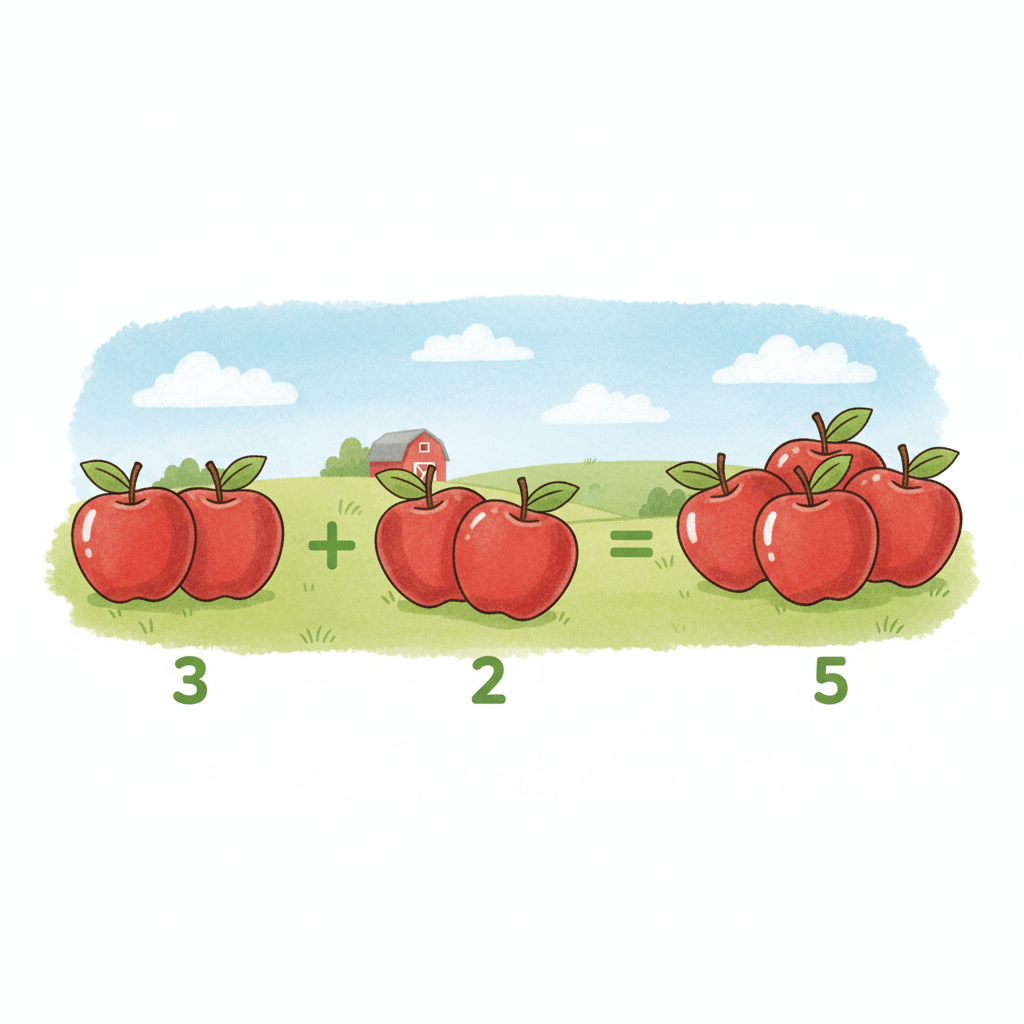
Sometimes, we write our addition problems so the numbers are next to each other, like reading a book from left to right. This is called horizontal addition. Imagine you have 3 colorful balloons, and then you get 2 more. You can write this as: 3 + 2.
To solve 3 + 2, you can count them all:
- Start with your 3 balloons.
- Now, count 2 more balloons.
- How many do you have in total? Let's count: 1, 2, 3, 4, 5!
So, 3 + 2 = 5. The equals sign (=) tells us what the total is.
Analogy Time! Think about lining up your toy cars. If you have 4 blue cars in a row, and your dad gives you 1 red car to add to the end of the row, you are adding horizontally! You're putting them side-by-side.
Let's try another one: 5 + 3. Imagine you have 5 yummy cookies, and you bake 3 more. How many cookies do you have now? You can count on your fingers or draw little circles:
○○○○○ (5 cookies) + ○○○ (3 cookies) = ?
Count all the circles: 1, 2, 3, 4, 5, 6, 7, 8. That's right, 8 cookies!
So, 5 + 3 = 8.
 ⚠️ This picture may have spelling mistakes. Trust the words in the lesson.
Adding Vertically (Up and Down)
Sometimes, especially when numbers get bigger, we like to stack them on top of each other to add them. This is called vertical addition. It's like stacking blocks!
Let's take our first example: 3 + 2. To add vertically, we write the numbers one above the other, with the plus sign to the side, and draw a line underneath:
3
+ 2
---
We start adding from the bottom up (or top down, it's the same here!). In this case, we look at the column of numbers. We have a 3 and a 2. We add them together: 3 + 2 = 5. The answer goes underneath the line.
3
+ 2
---
5
So, 3 + 2 = 5, just like before!
Analogy Time! Imagine you are building a tower with LEGO bricks. You put down a red brick (that's like the number 3), and then you put a blue brick right on top of it (that's like the number 2). You are stacking them vertically!
Let's try the cookie example vertically: 5 + 3.
5
+ 3
---
We add the numbers in the column: 5 + 3 = 8. The answer goes below the line.
5
+ 3
---
8
So, 5 + 3 = 8. Whether we write it side-by-side or stacked up, we get the same total!
Why Learn Addition?
Addition is super useful! It helps us count things, share toys fairly, figure out how much money we have, and so much more. It's like a secret code to understand how quantities change when we bring them together.
Remember, whether you're adding horizontally (side-by-side) or vertically (up-and-down), you're always finding the total amount when you combine groups. Keep practicing, and you'll become an addition superstar!
Keep learning, free
Create a free Syllabax account to unlock practice questions and games for this topic.
Visual Learning Enhanced! 🚀
To help you master this topic, we use Advanced Syllabax AI to generate detailed diagrams and visual models.
Note on Visuals: The AI sometimes makes spelling errors in image labels. Please refer to the lesson text for the correct terminology.