Learning Journey
Watch this topic in 60 seconds
Free preview · Lesson 1
Understanding Properties of shapes (sides, corners, edges, faces) (Basic Shapes)
Exploring the Wonderful World of Shapes: Sides, Corners, Edges, and Faces!
Hello young explorers! Get ready to embark on an exciting journey into the amazing world of shapes! We see shapes all around us, every single day. Think about your favorite toy car, a slice of pizza, a stop sign, or even the wheels on a bicycle. These are all made up of different shapes! Today, we're going to become shape detectives and learn about the special parts that make up these shapes: their sides, corners, edges, and faces.
What are Shapes?
Shapes are like the building blocks of everything we see! They have different sizes and can be flat or solid. We'll focus on some of the most common and basic shapes first.
Flat Shapes: 2D Shapes
Imagine drawing on a piece of paper. The shapes you draw are called 2D (two-dimensional) shapes because they are flat. They only have length and width, but no thickness. Let's meet some of our flat shape friends:
1. The Circle: Round and Smooth!
The circle is like a perfectly round wheel or a yummy cookie. It has no corners and no straight sides. It's just one continuous, smooth, curved line!
- Sides: A circle doesn't have straight sides. It has one continuous curved line. Think of it like a race track where you can go around and around without ever reaching a corner!
- Corners: A circle has zero corners. A corner is where two or more lines meet. Since a circle is just one curve, there are no places for lines to meet and form a corner.
2. The Square: Perfectly Balanced!
A square is like a perfect checkerboard tile or a window pane. It's very special because all its sides are exactly the same length, and all its corners are perfectly square (like the corner of a book!).
- Sides: A square has 4 straight sides. Imagine the sides of a perfectly built box. Each side is equal in length.
- Corners: A square has 4 corners. Think of these like the pointy tips of an arrow. These corners are all the same kind of 'pointy-ness'.
3. The Rectangle: Like a Door!
A rectangle is a bit like a square, but it's stretched out! Think of a door, a book, or a TV screen. It has 4 straight sides and 4 corners, but not all sides are the same length. It has two longer sides and two shorter sides.
- Sides: A rectangle has 4 straight sides. It has two pairs of equal sides. The two longer sides are the same length, and the two shorter sides are the same length.
- Corners: A rectangle has 4 corners, just like a square. These corners are also perfectly square.
4. The Triangle: Three is Company!
A triangle is a shape with exactly three sides and three corners. Think of a slice of pizza, a traffic sign (like a yield sign), or the roof of a simple house drawing.
- Sides: A triangle has 3 straight sides. These sides can be all different lengths, or two can be the same, or all three can be the same!
- Corners: A triangle has 3 corners. Each corner is where two sides meet.
Solid Shapes: 3D Shapes
Now, let's step out of the flat world and into the solid world! 3D (three-dimensional) shapes are shapes that have thickness, width, AND height. They are solid objects that you can hold! Think about your toys, a ball, or a building.
1. The Cube: Like a Dice!
A cube is a solid shape that looks like a perfect box. Think of a dice you use to play board games. It's like a square that has been puffed out in all directions!
- Faces: The flat surfaces of a 3D shape are called faces. A cube has 6 square faces. Imagine the sides of a box – each side is a face. All the faces on a cube are the same size and shape (squares!).
- Edges: Edges are the lines where two faces meet. Think of the lines where the sides of a box connect. A cube has 12 edges.
- Corners (or Vertices): The points where three or more edges meet are called corners (or vertices). These are the pointy bits! A cube has 8 corners.
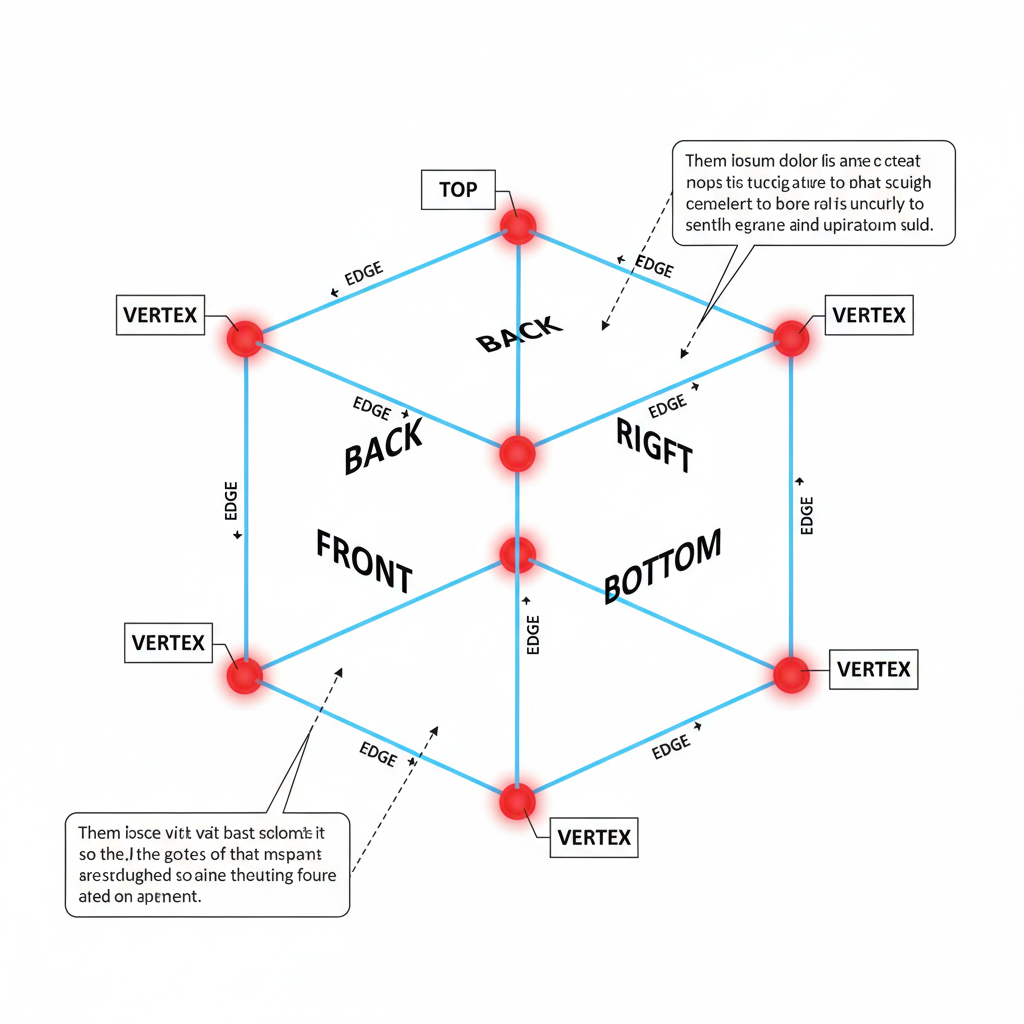 ⚠️ This picture may have spelling mistakes. Trust the words in the lesson.
2. The Sphere: A Perfect Ball!
A sphere is a perfectly round solid shape, like a ball, a globe, or an orange. It has no flat faces, no edges, and no corners.
- Faces: A sphere has 1 curved face. It's just one continuous curved surface.
- Edges: A sphere has 0 edges. Since there are no flat faces to meet, there are no edges.
- Corners: A sphere has 0 corners. It's perfectly round all over.
3. The Cylinder: Like a Can!
A cylinder is a solid shape with two flat circular ends and a curved surface connecting them. Think of a soup can, a toilet paper roll, or a pipe.
- Faces: A cylinder has 3 faces: 2 flat circular faces (the top and bottom) and 1 curved face (the side).
- Edges: A cylinder has 2 edges. These are the circular lines where the flat top and bottom circles meet the curved side.
- Corners: A cylinder has 0 corners.
4. The Cone: Like an Ice Cream Cone!
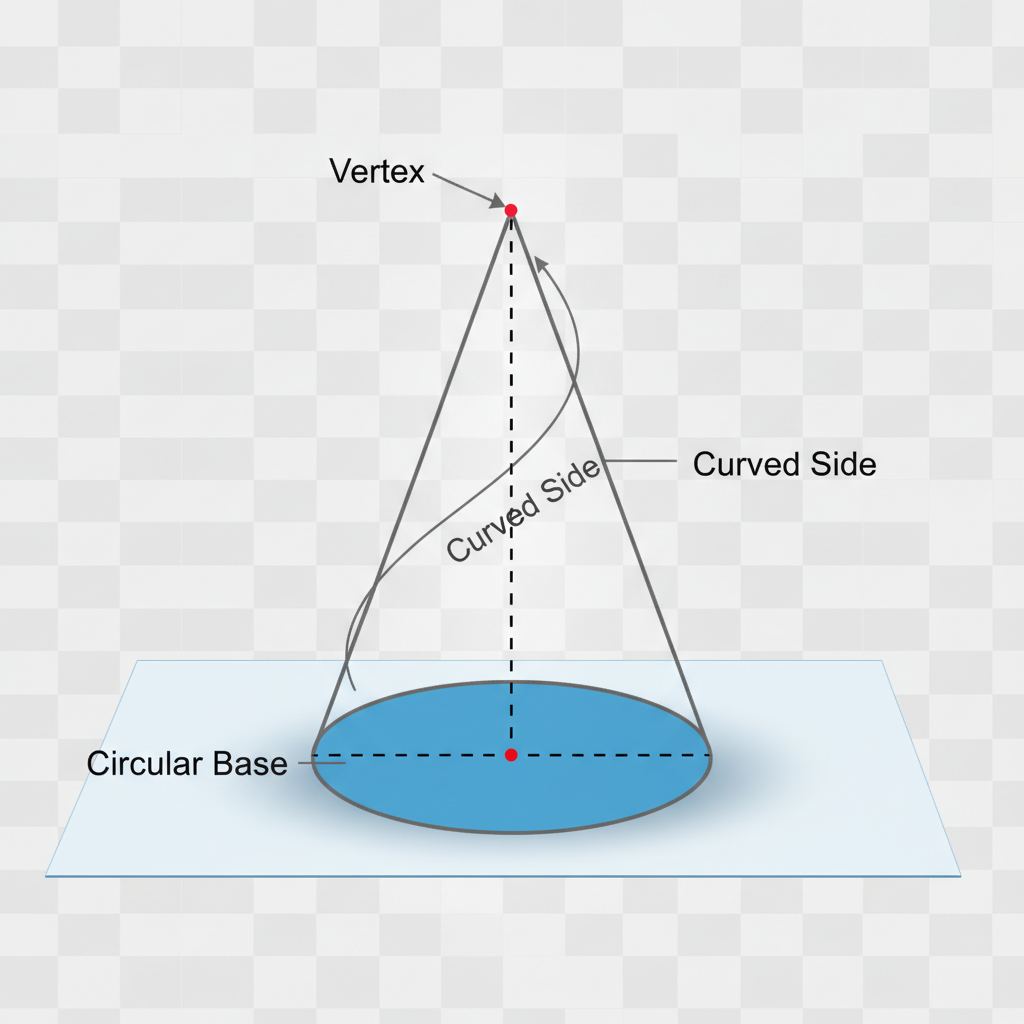
A cone is a solid shape that has a flat circular base and tapers up to a single point called the vertex. Think of an ice cream cone or a party hat.
- Faces: A cone has 2 faces: 1 flat circular face (the bottom) and 1 curved face (the side that goes up to the point).
- Edges: A cone has 1 edge. This is the circular line where the flat bottom meets the curved side.
- Corners: A cone has 1 corner (the pointy top, called a vertex).
Recap: Shape Detectives at Work!
We've learned about many exciting shapes today! Let's quickly remember the main parts:
- Sides: The straight lines that make up flat shapes, or the boundaries of flat surfaces on solid shapes.
- Corners: The points where sides or edges meet.
- Faces: The flat or curved surfaces of solid shapes.
- Edges: The lines where two faces of a solid shape meet.
Keep looking for these shapes and their parts everywhere you go! You are now officially shape experts!
Keep learning, free
Create a free Syllabax account to unlock practice questions and games for this topic.
Visual Learning Enhanced! 🚀
To help you master this topic, we use Advanced Syllabax AI to generate detailed diagrams and visual models.
Note on Visuals: The AI sometimes makes spelling errors in image labels. Please refer to the lesson text for the correct terminology.