Diseases (communicable vs non-communicable)[BIOLOGY]
Watch this topic in 60 seconds
Free preview · Lesson 1
Understanding Diseases (communicable vs non-communicable)[BIOLOGY]
Understanding Diseases: Communicable vs. Non-Communicable
Hello, young scientists! Today, we're going to embark on an exciting journey into the world of biology to learn about something very important: diseases. Diseases are conditions that make our bodies feel unwell and can affect how we function. But did you know that not all diseases are the same? We can actually group them into two main types: communicable diseases and non-communicable diseases. Let's dive in and explore what makes them different!
What is a Disease?
Before we talk about the two types, let's quickly define what a disease is. Think of your body as a super-cool, complex machine. When a part of this machine isn't working right, or when something foreign enters and messes things up, that's a disease. It's like when your favorite toy stops working because a piece is broken or something has gotten stuck inside it. A disease can affect your body's cells, tissues, or organs, making you feel sick, weak, or in pain.
Communicable Diseases: The 'Catchable' Ones!
Let's start with communicable diseases. The word 'communicable' sounds a bit like 'communicate,' right? And that's a good clue! Communicable diseases are those that can be passed from one person to another. They are like a game of tag – you can 'catch' them from someone else!
How do they spread?
These diseases are usually caused by tiny, invisible living things called pathogens. Think of pathogens as tiny troublemakers or germs. The main types of pathogens are:
- Bacteria: These are like tiny, single-celled organisms that can live almost anywhere. Some bacteria are good for us (like those in our yogurt!), but others can make us sick. Imagine them as tiny little robots that can sometimes go rogue and cause problems.
- Viruses: Viruses are even smaller than bacteria. They can't survive on their own; they need to get inside living cells (like yours!) to make more of themselves. Think of a virus as a tiny, microscopic pirate that hijacks your body's cells and forces them to make more pirates!
- Fungi: These are a bit like the mold you might see on old bread, but some can cause infections on our skin or inside our bodies.
- Protozoa: These are also tiny, single-celled organisms, but they are a bit more complex than bacteria.
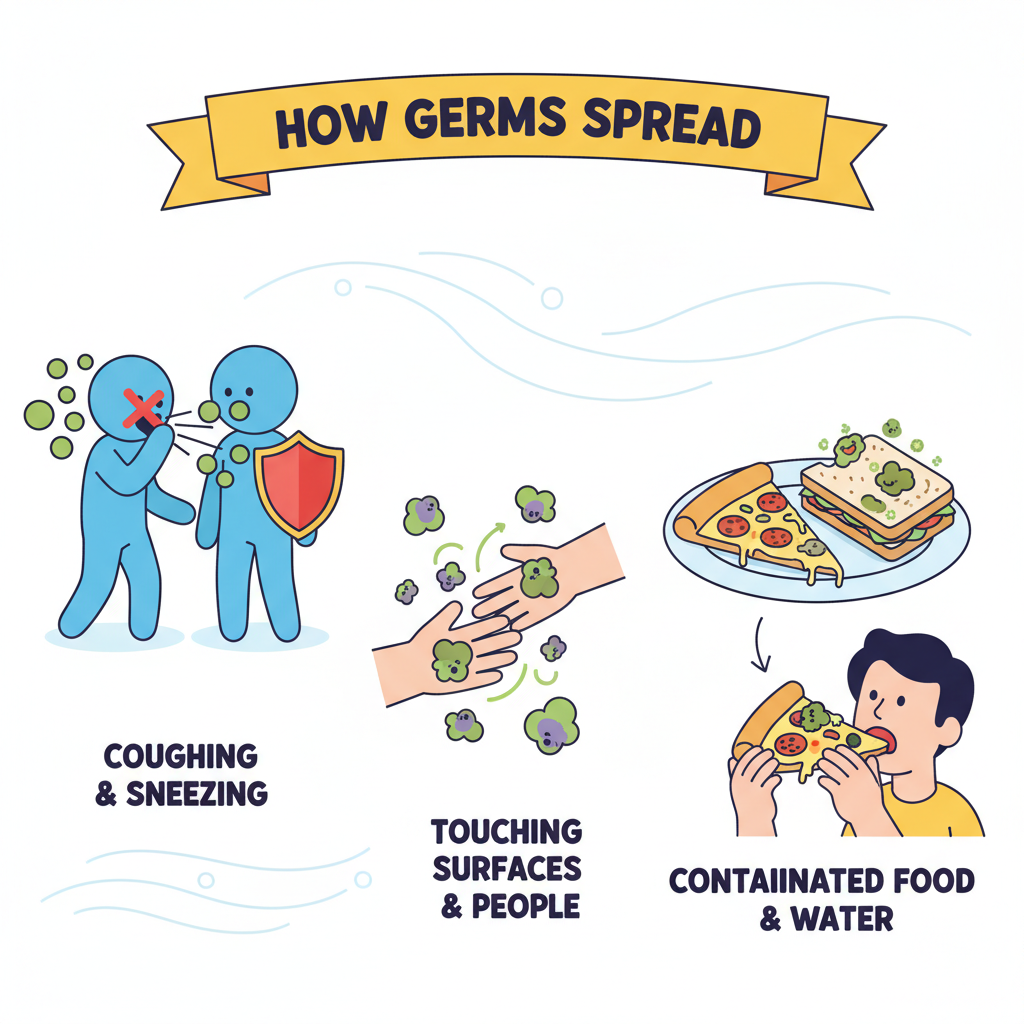
These pathogens can travel from one person to another in several ways:
- Direct Contact: This is like shaking hands or hugging someone who is sick. It's like passing a ball directly from one player to another.
- Indirect Contact: This happens when you touch something a sick person has touched, like a doorknob, a toy, or a phone. The germs are left behind on the object, waiting for someone else to pick them up. Imagine leaving your muddy footprints on a path – the next person walking by might step in them.
- Airborne Transmission: When a sick person coughs, sneezes, or even talks, they can send tiny droplets containing germs into the air. If you breathe in these droplets, you can get sick. It's like someone blowing invisible confetti that carries germs.
- Contaminated Food or Water: If food or water is not clean and has germs in it, eating or drinking it can make you sick. Think of it like accidentally eating a tiny bug that fell into your juice box.
- Through Insects (Vectors): Some insects, like mosquitoes or ticks, can carry pathogens and transmit them to people when they bite. These insects act like tiny delivery trucks for germs.
Examples of Communicable Diseases:
You've probably heard of many of these!
- The Common Cold and Flu: Caused by viruses, spread through coughing, sneezing, and direct contact.
- Chickenpox: A viral infection that causes itchy spots, spread through direct contact and airborne droplets.
- Strep Throat: Caused by bacteria, spread through droplets from coughing and sneezing.
- Food Poisoning: Often caused by bacteria or viruses in contaminated food.
How can we prevent communicable diseases?
The good news is we can fight these 'catchable' diseases! We can:
- Wash our hands often with soap and water. This is like washing away any tiny troublemakers that might be on your hands.
- Cover our mouths and noses when we cough or sneeze. Think of it as putting up a shield so germs don't fly everywhere.
- Get vaccinated. Vaccines are like training for your body's defense system (your immune system) to recognize and fight specific pathogens before they can make you very sick.
- Avoid close contact with people who are sick.
- Eat healthy food and drink clean water.
Analogy Alert! Think of your body like a castle. Pathogens are like invaders trying to get into your castle. Communicable diseases are when these invaders successfully enter and spread throughout the castle, causing damage. Washing hands, covering coughs, and vaccines are like your castle's guards and defenses, keeping the invaders out or fighting them off!
 ⚠️ This picture may have spelling mistakes. Trust the words in the lesson.
Non-Communicable Diseases: The 'Not Catchable' Ones!
Now, let's talk about non-communicable diseases. The 'non' at the beginning means 'not.' So, these are diseases that you cannot catch from another person. They are not spread by germs like communicable diseases.
What causes them?
Non-communicable diseases often develop over time due to a variety of factors:
- Genetics (Inherited Traits): Sometimes, you can inherit a tendency for a certain disease from your parents. It's like having a certain eye color or hair color – it's something you're born with.
- Lifestyle Choices: What you eat, how much you exercise, whether you smoke or drink alcohol – these things can greatly impact your health and increase your risk of certain diseases. Think of your lifestyle as the daily routines and habits you have.
- Environmental Factors: Things in the environment around you, like pollution or exposure to certain chemicals, can sometimes contribute to diseases.
- Internal Body Problems: Sometimes, parts of your body just stop working correctly on their own.
Examples of Non-Communicable Diseases:
These are often long-term conditions.
- Diabetes: A condition where the body has trouble controlling its blood sugar levels.
- Heart Disease: Problems with the heart and blood vessels.
- Asthma: A breathing condition that causes airways to narrow.
- Allergies: When your body reacts strongly to certain substances like pollen or certain foods.
- Cancer: A disease where some cells in the body grow out of control.
- Vitamin Deficiencies: Like scurvy (lack of Vitamin C) or rickets (lack of Vitamin D).
Can they be prevented?
While you can't prevent all non-communicable diseases (especially those due to genetics), many can be managed or their risk reduced by making healthy lifestyle choices:
- Eating a balanced diet full of fruits, vegetables, and whole grains.
- Getting regular physical activity.
- Avoiding smoking and excessive alcohol use.
- Getting regular medical check-ups.
Analogy Alert! If communicable diseases are like invaders attacking your castle, non-communicable diseases are more like problems that develop from within the castle itself. Maybe a part of the castle's plumbing system starts leaking (like a body organ not working right), or the way the castle is managed leads to cracks in the walls over time (like unhealthy lifestyle choices). You can't 'catch' a leaky pipe from a neighbor, but it still needs to be fixed!
Key Differences at a Glance
Let's summarize the main differences:
| Feature | Communicable Diseases | Non-Communicable Diseases |
|---|---|---|
| Can be spread? | Yes, from person to person (or animal to person) | No, cannot be spread from person to person |
| Caused by? | Pathogens (germs like bacteria, viruses, fungi, protozoa) | Genetics, lifestyle, environment, internal body issues |
| Prevention? | Hygiene, vaccination, avoiding sick people | Healthy lifestyle, regular check-ups, managing risks |
Understanding these differences helps us know how to protect ourselves and others. By practicing good hygiene, we help stop the spread of communicable diseases. By making healthy choices, we help prevent non-communicable diseases. Both are super important for keeping our amazing bodies healthy!
Keep learning, free
Create a free Syllabax account to unlock practice questions and games for this topic.
Visual Learning Enhanced! 🚀
To help you master this topic, we use Advanced Syllabax AI to generate detailed diagrams and visual models.
Note on Visuals: The AI sometimes makes spelling errors in image labels. Please refer to the lesson text for the correct terminology.