Complementary & supplementary angles (Lines & Angles)
Watch this topic in 60 seconds
Free preview · Lesson 1
Understanding Complementary & supplementary angles (Lines & Angles)
Discovering Angles: Complementary & Supplementary Adventures!
Hey there, future geometry wizards! Get ready to unlock some cool secrets about lines and angles. We're going to explore two very special types of angle relationships: complementary angles and supplementary angles. Don't worry, even though the names sound a bit fancy, the ideas behind them are as simple as pie (or a slice of pie, to be exact!).
What is an Angle, Anyway?
Before we dive into the main event, let's quickly remember what an angle is. Imagine two straight lines (we call them 'rays' in geometry) that start from the exact same point. The 'opening' between these two rays is what we call an angle. Think of it like a hinge on a door: the wider you open the door, the larger the angle becomes!
Special Angles We Already Know:
- Right Angle: This is a super important angle! It measures exactly 90 degrees. You see right angles everywhere – the corner of a square, the edge of a book, where the wall meets the floor in your room. It looks like a perfect 'L' shape.
- Straight Angle: Imagine a perfectly straight line. That's a straight angle! It measures exactly 180 degrees. If you take two right angles and put them side-by-side, they make a straight angle.
Complementary Angles: A Perfect Pair!
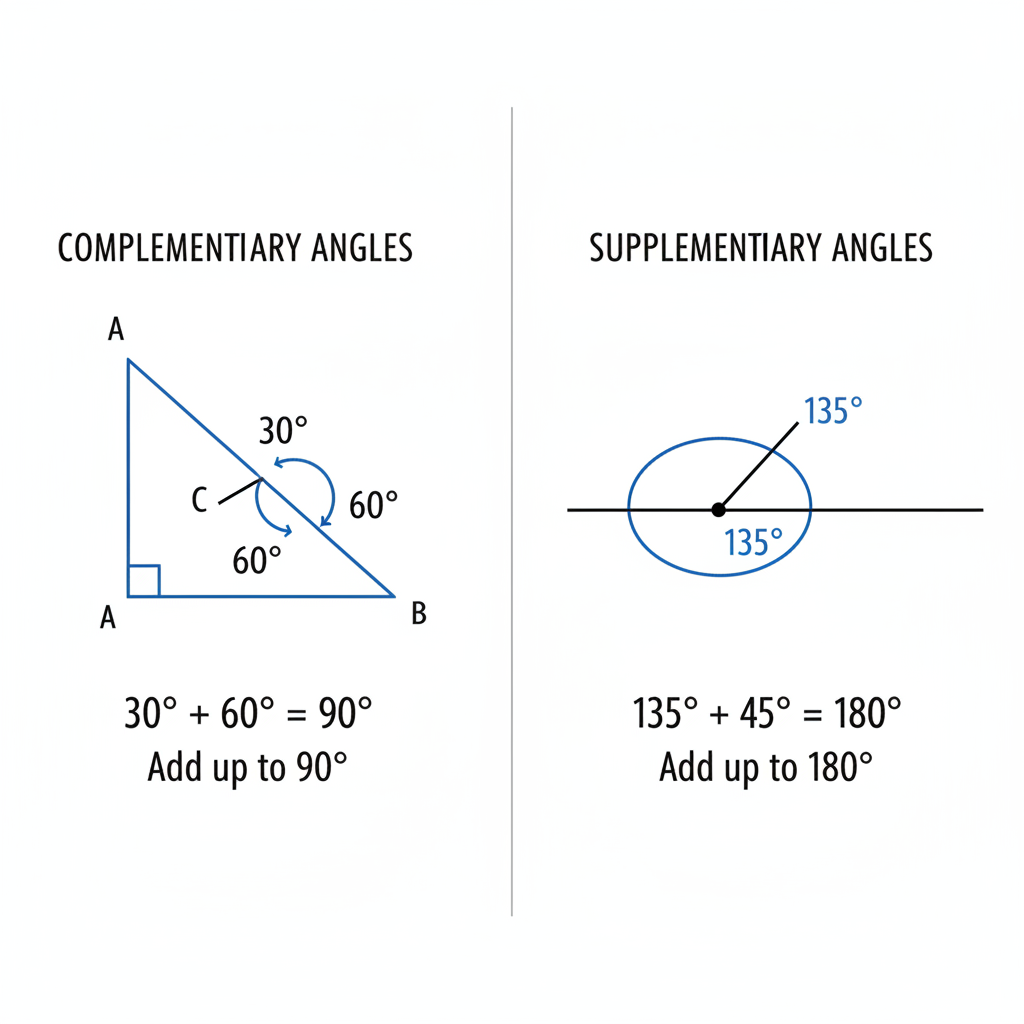
Let's start with our first special relationship: Complementary Angles. This is when you have two angles that add up to exactly 90 degrees. That's it! If you put them together, they form a perfect right angle.
Definition: Complementary Angles
Two angles are complementary if their sum is 90 degrees.
Example: If one angle is 30 degrees, its complementary angle would be 60 degrees (because 30 + 60 = 90).
Example: If one angle is 45 degrees, its complementary angle would also be 45 degrees (because 45 + 45 = 90).
It doesn't matter how the angles are positioned – they don't even have to be touching! As long as their measurements add up to 90 degrees, they are complementary.
Supplementary Angles: Straight Line Friends!
Now, let's meet their 'straight' relatives: Supplementary Angles. This time, we're looking for two angles that add up to exactly 180 degrees. Remember that a straight angle is 180 degrees? Well, supplementary angles are two angles that team up to form a straight line!
Definition: Supplementary Angles
Two angles are supplementary if their sum is 180 degrees.
Example: If one angle is 60 degrees, its supplementary angle would be 120 degrees (because 60 + 120 = 180).
Example: If one angle is 90 degrees, its supplementary angle would also be 90 degrees (because 90 + 90 = 180). This means two right angles are supplementary!
Just like complementary angles, supplementary angles don't have to be touching to be supplementary. They just need to add up to that magic number: 180 degrees.
Putting It All Together: Complementary vs. Supplementary
The trickiest part is often remembering which is which! Here's a simple way to remember:
- C for Complementary: Think of 'C' also standing for Corner, like a right-angle corner (90 degrees).
- S for Supplementary: Think of 'S' also standing for Straight line (180 degrees).
Here's a visual aid to help solidify your understanding:
 ⚠️ This picture may have spelling mistakes. Trust the words in the lesson.
Why are these important?
Understanding complementary and supplementary angles is like learning the basic building blocks of geometry. They help us find unknown angles in diagrams, solve puzzles, and even understand how structures are built. For instance, architects and engineers use these concepts constantly to ensure buildings are stable and angles are correct.
Great job! You've just taken a big step in understanding how angles relate to each other. Keep practicing, and these concepts will become second nature!
Keep learning, free
Create a free Syllabax account to unlock practice questions and games for this topic.
Visual Learning Enhanced! 🚀
To help you master this topic, we use Advanced Syllabax AI to generate detailed diagrams and visual models.
Note on Visuals: The AI sometimes makes spelling errors in image labels. Please refer to the lesson text for the correct terminology.