Radius, diameter, chord (Circle Fundamentals)
Watch this topic in 60 seconds
Free preview · Lesson 1
Understanding Radius, diameter, chord (Circle Fundamentals)
Circle Fundamentals: Understanding Radius, Diameter, and Chord
Welcome, future geometry gurus! Today, we're diving into the wonderful world of circles. Circles are all around us, from the wheels on your bike to the plates on your dinner table, the coins in your pocket, and even the planets orbiting the sun. They might look simple, but they have some very important parts that help us understand their shape and properties. We're going to explore three fundamental components: the radius, the diameter, and the chord. Don't worry, we'll use simple terms and lots of everyday analogies to make everything crystal clear!
The Heart of the Circle: The Center
Before we talk about anything else, every circle has a very special point right in its middle. We call this the center of the circle. Think of it like the bullseye on a dartboard, or the pivot point of a compass you use to draw a circle. Every point on the edge of the circle is exactly the same distance away from this center point. It's the anchor that holds the entire circle together!
Part 1: The Radius – Reaching from the Center to the Edge
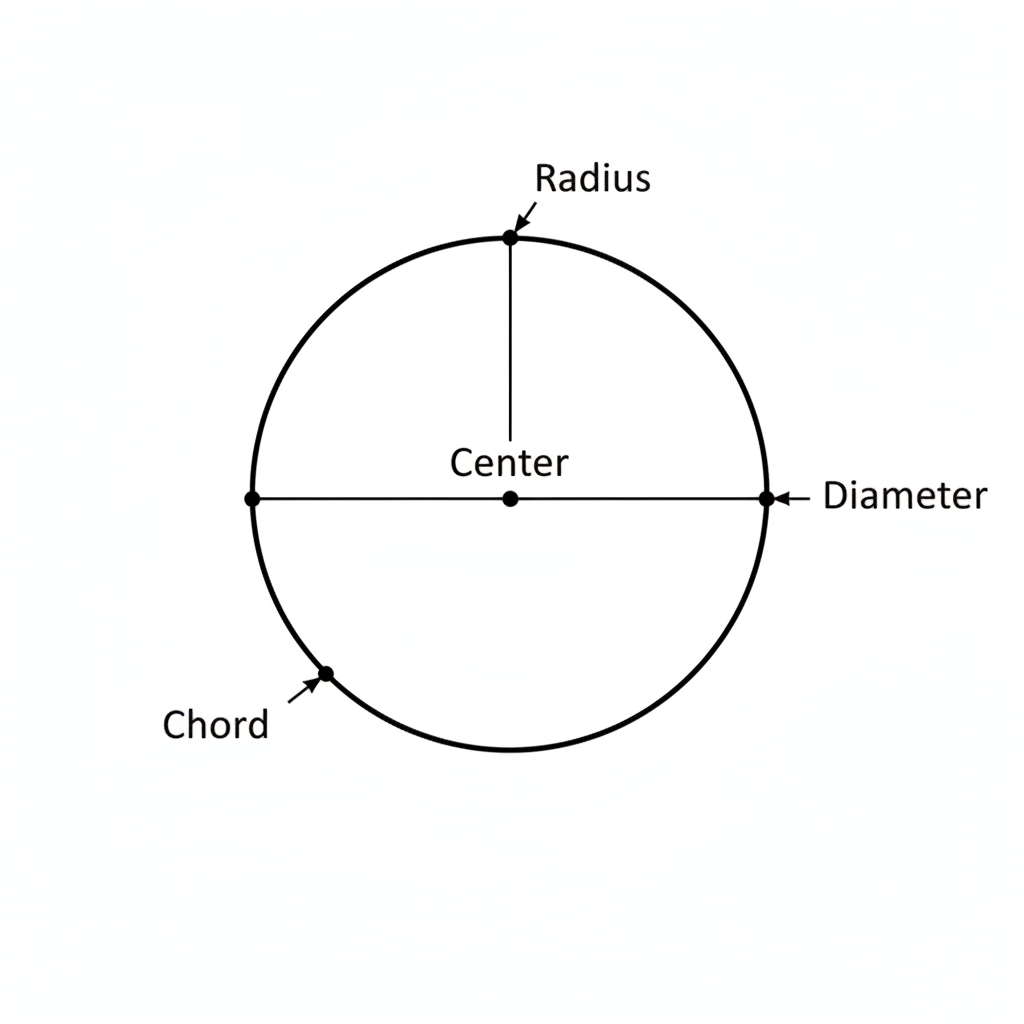
Imagine you're standing exactly at the center of a circular park. You want to walk straight to the very edge of the park. Any straight path you take from the center directly to the boundary of the circle is what we call a radius.
- Definition: A radius (plural: radii) is a straight line segment that connects the center of a circle to any point on its circumference (the edge of the circle).
- Analogy 1: Think of the spokes on a bicycle wheel. Each spoke goes from the center hub to the outer rim. Every spoke is a radius!
- Analogy 2: If you're holding a string with one end tied to a pole (the center) and you walk around in a circle, keeping the string taut, the length of that string is the radius.
The radius is super important because it tells us how 'big' a circle is. A larger radius means a larger circle.
Part 2: The Diameter – The Longest Path Across
Now, let's take that idea of walking across the park a step further. What if you wanted to walk straight from one side of the park, through the very center, and all the way to the exact opposite side? That straight path across the park, passing through the center, is called the diameter.
- Definition: A diameter is a straight line segment that passes through the center of a circle and has both of its endpoints on the circumference of the circle.
- Analogy 1: Imagine cutting a pizza exactly in half, straight through the middle. The cut line is a diameter.
- Analogy 2: If you're building the longest possible bridge across a perfectly circular lake, and you want it to go straight through the absolute middle of the lake, that bridge would represent the diameter.
The Special Relationship Between Radius and Diameter
Did you notice something about the diameter? It's like two radii (radiuses) put together, end-to-end, both starting from the center and going in opposite directions! This is a very crucial relationship:
- The diameter is always twice the length of the radius. We can write this as:
Diameter = 2 × Radiusord = 2r. - Conversely, the radius is half the length of the diameter:
Radius = Diameter / 2orr = d/2.
So, if a circle has a radius of 5 cm, its diameter will be 10 cm. If a circle has a diameter of 20 meters, its radius will be 10 meters.
Part 3: The Chord – Any Straight Slice Across
What if you want to walk from one side of the circular park to another, but you don't necessarily want to go through the very center? You just want to take a straight shortcut. Any straight line segment that connects two points on the circumference of a circle is called a chord.
- Definition: A chord is a straight line segment whose endpoints both lie on the circumference of a circle.
- Analogy 1: Think of making a straight cut across a round cake, but not necessarily through the middle. That cut line is a chord.
- Analogy 2: If you imagine a circular trampoline, and you draw a straight line from one edge to another (without leaving the trampoline), that line is a chord. It could be short, or it could be long.
The Diameter is a Special Type of Chord!
This is a super important point: While all diameters are chords, not all chords are diameters. A chord only becomes a diameter when it passes through the center of the circle. In fact, the diameter is the longest possible chord you can draw in any given circle!
Here's an illustration to help you visualize these concepts:
Putting It All Together: A Quick Recap
- The center is the exact middle point of the circle.
- The radius goes from the center to the edge (like a bike spoke).
- The diameter goes all the way across the circle, passing through the center (like cutting a pizza exactly in half). It's twice the radius.
- The chord connects any two points on the edge of the circle (like a straight shortcut across a field).
- The diameter is always the longest possible chord in a circle.
Understanding these three basic terms—radius, diameter, and chord—is the first step to unlocking many more exciting concepts in geometry. Keep practicing identifying them, and you'll be a circle master in no time!
Keep learning, free
Create a free Syllabax account to unlock practice questions and games for this topic.
Visual Learning Enhanced! 🚀
To help you master this topic, we use Advanced Syllabax AI to generate detailed diagrams and visual models.
Note on Visuals: The AI sometimes makes spelling errors in image labels. Please refer to the lesson text for the correct terminology.