Everyday uses of Magnets (PHYSICS)
Watch this topic in 60 seconds
Free preview · Lesson 1
Understanding Everyday uses of Magnets (PHYSICS)
Everyday Uses of Magnets (Physics)
Welcome, young scientists, to the fascinating world of magnets! You've probably played with magnets before, maybe sticking them to your refrigerator or using them to play games. But did you know that magnets are all around us, helping us in many surprising ways every single day? Magnets are special objects that can attract or repel certain materials, and this special ability makes them incredibly useful.
What is a Magnet?
Imagine a superhero with a special power – the power to pull certain things towards it, or maybe even push them away! That's a bit like a magnet. A magnet has an invisible force field around it. This force field is called a magnetic field. This magnetic field is strongest at two special points on the magnet called the poles. Most magnets have a North pole (often marked with 'N') and a South pole (often marked with 'S').
Think of it like a friendly handshake or a playful push. Like poles, if they are the same (North and North, or South and South), they will push each other away – this is called repulsion. Unlike poles, if they are different (North and South), they will pull towards each other – this is called attraction. It's like how some people are best friends and want to be close, while others might get on each other's nerves and prefer to keep their distance!
What Materials Can Magnets Affect?
Magnets are picky eaters! They don't attract everything. The materials that magnets love to attract are called magnetic materials. The most common magnetic material is iron. Other metals like nickel and cobalt are also magnetic. Things like wood, plastic, paper, and most fabrics are not magnetic. So, a magnet will happily stick to a metal spoon but won't do anything to your wooden toy car.
Everyday Heroes: Magnets at Work!
1. Keeping Things Together (Refrigerators and More!)
You've seen them on your fridge, right? Those colorful magnets that hold your drawings, your school schedule, or even a shopping list. These are simple magnets doing a big job of keeping important things visible and organized. It's like having tiny, invisible helpers making sure nothing important falls off!
But it's not just refrigerators! Many cabinets, especially in kitchens and bathrooms, have magnetic catches to keep doors shut. Think of a toy box lid that closes with a 'snap' – that's often a magnet at work, ensuring things stay tidy. It's like a gentle hug that keeps the door closed until you're ready to open it.
2. In Our Homes: Speakers and Electronics
Have you ever wondered how your favorite music or the sounds from your TV come out? Magnets play a crucial role in speakers! Inside a speaker, there's a magnet and a coil of wire. When an electrical signal (the music or sound) travels through the wire, it makes the magnet vibrate. These vibrations create the sound waves we hear. It's like a tiny orchestra inside the speaker, powered by magnets!
Many other electronic devices, from headphones to some computer components, also use magnets. They help convert electrical signals into sound or motion. Imagine a tiny dancer inside the speaker, moving to the music because of the magnet's push and pull!
3. In the Kitchen: Can Openers and Scales
Some manual can openers use a small magnet to hold the metal lid after it's cut, so you don't have to touch the sharp edge. It's a small but very helpful feature!
Kitchen scales, the ones you use to measure ingredients for baking, often use magnets to work. Inside, a magnet moves within a spring. When you place something heavy on the scale, the magnet moves, and this movement is used to show you the weight. It's like a magnet helping you be a master chef by telling you exactly how much flour to use!
4. Transportation: Trains and Cars
Did you know that some very fast trains, called maglev trains (which stands for Magnetic Levitation), actually float above the tracks? They use powerful magnets to lift and propel the train forward. This means there's no friction from wheels touching the track, allowing them to go incredibly fast! Imagine a magic carpet that zooms across the country – that's sort of what a maglev train feels like.
Even in regular cars, magnets are hidden. They are used in the alternator to generate electricity, in the starter motor to get the engine going, and in speakers for the car's sound system. So, magnets are helping your car move and entertain you!
5. Medical World: MRI Scanners
In hospitals, magnets are used in a very important machine called an MRI scanner (Magnetic Resonance Imaging). MRI scanners use very strong magnets to create detailed pictures of the inside of your body, like your brain or your bones. This helps doctors see what's happening inside you without having to do surgery. It's like a super-powered camera that can look through your skin!
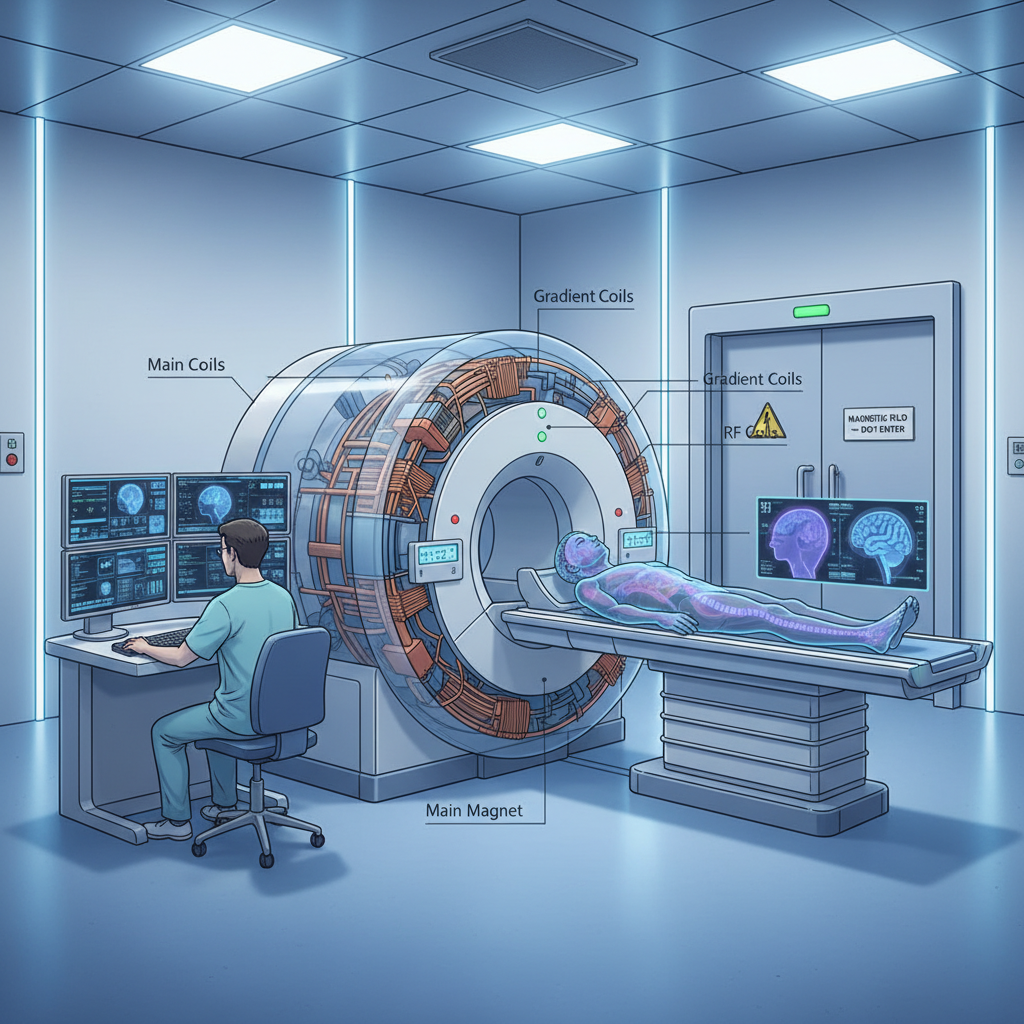 ⚠️ This picture may have spelling mistakes. Trust the words in the lesson.
6. In the Junkyard: Lifting Heavy Metal
Ever seen a big crane with a giant magnet at the end, lifting piles of scrap metal? That's one of the most powerful uses of magnets! These electromagnets (magnets that can be turned on and off using electricity) are used to pick up and move large amounts of iron and steel, like old cars or metal scraps in a recycling yard. It's like a giant, super-strong hand that can grab and move huge metal objects with ease!

7. Space Exploration: Satellites and Spacecraft
Even in space, magnets are essential! Satellites orbiting Earth use magnetic fields to help them orient themselves and communicate with us. They help keep our navigation systems working and our weather forecasts accurate. It's like magnets helping our space explorers stay on the right path!
Conclusion
So, you see, magnets are not just toys; they are essential tools that make our lives easier, safer, and more exciting. From holding your artwork on the fridge to helping doctors see inside your body and even enabling super-fast trains, magnets are truly everywhere!
Keep learning, free
Create a free Syllabax account to unlock practice questions and games for this topic.
Visual Learning Enhanced! 🚀
To help you master this topic, we use Advanced Syllabax AI to generate detailed diagrams and visual models.
Note on Visuals: The AI sometimes makes spelling errors in image labels. Please refer to the lesson text for the correct terminology.