Visual reasoning tasks [HOTS (Higher Order Thinking Skills)]
Watch this topic in 60 seconds
Free preview · Lesson 1
Understanding Visual reasoning tasks [HOTS (Higher Order Thinking Skills)]
Visual Reasoning: Thinking with Pictures!
Welcome, super thinkers! Today, we're going on an exciting adventure into the world of visual reasoning. What does that mean? It means using your amazing eyes and your brilliant brain to solve puzzles and understand things just by looking at pictures! Think of it like being a detective, but instead of fingerprints, you're looking for clues in images.
What is Visual Reasoning?
Visual reasoning is like having a superpower that lets you see patterns, understand relationships between objects, and make smart guesses based on what you see. It’s not just about *seeing* something, it’s about *understanding* it.
Imagine this:
You have a box of LEGO bricks. Some are red, some are blue, some are square, some are long. If you're asked to build a tower with all the red bricks first, then all the blue bricks, you're using visual reasoning! You're looking at the colors and shapes (visual information) and figuring out how to arrange them (reasoning).
Another example: If you see a picture of a sad face, you automatically understand that the person might be feeling unhappy. You don't need anyone to tell you; your brain figures it out from the way the mouth is turned down and maybe the eyes look droopy. That's visual reasoning in action!
Why is Visual Reasoning Important?
Visual reasoning helps us in so many ways, even when we're not doing puzzles.
- Solving Problems: When you see a jumbled toy box, you can figure out how to organize it by looking at where things should go.
- Understanding Instructions: Many instruction manuals have pictures to show you how to put things together. You use visual reasoning to follow them.
- Being Creative: When you draw a picture, you decide where to put the sun, the trees, and the people. You're using visual reasoning to make your drawing make sense.
- Learning New Things: Maps, diagrams, and charts in books all use pictures to help us learn.
Types of Visual Reasoning Tasks
There are many fun ways to practice visual reasoning. Let's look at a few:
1. Identifying Patterns
This is like spotting a repeating sequence. Imagine a string of beads: red, blue, red, blue, red... What comes next? If you said blue, you're a pattern expert! In pictures, patterns can be about colors, shapes, sizes, or positions.
Analogy: It’s like listening to a song where a certain rhythm or melody repeats. You learn to expect the next part of the music.
2. Spatial Reasoning
This is about understanding how objects fit together in space. Imagine a puzzle where you have to fit different shaped pieces into a board. You need to figure out how they twist and turn to make a complete picture. It's also about understanding directions, like 'left', 'right', 'above', and 'below'.
Analogy: Think about packing a suitcase. You have to arrange your clothes so they fit without too much squishing. You're thinking about shapes and how they fit together.
3. Analogies
This is where you see a relationship between two things and then find another pair that has the same relationship. It’s like saying: Dog is to Puppy as Cat is to Kitten. You see that a puppy is a baby dog, so you look for a baby cat.
Analogy: It’s like finding matching socks. If one sock has stripes, you look for another sock that also has stripes. The 'stripe' is the relationship.
4. Visual Completion
Sometimes, a picture is missing a part, and you have to figure out what that part should be to make the picture complete or make sense.
Analogy: Imagine you're building a puzzle, and one piece is lost. You look at the empty space and the surrounding pieces, and you can guess what shape the missing piece should be.
Let's Practice!
Now that we know about visual reasoning, let’s try some exercises. Look carefully at the pictures and think about the relationships, patterns, or missing pieces!
Imagine you have a grid, like a checkerboard. You see:
Row 1: Apple, Banana, Cherry
Row 2: Dog, Cat, Mouse
Row 3: Sun, Moon, Star
If you were asked what might go in the empty spot in Row 4, if the pattern was 'fruits', 'animals', 'things in the sky', what would you guess?
You'd probably guess another 'thing in the sky', like 'Cloud' or 'Rainbow'! You used visual reasoning to spot the category pattern.
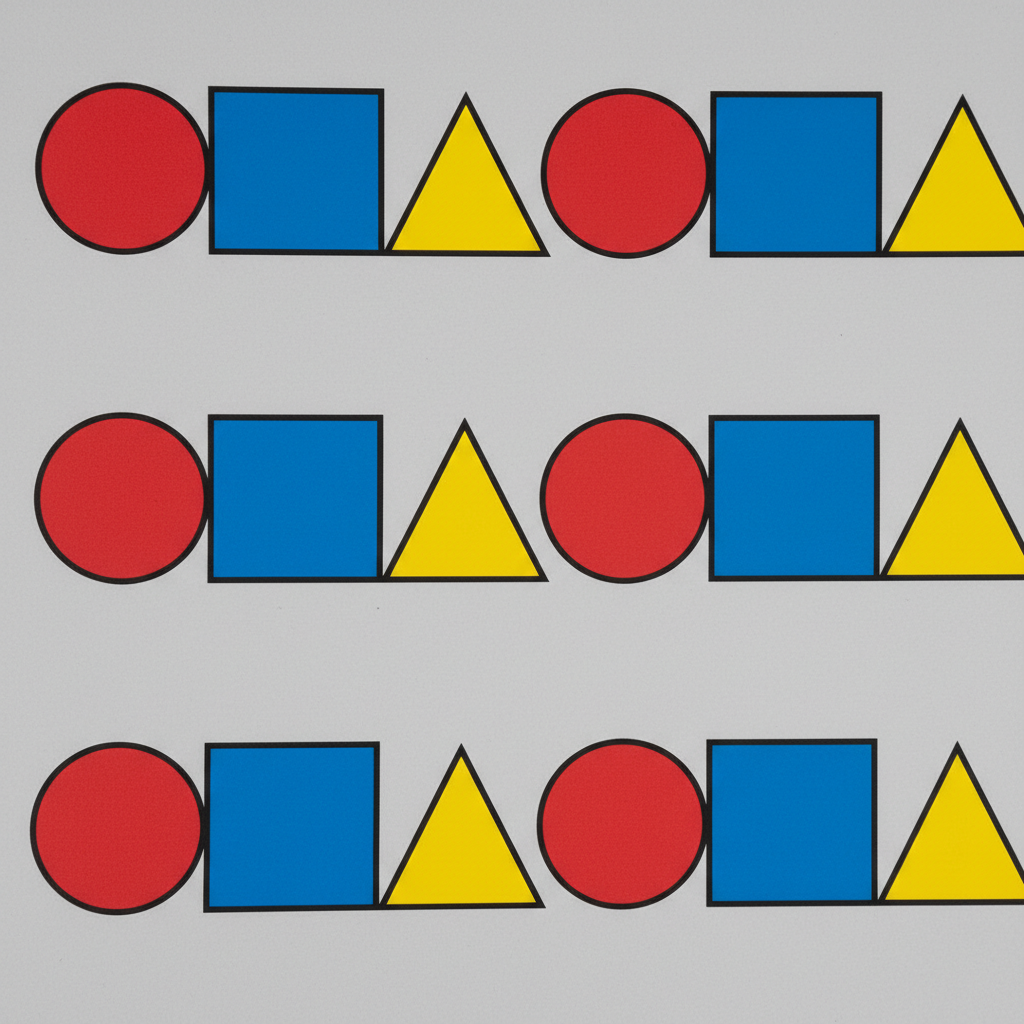
Here’s another one. Look at these shapes:
Circle, Square, Triangle, Circle, Square...
What shape comes next?
That’s right, a Triangle! You saw the pattern Circle, Square, Triangle repeating.
 ⚠️ This picture may have spelling mistakes. Trust the words in the lesson.
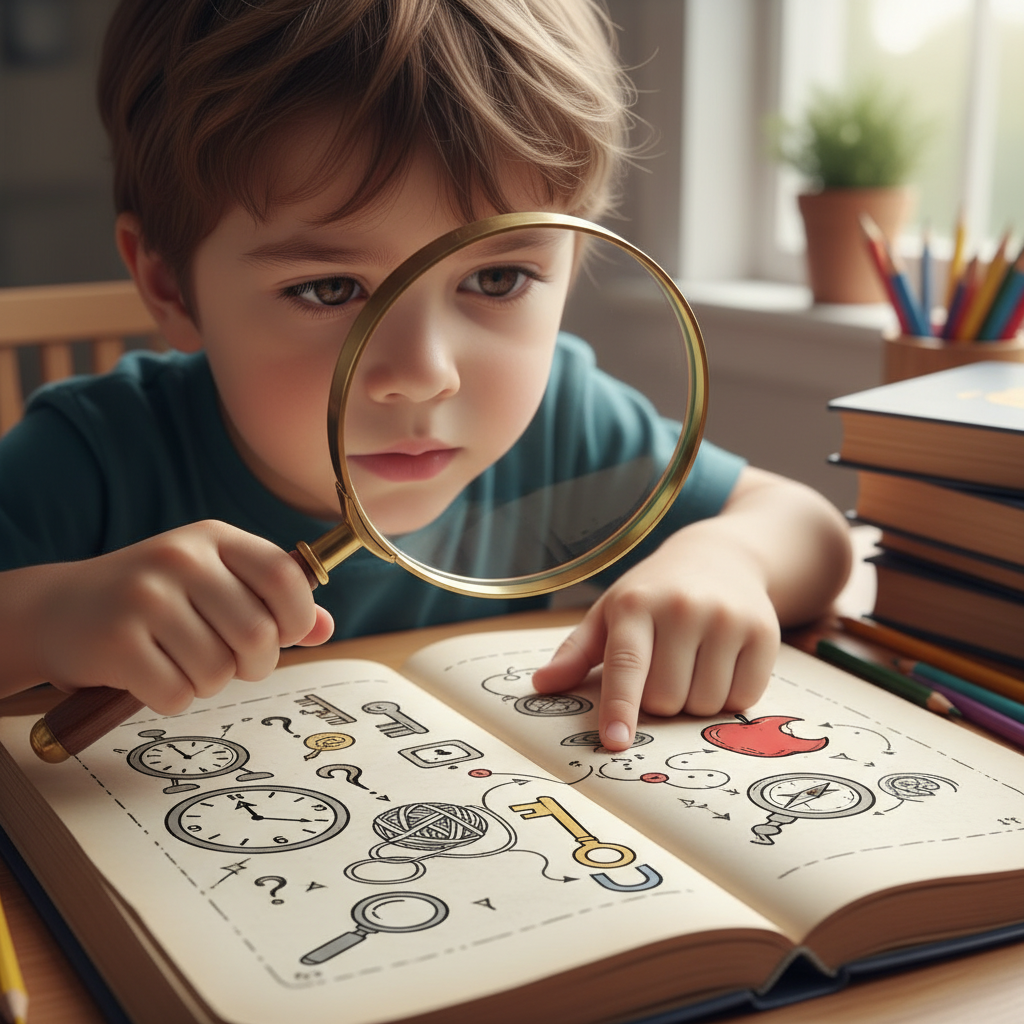
Visual reasoning is like a muscle. The more you practice, the stronger it gets! It helps you become a better problem-solver and a sharper thinker. Keep looking, keep questioning, and keep reasoning!
 ⚠️ This picture may have spelling mistakes. Trust the words in the lesson.
Remember, even when things look complicated, breaking them down and looking for the clues is the key. You've got this!
Keep learning, free
Create a free Syllabax account to unlock practice questions and games for this topic.
Visual Learning Enhanced! 🚀
To help you master this topic, we use Advanced Syllabax AI to generate detailed diagrams and visual models.
Note on Visuals: The AI sometimes makes spelling errors in image labels. Please refer to the lesson text for the correct terminology.