Food chains[BIOLOGY]
Watch this topic in 60 seconds
Free preview · Lesson 1
Understanding Food chains[BIOLOGY]
Understanding Food Chains: Who Eats Whom?
Welcome, young scientists, to an exciting journey into the world of biology! Today, we're going to explore something called a food chain. Imagine a nature documentary where you see a lion chasing a gazelle, and then you see a tiny insect eating a leaf. All these actions are part of a bigger story about how living things get the energy they need to survive. That's what a food chain helps us understand!
What is a Food Chain?
Simply put, a food chain shows us the path that energy takes as it moves from one living thing to another in an ecosystem. Think of it like a line of dominoes falling. When one domino falls, it knocks over the next, and then the next. In a food chain, when one organism (a living thing) eats another, it gets energy from it, just like the falling domino transfers energy.
The Sun: The Ultimate Energy Source
Every food chain starts with the sun. The sun is like the giant, glowing power station for our planet! Plants are amazing because they can capture the sun's energy using a process called photosynthesis. They are the 'chefs' of the ecosystem, making their own food from sunlight, water, and air. Because they make their own food, we call them producers.
Analogy: Think of plants like solar-powered bakeries. They use sunlight (solar power) to bake their own sugary food (energy). They don't need to go to the grocery store!
Consumers: The Eaters!
Organisms that cannot make their own food have to get energy by eating other living things. These are called consumers. There are different types of consumers:
1. Primary Consumers (Herbivores)
These are the animals that eat plants. They are like the first customers of our plant bakeries! Because they only eat plants, we call them herbivores.
Examples: A rabbit nibbling on grass, a deer munching on leaves, a grasshopper chewing on a stem, or even a tiny ant eating a plant.
Analogy: Imagine a zoo where some animals only eat vegetables and fruits. These would be your primary consumers!
2. Secondary Consumers (Carnivores and Omnivores)
These consumers eat the primary consumers. They are the next link in our energy-eating chain.
- Carnivores: These animals eat only other animals. They are the 'meat-eaters' of the food chain.
- Omnivores: These animals eat both plants and animals. They are 'all-eaters' and are more flexible in their diet.
Examples of Secondary Consumers:
- A snake eating a mouse (carnivore).
- A frog eating a grasshopper (carnivore).
- A fox eating a rabbit (carnivore).
- A bird eating seeds and insects (omnivore).
- A bear eating berries and fish (omnivore).
Analogy: Think of secondary consumers as people who eat salads (plants) and also enjoy a grilled chicken sandwich (animals). They have a mixed diet!
3. Tertiary Consumers (Carnivores and Omnivores)
These consumers eat the secondary consumers. They are higher up in the food chain, getting energy from those who have already eaten other animals or plants.
Examples: A hawk catching a snake, an owl catching a mouse that ate seeds, a wolf eating a fox.
Analogy: Imagine a fancy restaurant where the chef cooks a dish using ingredients that were already prepared. The tertiary consumer is like that chef, using a 'cooked' meal (another animal) to get their energy.
4. Quaternary Consumers (Apex Predators)
These are at the very top of many food chains. They eat tertiary consumers and are often called apex predators because they have few or no natural predators themselves.
Examples: Lions at the top of a savanna food chain, sharks in the ocean, eagles.
Analogy: Think of an apex predator as the ultimate boss in a video game. They are the strongest and usually defeat everyone else.
Decomposers: The Nature's Clean-up Crew
What happens when plants and animals die? Do all those nutrients just disappear? Nope! That's where the amazing decomposers come in. These are tiny organisms like bacteria and fungi (mushrooms are a type of fungus) that break down dead plants and animals. They are like nature's recyclers!
When decomposers break down dead things, they return essential nutrients back into the soil. These nutrients are then used by plants to grow, starting the whole cycle again! Without decomposers, our planet would be piled high with dead stuff, and plants wouldn't have the food they need to grow.
Analogy: Imagine a group of tireless workers constantly cleaning up a park. They pick up fallen leaves, dead branches, and leftover food, turning them back into soil that helps new flowers and trees grow. That's what decomposers do for the ecosystem!
Putting It All Together: A Simple Food Chain Example
Let's draw a simple food chain. We use arrows (→) to show the direction of energy flow. The arrow always points from the organism being eaten to the organism that eats it.
Example: Grass → Grasshopper → Frog → Snake → Hawk
- Grass: Producer (makes its own food from the sun)
- Grasshopper: Primary Consumer (eats the grass)
- Frog: Secondary Consumer (eats the grasshopper)
- Snake: Tertiary Consumer (eats the frog)
- Hawk: Quaternary Consumer / Apex Predator (eats the snake)
This shows how energy flows from the grass, to the grasshopper, then to the frog, then the snake, and finally to the hawk. If the hawk dies, decomposers will break it down, returning nutrients to the soil for the grass to grow!
Here's a visual representation:
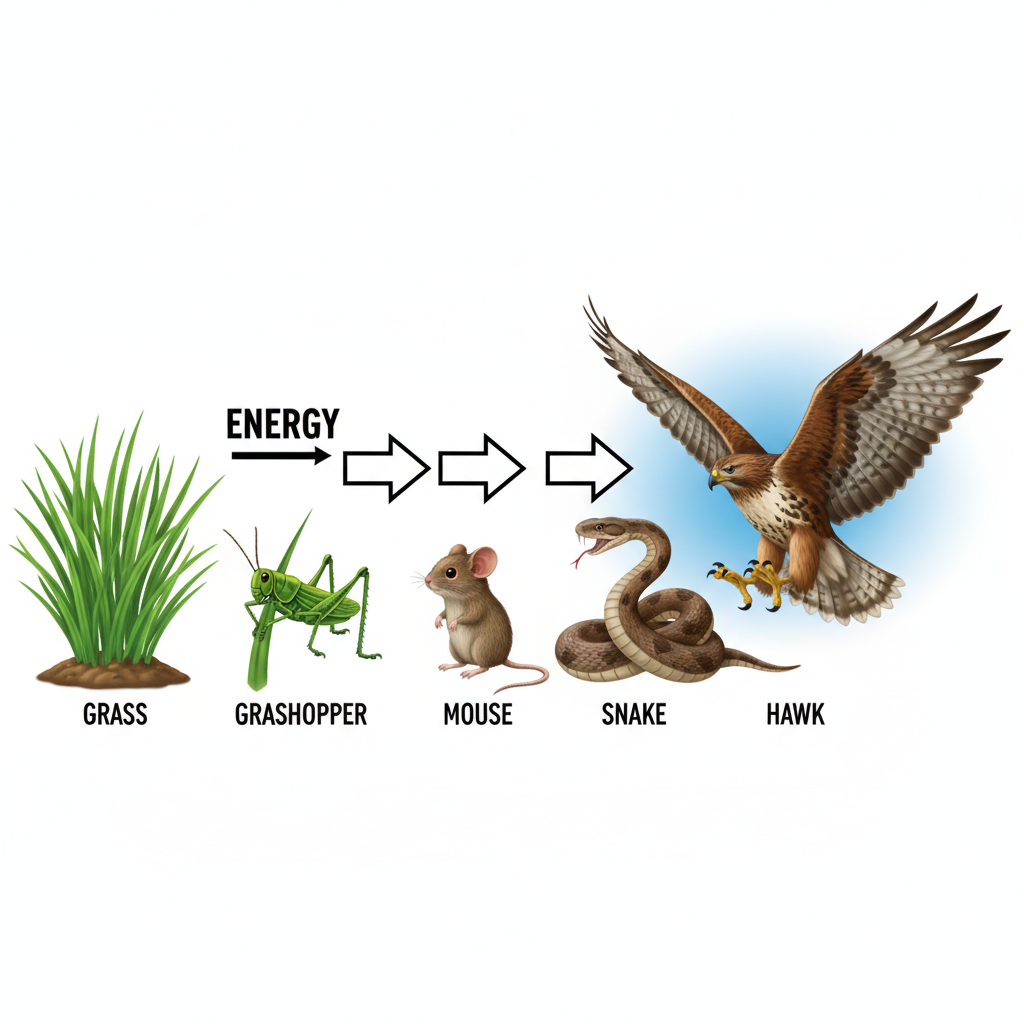 ⚠️ This picture may have spelling mistakes. Trust the words in the lesson.
Why are Food Chains Important?
Food chains help us understand how energy moves through an ecosystem. They show us the relationships between different living things and how they depend on each other. If one part of the food chain is removed or harmed (like if all the grasshoppers disappeared), it can have a big impact on the animals that eat them and the plants they eat. It’s like removing a crucial link from a chain – the whole thing can weaken!
Key Terms to Remember:
- Producer: Organism that makes its own food (usually plants).
- Consumer: Organism that eats other organisms for energy.
- Primary Consumer: Eats producers (herbivore).
- Secondary Consumer: Eats primary consumers (carnivore or omnivore).
- Tertiary Consumer: Eats secondary consumers (carnivore or omnivore).
- Apex Predator: Top predator with no natural enemies.
- Decomposer: Breaks down dead organisms (bacteria, fungi).
- Photosynthesis: Process plants use to make food from sunlight.
- Herbivore: Eats only plants.
- Carnivore: Eats only animals.
- Omnivore: Eats both plants and animals.
Understanding food chains is like learning the secret language of nature, telling us who is connected to whom and how energy keeps everything alive!
Keep learning, free
Create a free Syllabax account to unlock practice questions and games for this topic.
Visual Learning Enhanced! 🚀
To help you master this topic, we use Advanced Syllabax AI to generate detailed diagrams and visual models.
Note on Visuals: The AI sometimes makes spelling errors in image labels. Please refer to the lesson text for the correct terminology.