Collecting Data: Observations
Watch this topic in 60 seconds
Free preview · Lesson 1
Understanding Collecting Data: Observations
Collecting Data: Learning to Be a Super Observer!
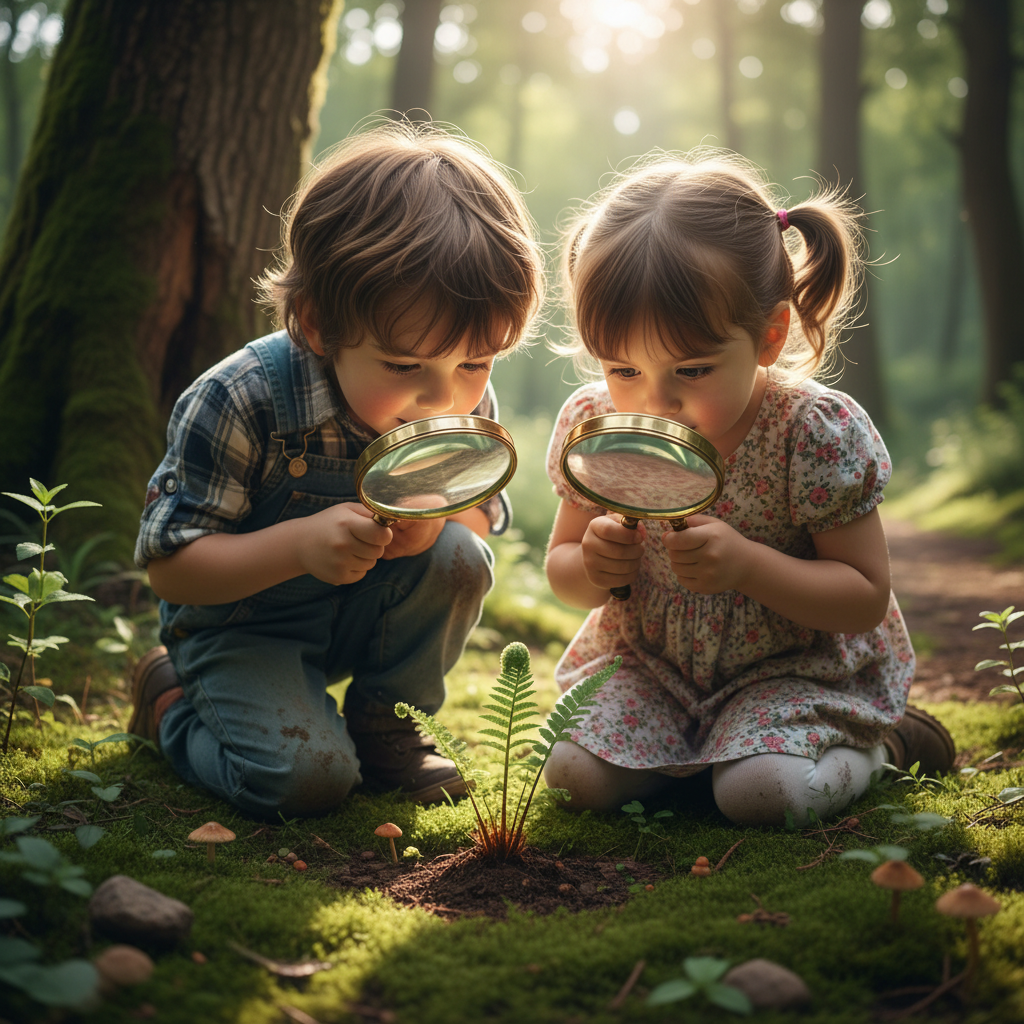
Hey there, future scientists and amazing explorers! Have you ever wondered how we learn about the world around us? It all starts with something super important called observation. Think of yourself as a detective, and the world is your mystery to solve!
What Exactly is an Observation?
An observation is simply using your five senses to gather information about something. It's like your brain collecting clues! When you look, listen, touch, smell, or taste, you are making an observation. It’s how you learn if a cookie is crunchy, if a song is loud, or if a flower smells sweet.
Your Five Super Senses: Your Observation Tools!
You have five amazing tools built right into your body that help you make observations every single day:
- Seeing (Eyes): You use your eyes to notice colors, shapes, sizes, and movements. Analogy: Imagine you're watching a parade! You see the bright red floats, the tall people on stilts, and the way the confetti sparkles. All those details come from your eyes.
- Hearing (Ears): Your ears help you listen to sounds. Are they loud or soft? High or low? Analogy: When you're in the forest, you might hear birds chirping, leaves rustling in the wind, or a distant dog barking. Your ears are like tiny microphones recording all these sounds.
- Touching (Skin): Your skin helps you feel textures, temperatures, and shapes. Is something smooth or rough? Hot or cold? Hard or soft? Analogy: If you close your eyes and someone hands you a piece of sandpaper and then a piece of silk, you can tell the difference just by touching!
- Smelling (Nose): Your nose detects different scents. Does something smell sweet, sour, smoky, or fresh? Analogy: When you walk into a kitchen where cookies are baking, your nose quickly tells you "Yummy!" Or if you smell smoke, your nose warns you there might be a fire.
- Tasting (Tongue): Your tongue helps you identify flavors like sweet, salty, sour, bitter, or umami. Analogy: When you eat an apple, your tongue tells you it's sweet and maybe a little tart. If you eat a potato chip, your tongue says "Salty!"
All these senses work together to help you understand the world. Without them, it would be very hard to learn anything new!
Two Kinds of Observations: Numbers vs. Descriptions
Observations can be sorted into two main types: Quantitative and Qualitative. Don't worry, these fancy words are easier than they sound!
1. Quantitative Observations (Think "Quantity" = Numbers!)
When you make a quantitative observation, you are collecting information that involves numbers or measurements. Think "quantity" – how much, how many, how long, how heavy?
- Examples:
- "The tree is 10 meters tall." (You measured its height.)
- "There are 5 birds in the nest." (You counted them.)
- "The temperature outside is 20 degrees Celsius." (You read a thermometer.)
- "The rock weighs 2 kilograms." (You weighed it.)
Analogy: Imagine you're baking a cake. The recipe says you need "2 cups of flour," "1 cup of sugar," and to bake it for "30 minutes." All those numbers are quantitative observations! They tell you how much of each ingredient and how long to cook it.
 ⚠️ This picture may have spelling mistakes. Trust the words in the lesson.
2. Qualitative Observations (Think "Quality" = Descriptions!)
When you make a qualitative observation, you are collecting information that describes qualities, characteristics, or attributes. These observations usually don't involve numbers; they use words to describe what something is like.
- Examples:
- "The tree has rough bark." (You felt it.)
- "The birds in the nest are chirping loudly." (You heard them.)
- "The sky is a bright blue." (You saw it.)
- "The flower smells sweet and fresh." (You smelled it.)
Analogy: After you bake that cake, you might say, "The cake is moist and fluffy," or "It tastes sweet and has a delicious vanilla flavor." These are qualitative observations because you're describing the cake's qualities, not measuring anything.
Sometimes, you use both! For example, you might say, "The plant has 3 big, green leaves." "3" is quantitative, and "big, green" is qualitative!
Why Are Observations So Important?
Observations are the first step in learning new things. They are crucial for:
- Science: Scientists observe the world to ask questions and do experiments. How do plants grow? How do animals behave? It all starts with looking closely.
- Daily Life: You use observations every day! You observe traffic to cross the street safely, you observe your friend's mood to know if they're happy or sad, and you observe the weather to decide what to wear.
- Problem Solving: If something isn't working, you observe to figure out why. Is the light bulb burnt out? Is the toy broken?
Being a Good Observer: Tips and Tricks!
To be a great observer, you need to:
- Use ALL Your Senses: Don't just look! What can you hear, smell, or feel? (Unless it's dangerous, like touching something hot or tasting something unknown!)
- Be Detailed: Don't just say "The bird is flying." Say "The small, brown bird with a long tail is flying quickly towards the tall oak tree."
- Record Your Observations: Write them down or draw pictures! This helps you remember and organize what you found. A scientist's notebook is full of observations!
- Be Objective: Try to describe what you actually see, hear, feel, taste, or smell, without adding your opinions. Instead of "That's a gross bug," say "The bug has a hard, black shell and six legs."
Observations are like building blocks. The more careful and detailed observations you make, the stronger and more accurate your understanding of the world will be. So, put on your detective hat and start exploring with your amazing senses!
Keep learning, free
Create a free Syllabax account to unlock practice questions and games for this topic.
Visual Learning Enhanced! 🚀
To help you master this topic, we use Advanced Syllabax AI to generate detailed diagrams and visual models.
Note on Visuals: The AI sometimes makes spelling errors in image labels. Please refer to the lesson text for the correct terminology.