Rupees & paise (Money)
Watch this topic in 60 seconds
Free preview · Lesson 1
Understanding Rupees & paise (Money)
Understanding Rupees and Paise: Our Money!
Hello young mathematicians! Today, we're going on an exciting adventure to explore the world of money, specifically Indian Rupees (₹) and paise. Money is something we use every day to buy things we need and want. Think of it like special tokens that let you exchange goods and services!
What are Rupees and Paise?
In India, our main unit of money is the Rupee, which we write with the symbol ₹. You might have seen these coins and notes when you go to the shop with your parents. Paise are smaller units of money. Think of it like this: 100 paise make 1 Rupee. It's like having 100 tiny building blocks that together make one big block!
Imagine a big chocolate bar is 1 Rupee. Then, each tiny piece of that chocolate bar could be like a paisa. You need 100 of those tiny pieces to make the whole big chocolate bar!
So, when you see ₹1.50, it means 1 whole Rupee and 50 paise. The dot (.) separates the Rupees from the paise. It's like a mini-wall saying, 'Here are the big parts (Rupees), and here are the small parts (paise)!'
Coins: The Little Helpers
We have different coins with different values. Let's meet them!
- 1 paisa, 2 paise, 5 paise, 10 paise, 20 paise, 25 paise, 50 paise: These are the smaller coins. You might not see the very small ones often anymore, but they used to be very common! Think of them as small marbles.
- 1 Rupee coin: This is a common coin, often silver or golden. It's like a medium-sized marble.
- 2 Rupees coin, 5 Rupees coin, 10 Rupees coin: These are bigger coins with more value. They are like bigger, heavier marbles.
Coins are great for small amounts. If you want to buy a small candy that costs 50 paise, you might use a 50 paise coin or maybe two 25 paise coins.
Analogy: Think of coins like Lego bricks. A 50 paise coin is a small Lego brick, and a 1 Rupee coin is a bigger Lego brick. You can combine small bricks to make a bigger one (like 2 x 50 paise coins = 1 Rupee coin).
Notes: The Bigger Bundles
For larger amounts, we use banknotes, also called notes. These are made of paper or special plastic and have higher values.
- ₹5 note, ₹10 note, ₹20 note, ₹50 note, ₹100 note, ₹200 note, ₹500 note, ₹2000 note: These are the different notes. Each note is worth more than any single coin (except for very old, rare coins!).
Notes are like bigger bundles of our building blocks. A ₹10 note is like having 10 separate ₹1 coins put together!
Analogy: Imagine you are collecting stickers. A coin is like a single sticker. A note is like a sheet of stickers. A ₹10 note is like a sheet that has 10 stickers on it.
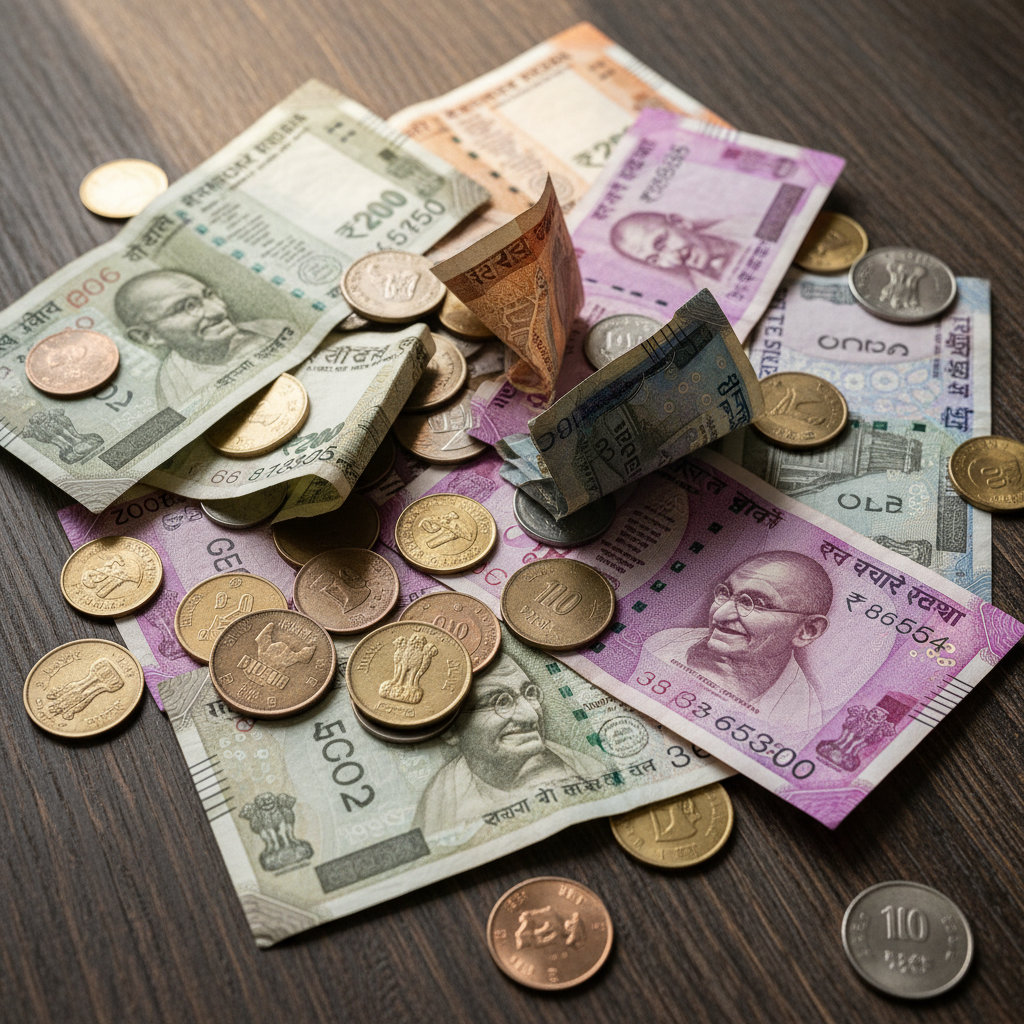 ⚠️ This picture may have spelling mistakes. Trust the words in the lesson.
Adding and Subtracting Money: Basic Shopping!
When we buy things, we use money. Sometimes we add money, and sometimes we subtract it.
Adding Money: Getting More!
If you have a ₹5 coin and someone gives you a ₹10 note, how much money do you have in total? You add them!
₹5 + ₹10 = ₹15
It's like putting your marbles together. If you have 5 blue marbles and someone gives you 10 red marbles, you count them all up to see how many marbles you have altogether.
Subtracting Money: Spending and Changing!
When you buy something, you give money, and usually, you get some money back if you paid too much. This is subtraction!
Let's say you want to buy a toy car that costs ₹8. You give the shopkeeper a ₹10 note. How much change will you get back?
₹10 - ₹8 = ₹2
You get ₹2 back. This is like taking away some of your marbles. If you had 10 marbles and gave away 8, you'd have 2 left.
What about paise? If something costs ₹1.25 (1 Rupee and 25 paise) and you pay with a ₹2 note, you'd get ₹0.75 back (75 paise). This is ₹2.00 - ₹1.25 = ₹0.75.
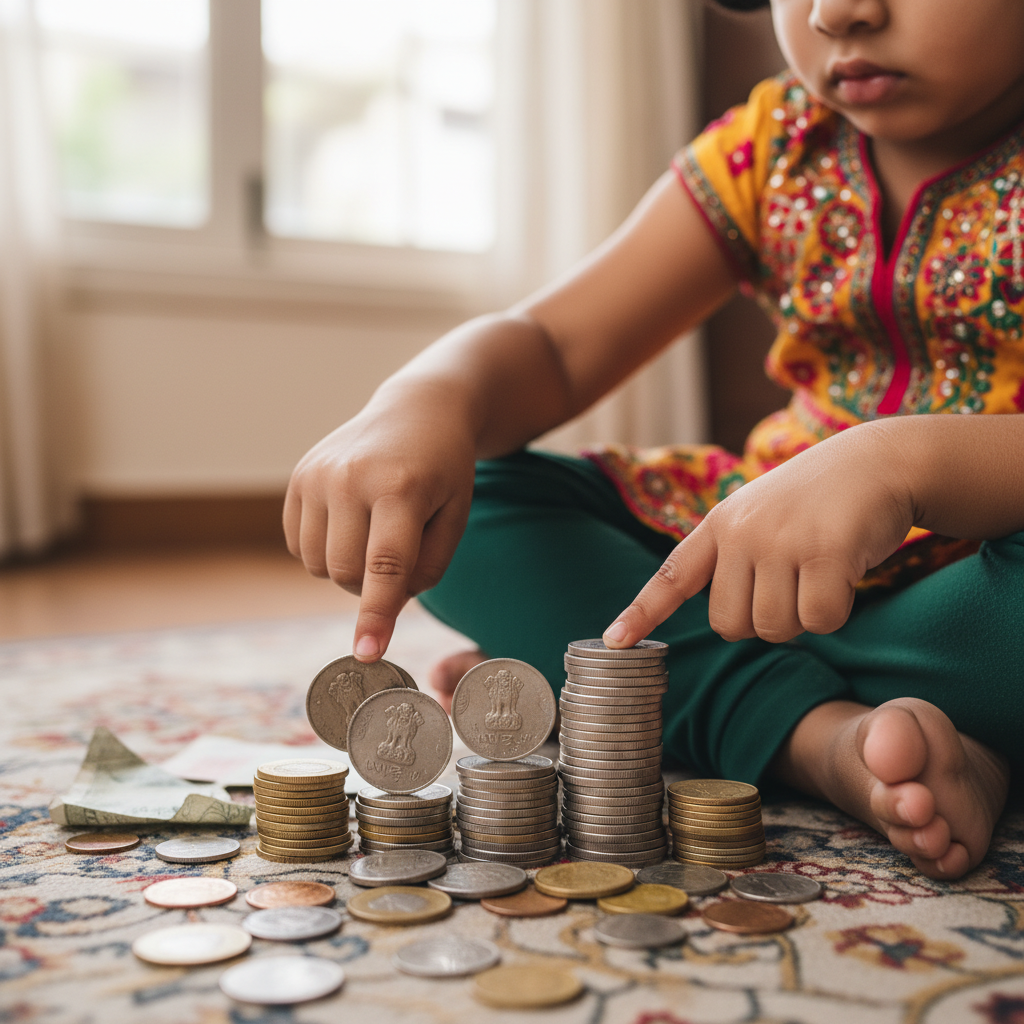 ⚠️ This picture may have spelling mistakes. Trust the words in the lesson.
Understanding Value
It's important to know which coin or note is worth more. A ₹10 note is worth much more than a ₹1 coin. Similarly, a ₹500 note is worth a lot more than a ₹20 note.
Analogy: Think of energy points in a game. A ₹1 coin is like 1 energy point. A ₹10 note is like 10 energy points. A ₹100 note is like 100 energy points! You can do more things with more energy points.
Knowing the value helps us make smart choices when we buy things. We want to make sure we have enough money and that we get the correct change!
Key Concepts Recap:
- Rupee (₹): The main unit of Indian money.
- Paisa: The smaller unit of money. 100 paise = 1 Rupee.
- Coins: Used for smaller amounts (e.g., ₹1, ₹2, ₹5).
- Notes: Used for larger amounts (e.g., ₹10, ₹50, ₹100).
- Adding: Combining money values.
- Subtracting: Taking away money values (like spending or getting change).
Money is a tool that helps us trade and get the things we need. Understanding Rupees and paise is the first step to becoming a smart shopper!
Keep learning, free
Create a free Syllabax account to unlock practice questions and games for this topic.
Visual Learning Enhanced! 🚀
To help you master this topic, we use Advanced Syllabax AI to generate detailed diagrams and visual models.
Note on Visuals: The AI sometimes makes spelling errors in image labels. Please refer to the lesson text for the correct terminology.