Learning Journey
Free preview · Lesson 1
Understanding Calendar problems [Time]
Mastering Calendar Problems: A 5th Grader's Guide to Time!
Hey there, Super Time Travelers! Have you ever looked at a calendar and wondered how it all fits together? It's like a giant puzzle, but instead of pieces, we have days, weeks, months, and years! Today, we're going to become calendar detectives and solve some fun puzzles using our knowledge of time. Think of a calendar as a special clock that tells us not just the hour, but the entire day, week, month, and even the whole year!
What is a Calendar? The Big Picture!
Imagine your week is a train. Each day is a carriage on that train. A calendar is like the whole railway map, showing you where all the carriages (days) are, and how they connect to form bigger journeys (weeks and months).
A day is the shortest journey on our time train – it's the time it takes for the Earth to spin around once. It has 24 hours. A week is a collection of 7 days, like a short trip on our train. We usually name these days: Sunday, Monday, Tuesday, Wednesday, Thursday, Friday, and Saturday.
A month is a longer journey, made up of about 4 weeks. Some months are like longer train carriages, with 31 days (like January or March), while others are a bit shorter, with 30 days (like April or June). And then there's February, which is like a special, shorter carriage that sometimes gets an extra day – that's a leap year! A leap year happens every 4 years, and February gets 29 days instead of 28. This helps keep our calendar in sync with the Earth's journey around the sun.
Finally, a year is the longest journey on our time train – it's the time it takes for the Earth to go all the way around the sun. A normal year has 365 days, and a leap year has 366 days.
 ⚠️ This picture may have spelling mistakes. Trust the words in the lesson.
Calendar Clues: Days, Weeks, and Months
Let's break down the clues we find on a calendar:
- Days of the Week: There are always 7 days in a week. If today is Monday, then tomorrow is Tuesday, and yesterday was Sunday. Simple, right?
- Weeks in a Month: Most months have 4 full weeks and a few extra days. For example, if a month starts on a Monday and has 30 days, it will have 4 full weeks (28 days) and then 2 extra days (the 29th and 30th).
- Number of Days in a Month: This is where it gets a little tricky, like remembering different train schedules! You need to know which months have 31 days and which have 30. Here's a handy rhyme to help you remember (try the knuckle trick!):
The Knuckle Rhyme:
“Thirty days hath September,
April, June, and November.
All the rest have thirty-one,
Excepting February alone,
Which hath twenty-eight days clear,
And twenty-nine in each leap year.”
You can also use your knuckles! Make a fist. The first knuckle is January (31 days). The dip between knuckles is February (28/29 days). The next knuckle is March (31 days). Keep going, alternating between knuckles (31 days) and dips (30 days, except for February). When you get to the end of one hand, start on the first knuckle of the other hand.
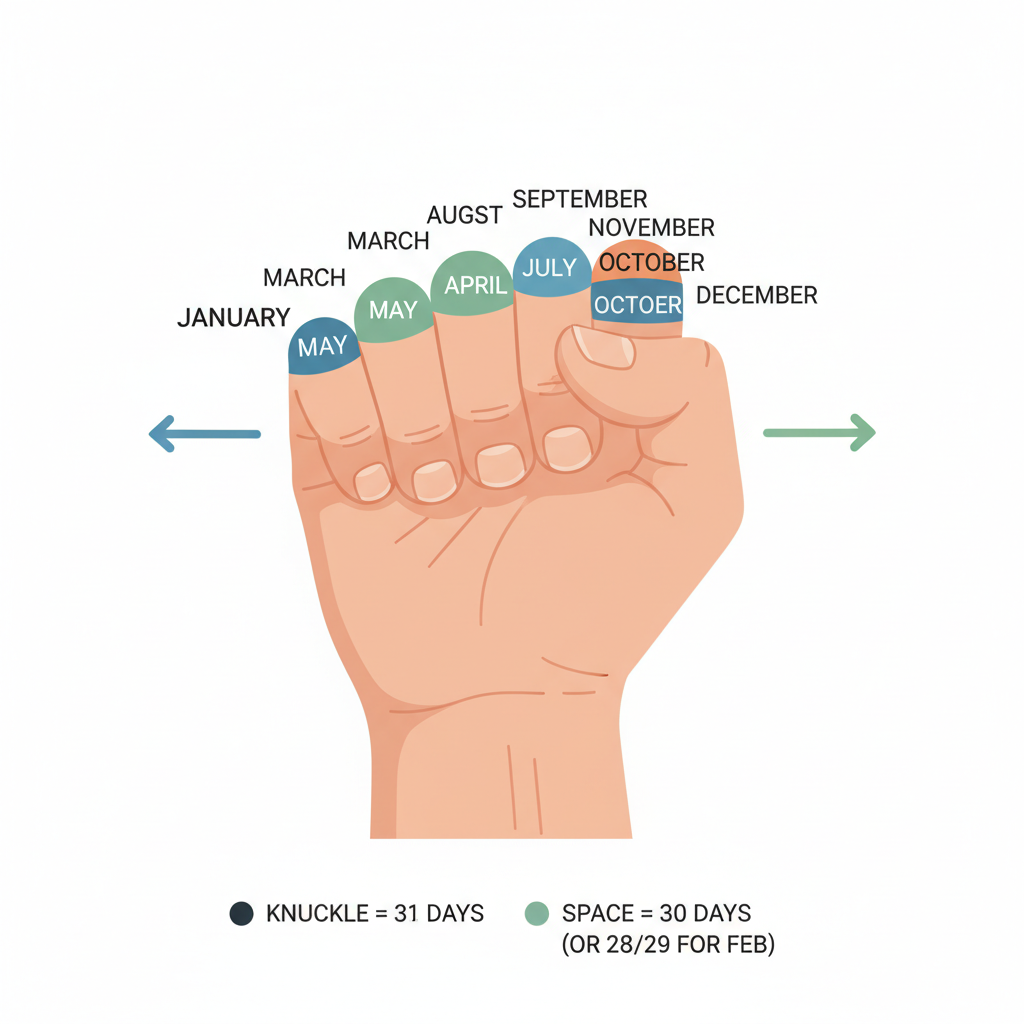 ⚠️ This picture may have spelling mistakes. Trust the words in the lesson.
Solving Calendar Puzzles: Putting It All Together!
Now, let's put on our detective hats and solve some problems!
Puzzle 1: Finding a Future Date
Problem: If today is Tuesday, March 15th, what day of the week will it be in exactly one week?
Solution: This is like asking what the next carriage on our train is. If today is Tuesday, exactly one week later will be the *same* day of the week! So, in one week, it will be Tuesday again.
Puzzle 2: Counting Days
Problem: How many days are there from March 1st to March 10th, inclusive?
Solution: Think of counting the carriages one by one. You count March 1st, March 2nd, ... all the way to March 10th. That's 10 days. A simple way to remember is: if you are counting from day A to day B (inclusive), the number of days is B - A + 1. So, 10 - 1 + 1 = 10 days.
Puzzle 3: Days Between Dates
Problem: How many days are there *between* March 1st and March 10th? (This means we don't count March 1st or March 10th).
Solution: This is like asking how many stops are between the first station and the tenth station, not counting the first or the last. The days between are March 2nd, 3rd, 4th, 5th, 6th, 7th, 8th, and 9th. That's 8 days. The formula is B - A - 1. So, 10 - 1 - 1 = 8 days.
Puzzle 4: Day of the Week After Many Days
Problem: If today is Wednesday, what day of the week will it be in 10 days?
Solution: This is like skipping carriages on our train. There are 7 days in a week. After 7 days, it will be Wednesday again. So, 10 days is one full week (7 days) plus 3 extra days (10 - 7 = 3). We just need to count 3 days forward from Wednesday: Thursday (1 day), Friday (2 days), Saturday (3 days). So, it will be a Saturday!
Puzzle 5: Days in a Month Challenge
Problem: How many days are there from April 20th to May 15th?
Solution: This puzzle involves two months! We need to figure out how many days are left in April and then add the days in May.
- First, how many days are in April? Using our rhyme or knuckle trick, April has 30 days.
- How many days are left in April starting from April 20th? We count April 20th, 21st, ..., 30th. That's 30 - 20 + 1 = 11 days left in April.
- Now, we need to count the days in May up to May 15th. That's 15 days.
- Total days = (Days left in April) + (Days in May) = 11 + 15 = 26 days.
So, from April 20th to May 15th, there are 26 days.
Keep Practicing!
Calendars are everywhere! Once you understand these basic ideas, you'll be able to figure out schedules, plan parties, and understand historical events. Keep looking at calendars, counting days, and solving these fun time puzzles!
Keep learning, free
Create a free Syllabax account to unlock practice questions and games for this topic.
Visual Learning Enhanced! 🚀
To help you master this topic, we use Advanced Syllabax AI to generate detailed diagrams and visual models.
Note on Visuals: The AI sometimes makes spelling errors in image labels. Please refer to the lesson text for the correct terminology.