Comparing simple decimals [Decimals (Intro)]
Watch this topic in 60 seconds
Free preview · Lesson 1
Understanding Comparing simple decimals [Decimals (Intro)]
Understanding and Comparing Simple Decimals
Welcome, young mathematicians! Today, we're going on an exciting adventure into the world of decimals. Decimals might look a little strange at first with that tiny dot, but they are actually super useful and help us talk about parts of a whole number, just like fractions do. Think of them as another way to slice a pizza or share a candy bar!
What is a Decimal?
Imagine you have one whole chocolate bar. That's like the number 1.
Now, imagine you break that chocolate bar into 10 equal pieces. Each of those pieces is a part of the whole. A decimal is a way to write these parts using a dot called a decimal point.
The number 1.0 means exactly one whole chocolate bar. But if we have 1.5, it means we have one whole chocolate bar AND half (or 5 out of 10 pieces) of another chocolate bar. That's like having one whole bar and 5 little squares from a second bar.
The Magic of the Decimal Point
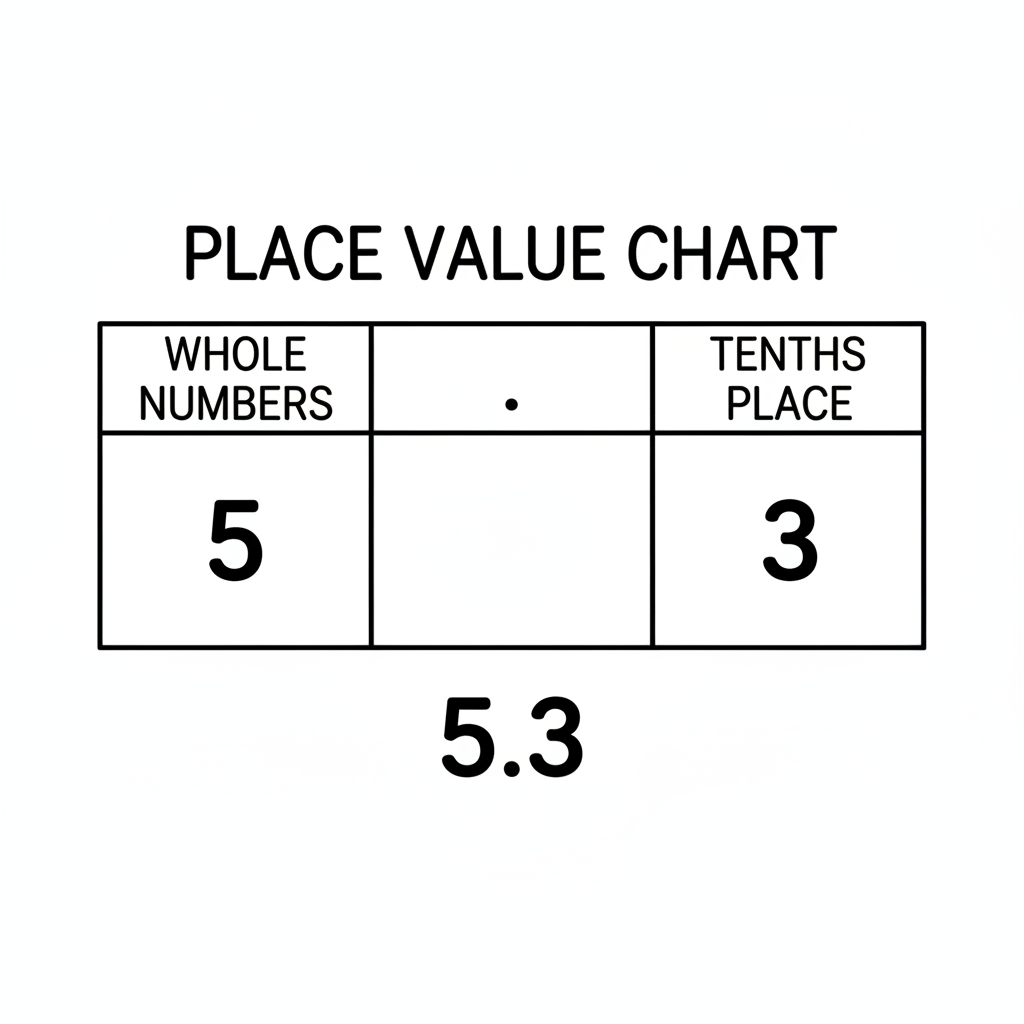
The decimal point is like a tiny separator. Everything to the left of the decimal point is a whole number (like the 1 in 1.5). Everything to the right of the decimal point is a part of a whole.
Let's look at numbers after the decimal point:
- The first digit after the decimal point is the tenths place. It represents parts out of 10. So, 0.5 means 5 out of 10 equal parts. This is the same as 1/2.
- The second digit after the decimal point is the hundredths place. It represents parts out of 100. So, 0.25 means 25 out of 100 equal parts. This is like getting 25 sprinkles on a cookie that has 100 spots for sprinkles.
For now, we will focus on the tenths place. Think of it like this:
Analogy: Sharing Cookies
You have a plate with 10 cookies. That's a whole plate!
If you eat 3 of those cookies, you have 7 cookies left. We can write this using decimals:
- The whole plate is 1.0.
- If you ate 3 out of 10 cookies, that's 0.3 of the plate eaten.
- You have 0.7 of the plate remaining.
Notice how 0.3 + 0.7 = 1.0. The parts add up to the whole!
Comparing Simple Decimals
Comparing decimals is like comparing lengths of candy canes or amounts of juice in cups. We want to know which one is bigger (has more) or smaller (has less).
When comparing two decimals, we follow these steps:
Step 1: Compare the Whole Numbers
First, always look at the numbers before the decimal point. The decimal with the larger whole number is the larger decimal.
Example: Compare 3.5 and 2.8.
- The whole number in 3.5 is 3.
- The whole number in 2.8 is 2.
- Since 3 is bigger than 2, 3.5 is bigger than 2.8.
Think of it like having two piles of building blocks. One pile has 3 full towers, and the other has 2 full towers. The pile with 3 towers is clearly bigger!
Step 2: Compare the Tenths Place (if whole numbers are the same)
What if the whole numbers are the same? Like comparing 4.6 and 4.2?
In this case, we move to the right of the decimal point and compare the digits in the tenths place.
Example: Compare 4.6 and 4.2.
- The whole numbers are both 4. They are the same!
- Now, look at the tenths place: 6 in 4.6 and 2 in 4.2.
- Since 6 is bigger than 2, 4.6 is bigger than 4.2.
This is like having two identical gift boxes, each with a whole toy inside. Now you look at the ribbon tied around each box. One ribbon is longer (6 inches) and the other is shorter (2 inches). The box with the longer ribbon is like the bigger decimal.
Let's try another one: Compare 7.1 and 7.9.
- Whole numbers are both 7 (the same).
- Tenths digits are 1 and 9.
- Since 9 is bigger than 1, 7.9 is bigger than 7.1.
Step 3: Comparing with Zeros
Sometimes you might see a decimal like 5.0. This is the same as the whole number 5. Adding a zero after the decimal point doesn't change the value if there are no other digits.
Analogy: Empty Juice Boxes
Imagine you have 5 full juice boxes. That's 5.0.
If you have another box that is completely empty, we can write that as 0.0.
Now, let's compare 5.0 and 5.3.
- Whole numbers are both 5 (same).
- Tenths digits are 0 (in 5.0) and 3 (in 5.3).
- Since 3 is bigger than 0, 5.3 is bigger than 5.0.
This means 5 full juice boxes and 3 tenths of another box is more than just 5 full juice boxes.
Let's Visualize!
Imagine two number lines. Each number line goes from 0 to 10.
Number Line 1:
0 --- 1 --- 2 --- 3 --- 4 --- 5 --- 6 --- 7 --- 8 --- 9 --- 10
Number Line 2 (showing tenths):
Imagine zooming in between the numbers on Number Line 1. Between 0 and 1, there are 10 equal sections. Each section is 0.1.
0.0 - 0.1 - 0.2 - 0.3 - 0.4 - 0.5 - 0.6 - 0.7 - 0.8 - 0.9 - 1.0
If we are comparing 3.4 and 3.7:
- Both numbers are between 3 and 4 on the number line.
- 3.4 is at the 4th mark after 3.
- 3.7 is at the 7th mark after 3.
- The 7th mark is further along the number line than the 4th mark, so 3.7 is bigger.
Here's an image to help you see it:
Comparing decimals is like finding the highest score in a game or the tallest person in a group. You look at the main score first (the whole number), and if there's a tie, you look at the tie-breaker (the tenths place).
More Examples:
Compare 0.8 and 0.5:
- Whole numbers are both 0.
- Tenths digits are 8 and 5.
- 8 is bigger than 5, so 0.8 is bigger than 0.5. (Imagine 8 out of 10 crayons vs. 5 out of 10 crayons).
Compare 1.2 and 2.1:
- Whole number in 1.2 is 1.
- Whole number in 2.1 is 2.
- 2 is bigger than 1, so 2.1 is bigger than 1.2. (Having 2 whole apples is more than having 1 whole apple and a little bit).
Putting it all together:
When you see two decimals, remember to:
- Look at the numbers before the decimal point (the whole numbers). The bigger whole number wins!
- If the whole numbers are the same, look at the first number after the decimal point (the tenths place). The bigger digit in the tenths place wins!
Decimals are just another way to talk about parts of things, and comparing them helps us understand which part is bigger or smaller. Keep practicing, and you'll become a decimal expert in no time!
Here is a visual aid to help you remember the places:
Keep learning, free
Create a free Syllabax account to unlock practice questions and games for this topic.
Visual Learning Enhanced! 🚀
To help you master this topic, we use Advanced Syllabax AI to generate detailed diagrams and visual models.
Note on Visuals: The AI sometimes makes spelling errors in image labels. Please refer to the lesson text for the correct terminology.