Animal tissues: epithelial, connective, muscular, nervous[BIOLOGY]
Watch this topic in 60 seconds
Free preview · Lesson 1
Understanding Animal tissues: epithelial, connective, muscular, nervous[BIOLOGY]
Exploring the Building Blocks of Animals: A Journey Through Tissues (Grade 9 Biology)
Imagine your body, or any animal's body, as a magnificent, bustling city. Just like a city is made of different types of buildings—houses, offices, roads, power stations—each with a specific job, an animal's body is made of different types of tissues. Tissues are groups of similar cells that work together to perform a specific function. They are the next level of organization after cells, and before organs. Think of them as specialized teams of cells, each with a unique role to keep the entire body running smoothly.
In this lesson, we're going to explore the four main types of animal tissues: epithelial, connective, muscular, and nervous. Each one has a critical job, and together, they make up all the organs and systems in an animal. Let's dive in!
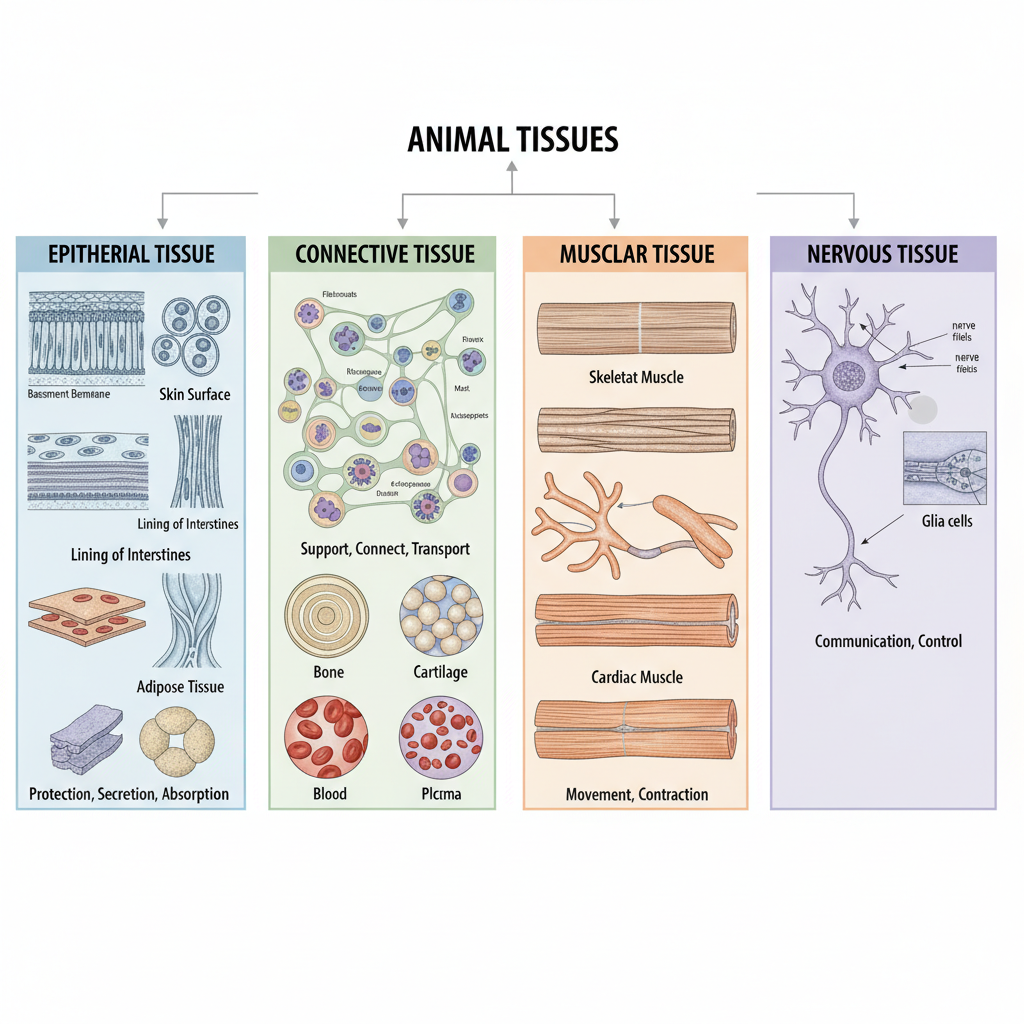 ⚠️ This picture may have spelling mistakes. Trust the words in the lesson.
1. Epithelial Tissue: The Body's Protective Cover and Lining
Think of epithelial tissue as the body's 'wallpaper' and 'skin'. It's everywhere! It forms the outer layer of your skin, lines your digestive tract from mouth to anus, covers all your internal organs, and lines the inside of your blood vessels and body cavities. Its main jobs are protection, secretion (making and releasing substances), and absorption (taking in substances).
Key Characteristics:
- Tight Packing: Epithelial cells are packed very closely together, like bricks in a wall, leaving very little space between them. This tight packing makes them excellent barriers.
- Forms Sheets: They usually arrange themselves in continuous sheets, either single-layered or multi-layered.
- Avascular: Unlike many other tissues, epithelial tissue doesn't have its own blood supply. It gets nutrients from the underlying connective tissue.
Analogies to Help You Understand:
- Skin as a Wrapper: Your skin is a type of epithelial tissue. It's like the protective wrapper around a gift, shielding the contents (your body) from the outside world.
- Organ Linings as Wallpaper: The lining of your stomach or intestines is also epithelial tissue. It's like the wallpaper inside a house, covering the walls and often having special functions like absorbing nutrients (like a sponge) or secreting digestive juices.
- Glands as Factories: Glands (like sweat glands or salivary glands) are made of epithelial tissue. They are like small factories, taking in raw materials and producing specific products (sweat, saliva, hormones).
Types of Epithelial Cells (Based on Shape):
- Squamous: These cells are flat and thin, like tiny pancakes or floor tiles. They are good for quick diffusion (passing through) of substances, like in the air sacs of your lungs.
- Cuboidal: These cells are cube-shaped, like dice. They are often involved in secretion and absorption, found in glands and kidney tubules.
- Columnar: These cells are tall and column-shaped, like pillars. They often have cilia (tiny hair-like structures) or microvilli (tiny finger-like projections) on their surface to aid in absorption (in the intestines) or movement (in the respiratory tract).
2. Connective Tissue: The Body's Support System and 'Glue'
Connective tissue is exactly what its name suggests: it connects, supports, binds, and separates other tissues or organs. It's the most diverse and abundant tissue type in the body, found almost everywhere! Think of it as the 'scaffolding' and 'packaging material' that holds your body together and fills in the spaces.
Key Characteristics:
- Cells are Scattered: Unlike epithelial tissue, connective tissue cells are usually spread out, not tightly packed.
- Abundant Extracellular Matrix: This is the defining feature! Connective tissue cells are suspended in a non-living material called the extracellular matrix. This matrix is made of a ground substance (liquid, gel-like, or solid) and protein fibers (like collagen for strength, elastic for stretch). The type and amount of matrix determine the tissue's function.
- Vascular: Most connective tissues have a rich blood supply, unlike epithelial tissue.
Analogies to Help You Understand:
- Glue and Packaging: Connective tissue is like the glue that holds different parts of a model together, and the packaging peanuts or bubble wrap that fills the empty spaces in a box.
- Scaffolding: Bones and cartilage, types of connective tissue, act like the rigid scaffolding of a building, providing support and shape.
- River for Transport: Blood is a specialized connective tissue. It's like a river flowing through your body, transporting nutrients, oxygen, waste, and immune cells.
Examples of Connective Tissue:
- Loose (Areolar) Connective Tissue: This is like the 'packing material' that fills spaces between organs, wraps around blood vessels and nerves. It has a loose arrangement of fibers.
- Dense (Fibrous) Connective Tissue: Strong and rope-like, forming tendons (connect muscle to bone) and ligaments (connect bone to bone). Think of strong cables holding structures together.
- Cartilage: Flexible but firm, found in your nose, ears, and between bones in joints. It's like the gristle in meat or the flexible plastic in some toys.
- Bone Tissue: Hardest connective tissue, forming your skeleton. It's like the steel beams in a skyscraper, providing rigid support and protection.
- Blood: Liquid matrix (plasma) with cells (red blood cells, white blood cells, platelets). As mentioned, it's the body's transport system.
- Adipose Tissue (Fat): Primarily made of fat cells, stores energy, insulates the body, and cushions organs. Think of it as bubble wrap for internal organs and a fuel tank for energy.
3. Muscular Tissue: The Body's Engine for Movement
Muscular tissue is specialized for one main thing: contraction. This contraction generates force and causes movement. Every move you make, from blinking your eyes to running a marathon, is thanks to your muscular tissue. Even internal movements, like your heart beating or food moving through your digestive system, are powered by muscles.
Key Characteristics:
- Contractile Cells: Muscle cells (also called muscle fibers) are elongated and contain special proteins (actin and myosin) that slide past each other, causing the cell to shorten or contract.
- Excitable: They can respond to electrical signals (from nervous tissue).
Analogies to Help You Understand:
- Engines and Levers: Muscle tissue acts like the engines of your body, pulling on bones (levers) to create movement.
- Rubber Bands: Imagine a rubber band that can pull tight and then relax. Muscle cells do something similar, shortening to create force.
Types of Muscular Tissue:
- Skeletal Muscle:
- Location: Attached to bones.
- Control: Voluntary (you consciously control it). Think about lifting your arm or smiling.
- Appearance: Striated (has stripes under a microscope).
- Analogy: These are like the muscles you use to play sports or pick up a book.
- Smooth Muscle:
- Location: Found in the walls of internal organs like the stomach, intestines, blood vessels, and bladder.
- Control: Involuntary (you don't consciously control it). It works automatically.
- Appearance: Non-striated (no stripes).
- Analogy: This is like the automatic conveyor belt that moves food through your digestive system or the automatic pump that adjusts blood vessel size.
- Cardiac Muscle:
- Location: ONLY found in the wall of the heart.
- Control: Involuntary.
- Appearance: Striated, but cells are branched and interconnected.
- Analogy: This is your heart, the tireless pump that works non-stop your entire life, without you ever having to tell it what to do.
4. Nervous Tissue: The Body's Communication Network
Nervous tissue is the master controller and communicator of your body. It allows you to think, feel, react, and coordinates all the different activities happening inside you. It's like the body's super-fast electrical wiring system or its complex internet network.
Key Characteristics:
- Excitable: Nervous tissue cells can generate and transmit electrical signals (nerve impulses).
- Two main cell types:
- Neurons: The main functional cells, responsible for sending and receiving signals.
- Neuroglia (Glial Cells): Support cells that protect, nourish, and insulate neurons. They are like the support staff for the superstar neurons.
Analogies to Help You Understand:
- Electrical Wires: Neurons are like the electrical wires that carry messages (nerve impulses) rapidly from one part of the body to another.
- Telephone Network: The nervous system is like a vast telephone network, with neurons as individual phones, making calls and sending texts (signals) to each other.
- Control Center: The brain and spinal cord (made of nervous tissue) are the body's central control center, processing information and sending out commands.
Parts of a Neuron (The Nerve Cell):
- Cell Body (Soma): The main part of the neuron, containing the nucleus. It's like the central processing unit.
- Dendrites: Tree-like branches extending from the cell body. They receive incoming signals from other neurons, like an antenna.
- Axon: A long, slender extension that carries signals away from the cell body to other neurons, muscles, or glands. It's like the transmission cable.
Putting It All Together
These four types of tissues don't work in isolation. They cooperate beautifully to form organs and organ systems. For example, your stomach has epithelial tissue for lining and secretion, connective tissue to hold it together, smooth muscle tissue for churning food, and nervous tissue to control its activity. This teamwork is what makes complex life possible!
Keep learning, free
Create a free Syllabax account to unlock practice questions and games for this topic.
Visual Learning Enhanced! 🚀
To help you master this topic, we use Advanced Syllabax AI to generate detailed diagrams and visual models.
Note on Visuals: The AI sometimes makes spelling errors in image labels. Please refer to the lesson text for the correct terminology.