Simple machines (intro): lever, pulley, wheel ( Force & Motion)
Watch this topic in 60 seconds
Free preview · Lesson 1
Understanding Simple machines (intro): lever, pulley, wheel ( Force & Motion)
Exploring Simple Machines: Making Work Easier!
Hello, young scientists! Have you ever wondered how people lift really heavy things, open stubborn jars, or even ride a bicycle without using super strength? The secret isn't magic; it's something called simple machines! These amazing tools help us do work much more easily. Think of them as your helpful sidekicks that give your muscles a boost!
Before we dive into our awesome machines, let's quickly remember two important words: Force and Motion.
- Force: Imagine pushing a toy car or pulling a wagon. That push or pull is a force! A force is what makes something start moving, stop moving, or change direction. It's the effort you put in.
- Motion: When something moves from one place to another, that's motion. If your toy car rolls across the floor, it's in motion.
Simple machines help us use force in clever ways to create motion or overcome a bigger force. They don't make the work disappear, but they make it feel much easier or let us do things we couldn't do alone!
1. The Lever: The Mighty Lifter!
Imagine you want to lift a very heavy rock. You try to push it with your hands, but it won't budge! What if you found a long, strong stick and placed it under the rock, then put a smaller rock (or a block) under the stick near the big rock? Now, when you push down on the other end of the stick, the big rock might just lift! Congratulations, you've just used a lever!
A lever is a simple machine made of a rigid bar (like our stick) that pivots, or turns, around a fixed point. This fixed point is called the fulcrum.
Every lever has three main parts:
- Fulcrum: This is the pivot point, like the small rock under your stick, or the middle of a seesaw.
- Effort: This is where you apply your force – where you push or pull. On our stick, it's where you push down.
- Load: This is the object you want to move or lift – the heavy rock or your friend on the seesaw.
How it works: Levers help us by changing the direction of the force or by making a smaller force able to move a much larger load. It's like magic, but it's just smart physics!
Analogy Time!
- Think of a seesaw! The middle part where it balances is the fulcrum. You and your friend are the loads, and when you push off the ground, that's your effort to make it move.
- Trying to open a paint can? A paint can opener is a lever! The rim of the can acts as the fulcrum, you push down on the handle (effort), and the lid pops up (load).
- A crowbar used to pull out a nail is also a lever. The part of the crowbar touching the wood is the fulcrum, your hand pulling the handle is the effort, and the nail is the load.

2. The Pulley: The High-Rise Helper!
Have you ever seen someone hoisting a flag up a flagpole, or a construction worker lifting heavy bricks high into the air? They're probably using a pulley!
A pulley is a wheel with a groove around its edge, and a rope or cable usually runs around this groove. It's like a special roller for ropes!
How it works: Pulleys are super helpful for lifting things. They can either change the direction of the force you apply (making it easier to pull down instead of lifting up), or they can help you lift very heavy objects with less force, by distributing the load across multiple ropes and wheels.
Analogy Time!
- Imagine you're trying to lift a heavy bucket of water from a well. If you just pull the rope straight up, it's hard work! But if the rope goes over a pulley at the top of the well, you can pull down on the rope, using your body weight to help you, and the bucket comes up. The pulley changes the direction of your effort, making it easier.
- Think about window blinds. When you pull the cord down, the blinds go up! That's a pulley at work.
- A flagpole uses a pulley at the very top. You pull the rope down, and the flag goes up!
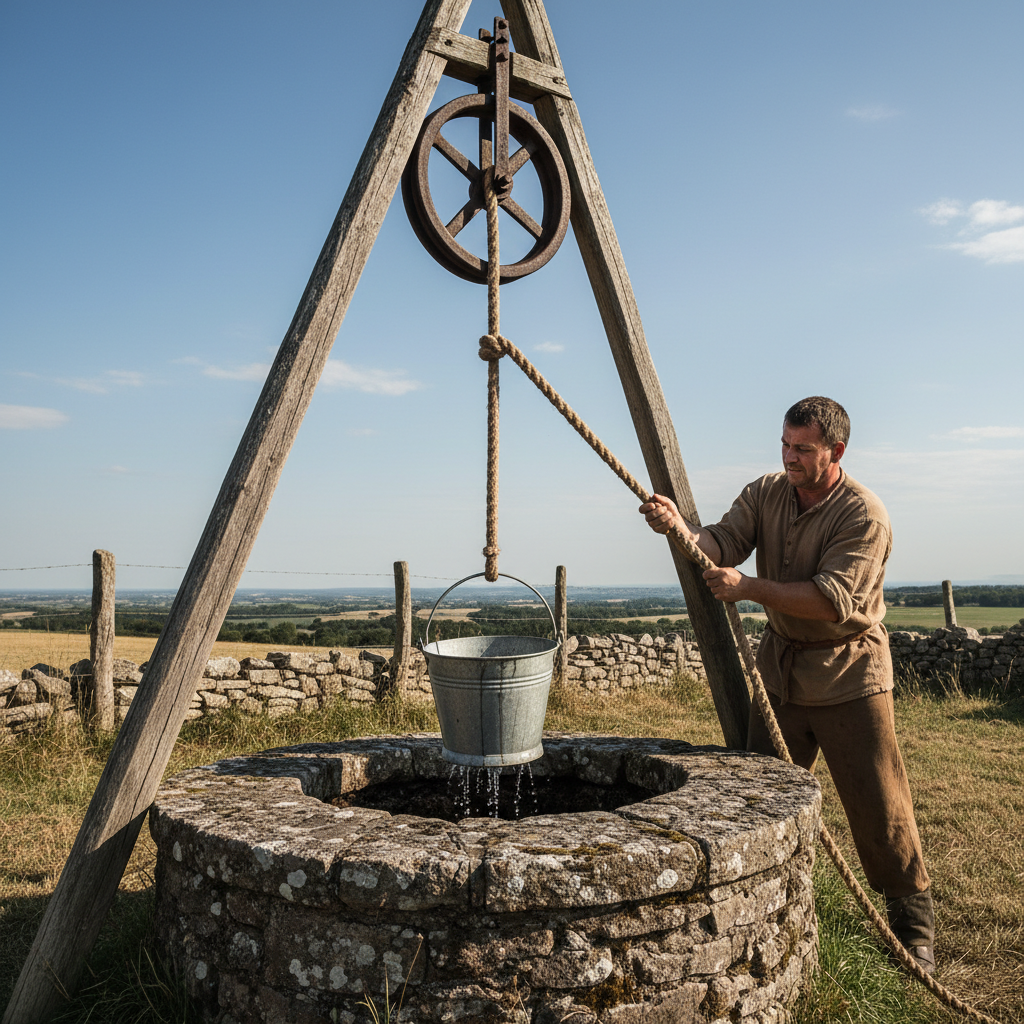 ⚠️ This picture may have spelling mistakes. Trust the words in the lesson.
3. The Wheel and Axle: The Smooth Mover!
How do cars move? How does a bicycle roll? How do you open a door? The answer often involves the wonderful wheel and axle!
This simple machine is made of two parts: a larger circular object (the wheel) connected to a smaller rod that runs through its center (the axle). They are usually fixed together so they turn at the same time.
How it works: The wheel and axle are fantastic for moving things. They help us by reducing friction and multiplying force. When you turn the wheel, the axle also turns, helping to move the object it's attached to. It makes moving heavy objects much easier than dragging them!
Analogy Time!
- Think of a doorknob. The round part you grab is the wheel, and the shaft that goes into the door is the axle. When you turn the doorknob (the wheel), it turns the axle inside the door, opening or closing the latch.
- A steering wheel in a car is a giant wheel and axle. Turning the big steering wheel makes the smaller axle inside turn, which helps steer the car's much larger wheels.
- Your bicycle wheels are perfect examples! The big rubber tire is the wheel, and the rod going through the middle of the hub is the axle. They make it easy to roll along without dragging your feet!
- A screwdriver is also a wheel and axle. The handle is the 'wheel' you turn, and the metal shaft is the 'axle' that turns the screw.
Simple Machines Everywhere!
Isn't it amazing how these simple ideas make so much of our daily lives easier? From playing on a seesaw to riding a bike, or even just opening a door, simple machines are helping us save effort and get things done. Keep an eye out, and you'll start seeing levers, pulleys, and wheels and axles all around you!
Keep learning, free
Create a free Syllabax account to unlock practice questions and games for this topic.
Visual Learning Enhanced! 🚀
To help you master this topic, we use Advanced Syllabax AI to generate detailed diagrams and visual models.
Note on Visuals: The AI sometimes makes spelling errors in image labels. Please refer to the lesson text for the correct terminology.