Place value & face value (Number Sense)
Watch this topic in 60 seconds
Free preview · Lesson 1
Understanding Place value & face value (Number Sense)
Understanding Place Value and Face Value - Grade 4
Welcome to the exciting world of numbers! Today, we're going to become number detectives and uncover the secrets behind how numbers are built. We'll be learning about two very important ideas: Place Value and Face Value. These concepts are like the building blocks for understanding all the numbers we use every day!
What is a Number?
Before we dive into place value, let's think about what a number is. Numbers are symbols we use to count things, measure things, and tell stories. For example, if you have 5 cookies, the symbol '5' tells us how many cookies you have. But numbers can be much bigger, like 123 cookies! How do we understand what '123' means?
Face Value: The Digit Itself!
Let's start with the easier one: Face Value. The face value of a digit is simply the digit itself, no matter where it is in a number. Think of it like looking at your own face in a mirror. Your face looks the same whether you're standing in front of your bedroom mirror or a giant mirror at a funhouse. The 'you' is still 'you'!
Let's take the number 345.
- The digit '3' has a face value of 3.
- The digit '4' has a face value of 4.
- The digit '5' has a face value of 5.
It's as simple as reading the digit! The face value never changes.
Place Value: Where the Digit Lives!
Now, let's move on to Place Value. This is where things get really interesting! Place value tells us the *worth* or *value* of a digit based on its *position* in the number. Imagine a big city with many houses. Each house has an address, and the address tells you where the house is located. The location of the house is very important, right? A house on a main street might be more valuable than a house way out in the countryside.
In a number, each digit sits in a specific 'place'. These places have names, and they tell us how much that digit is worth. We read numbers from right to left, and the places get bigger as we move left.
The Places We Know (and Love!)
Let's look at our number 345 again. We can break it down by place value:
The Ones Place: The digit furthest to the right is always in the ones place. It's like the smallest apartment in the building – it represents the basic units.
- In 345, the digit 5 is in the ones place. So, its place value is 5 ones, or just 5.
The Tens Place: The digit next to the ones place (moving left) is in the tens place. This is like a slightly bigger apartment – it represents groups of ten.
- In 345, the digit 4 is in the tens place. Its place value is 4 tens, which is the same as 4 groups of 10. What is 4 groups of 10? That's 40!
The Hundreds Place: The next digit to the left is in the hundreds place. This is like the penthouse suite – it represents large groups of a hundred.
- In 345, the digit 3 is in the hundreds place. Its place value is 3 hundreds, which is the same as 3 groups of 100. What is 3 groups of 100? That's 300!
Putting It All Together!
So, when we see the number 345, we can understand it using place value:
- The 3 in the hundreds place is worth 300.
- The 4 in the tens place is worth 40.
- The 5 in the ones place is worth 5.
If we add these up (300 + 40 + 5), we get 345! See? Place value helps us understand the real value of each digit within a number.
Think of it like a treasure chest. The chest has different compartments. A gold coin might be valuable, but a whole bag of gold coins in a big compartment is even more valuable! The compartment is the 'place'.
Bigger Numbers!
As numbers get bigger, we get more place value names:
Thousands Place: This is where we group things by 1,000. Imagine having 1,000 LEGO bricks. If you have 2 of those big bags, you have 2 thousands!
- The number 2,567 means:
- 2 in the thousands place (2 x 1000 = 2000)
- 5 in the hundreds place (5 x 100 = 500)
- 6 in the tens place (6 x 10 = 60)
- 7 in the ones place (7 x 1 = 7)
Adding them up: 2000 + 500 + 60 + 7 = 2,567!
Ten Thousands Place: This is for even bigger groups, groups of 10,000!
Hundred Thousands Place: And for super-duper big numbers, groups of 100,000!
Visualizing Place Value
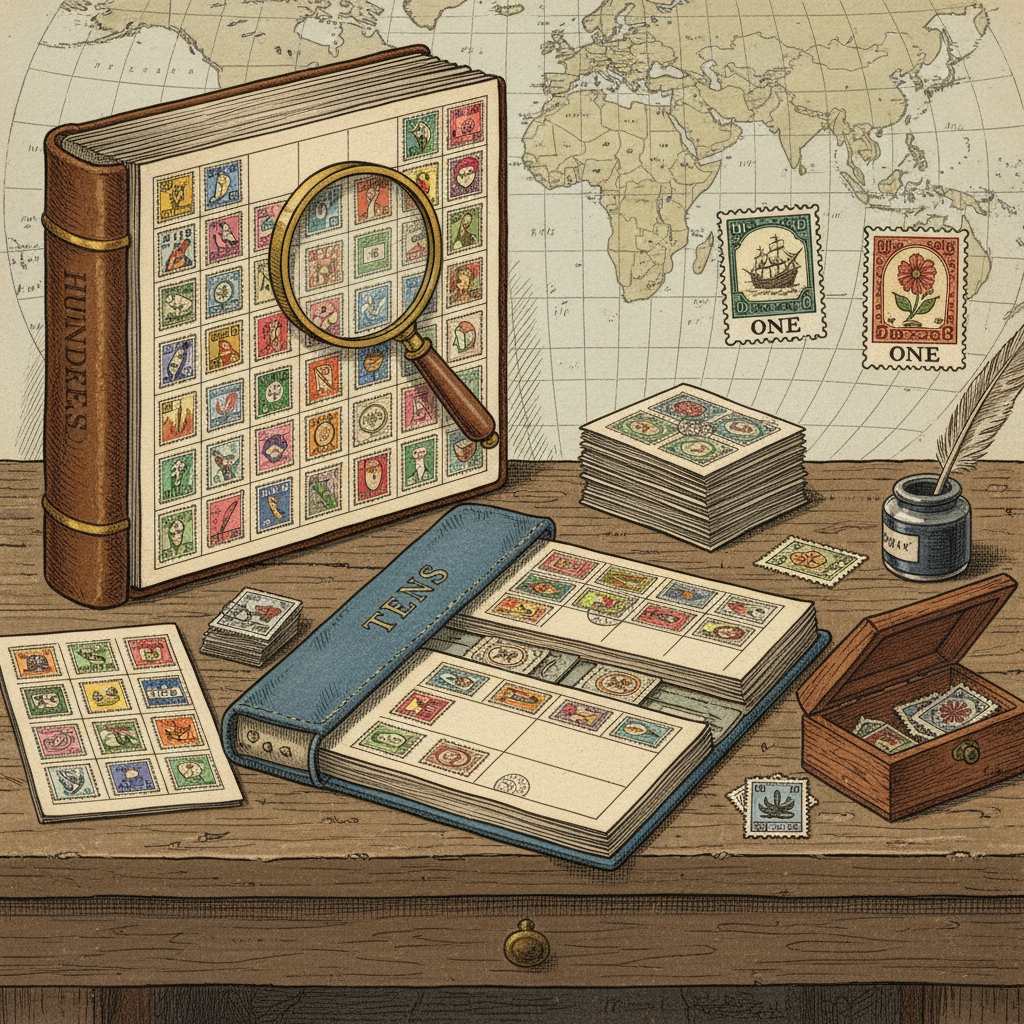
Let's use another analogy. Imagine you are collecting stamps. You keep your stamps in albums.
- If you have 7 individual stamps lying around, that's 7 ones.
- If you fill up a whole page in your album with 10 stamps, that page is worth 10 stamps. If you have 4 full pages, that's 4 tens, or 40 stamps.
- If you have a special binder that holds 10 full pages (which is 10 x 10 = 100 stamps!), that binder is worth 100 stamps. If you have 3 of these binders, that's 3 hundreds, or 300 stamps.
So, if you have 3 binders, 4 full pages, and 7 loose stamps, you have 300 + 40 + 7 = 347 stamps!
Key Differences Summarized
It's important to remember the difference between face value and place value:
- Face Value: The digit itself (e.g., in 345, the face value of the '3' is 3).
- Place Value: The value of the digit based on its position (e.g., in 345, the place value of the '3' is 300 because it's in the hundreds place).
Think of it like a superhero's costume! The superhero's face (face value) is always the same, but their costume (place value) can change their appearance and abilities depending on which mission they are on!
Why is this important?
Understanding place value helps us:
- Read and write large numbers correctly.
- Compare numbers (is 500 bigger than 100?).
- Add and subtract numbers accurately.
- Understand how our number system works!
You are now officially a number detective! Keep practicing, and you'll become a master of place value and face value!
Keep learning, free
Create a free Syllabax account to unlock practice questions and games for this topic.
Visual Learning Enhanced! 🚀
To help you master this topic, we use Advanced Syllabax AI to generate detailed diagrams and visual models.
Note on Visuals: The AI sometimes makes spelling errors in image labels. Please refer to the lesson text for the correct terminology.