Perimeter of square & rectangle (Perimeter)
Watch this topic in 60 seconds
Free preview · Lesson 1
Understanding Perimeter of square & rectangle (Perimeter)
Exploring the Perimeter: How Much is the Outside Edge?
Imagine you have a beautiful garden. You want to put a tiny fence all the way around it to keep your playful puppy from digging up the flowers. Or maybe you want to measure how much ribbon you need to go around the edge of a birthday present.
In math, when we talk about the total distance around the outside edge of a shape, we call it the perimeter. It’s like measuring the fence for your garden or the ribbon for your present!
What is Perimeter?
Perimeter comes from two Greek words: 'peri' meaning 'around' and 'metron' meaning 'measure'. So, perimeter literally means 'to measure around'!
Think of it like walking along the edges of a park. The total distance you walk from the starting point, all the way around the park, and back to where you started is the perimeter of the park.
Perimeter of a Square
Let's start with a square. A square is a very special shape because all four of its sides are exactly the same length. Think of a perfectly square cracker or a window pane.
If you know the length of just ONE side of a square, you know the length of ALL its sides!
Analogy: Imagine you have a square cookie cutter. If you know one edge is 3 inches long, then all the other edges are also 3 inches long.
To find the perimeter of a square, you just add up the lengths of all four sides. Since all sides are the same:
Perimeter of a Square = Side + Side + Side + Side
Or, a quicker way is to multiply the length of one side by 4:
Perimeter of a Square = 4 × Side Length
Example:
Let's say you have a square photo frame where each side is 10 centimeters long. To find the perimeter:
Perimeter = 10 cm + 10 cm + 10 cm + 10 cm = 40 cm
Or, using the multiplication method:
Perimeter = 4 × 10 cm = 40 cm
So, the total distance around the outside of the photo frame is 40 centimeters.
Perimeter of a Rectangle
Now, let's talk about rectangles. A rectangle is also a four-sided shape, but it's a bit different from a square. In a rectangle, opposite sides are equal in length. This means it has two longer sides and two shorter sides.
Think of a door, a book, or a playing card. These are all shapes of rectangles.
Analogy: Imagine you're building a rectangular sandbox for your pet hamster. You'll need to measure and buy wood for two longer sides and two shorter sides.
To find the perimeter of a rectangle, you add up the lengths of all four sides:
Perimeter of a Rectangle = Length + Width + Length + Width
Since opposite sides are equal, we can also say:
Perimeter of a Rectangle = (2 × Length) + (2 × Width)
Example:
Let's say you have a rectangular TV screen. The longer side (length) is 20 inches, and the shorter side (width) is 12 inches.
To find the perimeter:
Perimeter = 20 inches + 12 inches + 20 inches + 12 inches = 64 inches
Or, using the multiplication method:
Perimeter = (2 × 20 inches) + (2 × 12 inches)
Perimeter = 40 inches + 24 inches = 64 inches
So, the total distance around the outside of the TV screen is 64 inches.
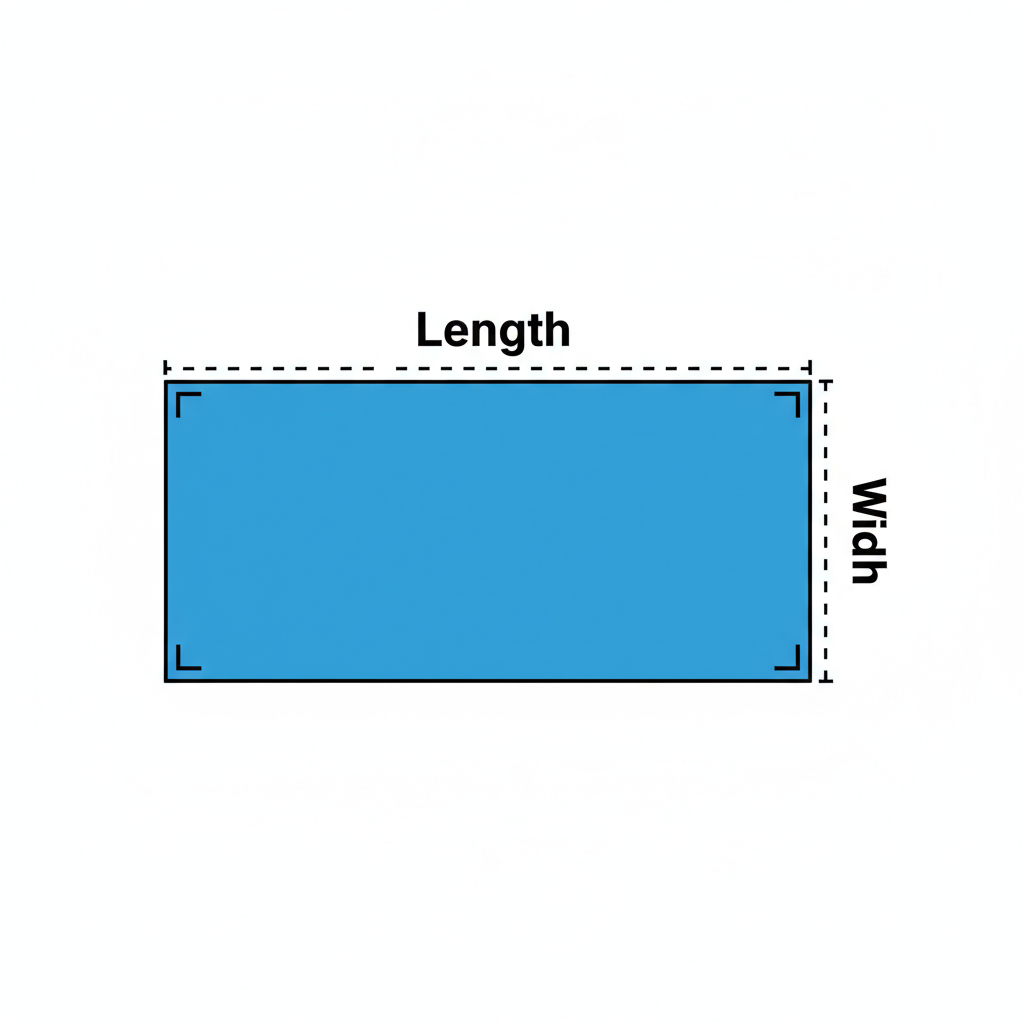 ⚠️ This picture may have spelling mistakes. Trust the words in the lesson.
Putting It All Together: Why is Perimeter Important?
Perimeter is a very useful concept in real life. Whenever you need to know the distance around something, perimeter is your answer!
- Fencing a yard: You need to know the perimeter to buy the right amount of fence.
- Decorating a room: If you want to put a border around the top of the walls, you need the perimeter of the room.
- Building a frame: Whether it's a picture frame or a frame for a garden bed, the perimeter tells you how much material you need.
- Lacing shoes: While not a perfect shape, you can think about the distance around the shoe's opening.
Remember, perimeter is simply the total distance around the outside of any shape. For squares and rectangles, we have simple formulas to help us calculate it quickly!
Keep learning, free
Create a free Syllabax account to unlock practice questions and games for this topic.
Visual Learning Enhanced! 🚀
To help you master this topic, we use Advanced Syllabax AI to generate detailed diagrams and visual models.
Note on Visuals: The AI sometimes makes spelling errors in image labels. Please refer to the lesson text for the correct terminology.