Comparison of fractions [Fractions]
Watch this topic in 60 seconds
Free preview · Lesson 1
Understanding Comparison of fractions [Fractions]
Comparing Fractions: Understanding How Big They Are!
Welcome, amazing mathematicians! Today, we're going on an adventure to understand how to compare fractions. Think of fractions as slices of a delicious pizza or pieces of a yummy cake. Sometimes, one slice might be bigger than another, and sometimes they might be the same size! Comparing fractions is like figuring out which slice is bigger or if they are equal.
What is a Fraction, Anyway?
Before we compare, let's quickly remember what a fraction is. A fraction has two parts: a numerator and a denominator.
- The denominator is the number on the bottom. It tells us how many equal parts the whole thing is divided into. Think of it as the total number of pizza slices in the whole pizza.
- The numerator is the number on the top. It tells us how many of those equal parts we have. Think of it as how many slices of pizza you've taken.
For example, in the fraction 3/4:
- 4 is the denominator (the pizza is cut into 4 equal slices).
- 3 is the numerator (you have 3 of those slices).
So, 3/4 means you have 3 out of 4 equal slices of the pizza.
Comparing Fractions with the Same Denominator
This is the easiest way to compare fractions! Imagine you and your friend both order the same size pizza, and both pizzas are cut into 8 equal slices. So, the denominator for both your pizza and your friend's pizza is 8.
Now, let's say you eat 3 slices, and your friend eats 5 slices.
- Your slices: 3/8
- Your friend's slices: 5/8
Since both pizzas have the same number of slices (8), we only need to look at the numerators (the number of slices eaten). The person who ate more slices has the bigger fraction!
In this case, 5 is bigger than 3. So, 5/8 is a bigger fraction than 3/8.
Analogy: Think of it like lining up toy cars. If all the cars are the same length (same denominator), the person with more cars is the winner (bigger numerator).
Rule: When fractions have the same denominator, the fraction with the larger numerator is the larger fraction.

Comparing Fractions with the Same Numerator
This can be a little trickier, but still very doable! Let's think about a different scenario. Imagine two candy bars, and you want to share them equally with different numbers of friends.
Suppose you have one candy bar, and you break it into 4 equal pieces. You decide to give 1 piece to your little sibling. That's 1/4 of the candy bar.
Now, imagine another candy bar of the same size. This time, you break it into 10 equal pieces. You decide to give 1 piece to your best friend. That's 1/10 of the candy bar.
- Your sibling gets: 1/4 of the candy bar
- Your friend gets: 1/10 of the candy bar
Both of you got 1 piece (same numerator). But were the pieces the same size? No!
When you break a candy bar into 4 pieces, each piece is bigger than when you break it into 10 pieces. So, 1/4 is a bigger fraction than 1/10.
Analogy: Imagine cutting a cake. If you cut it into 2 big slices (1/2 each), those slices are much bigger than if you cut the same cake into 12 tiny slices (1/12 each). Even though you might only have 1 slice in each case, the 1/2 slice is much larger!
Rule: When fractions have the same numerator, the fraction with the smaller denominator is the larger fraction.
Comparing Fractions by Making a Common Denominator (A Sneak Peek!)
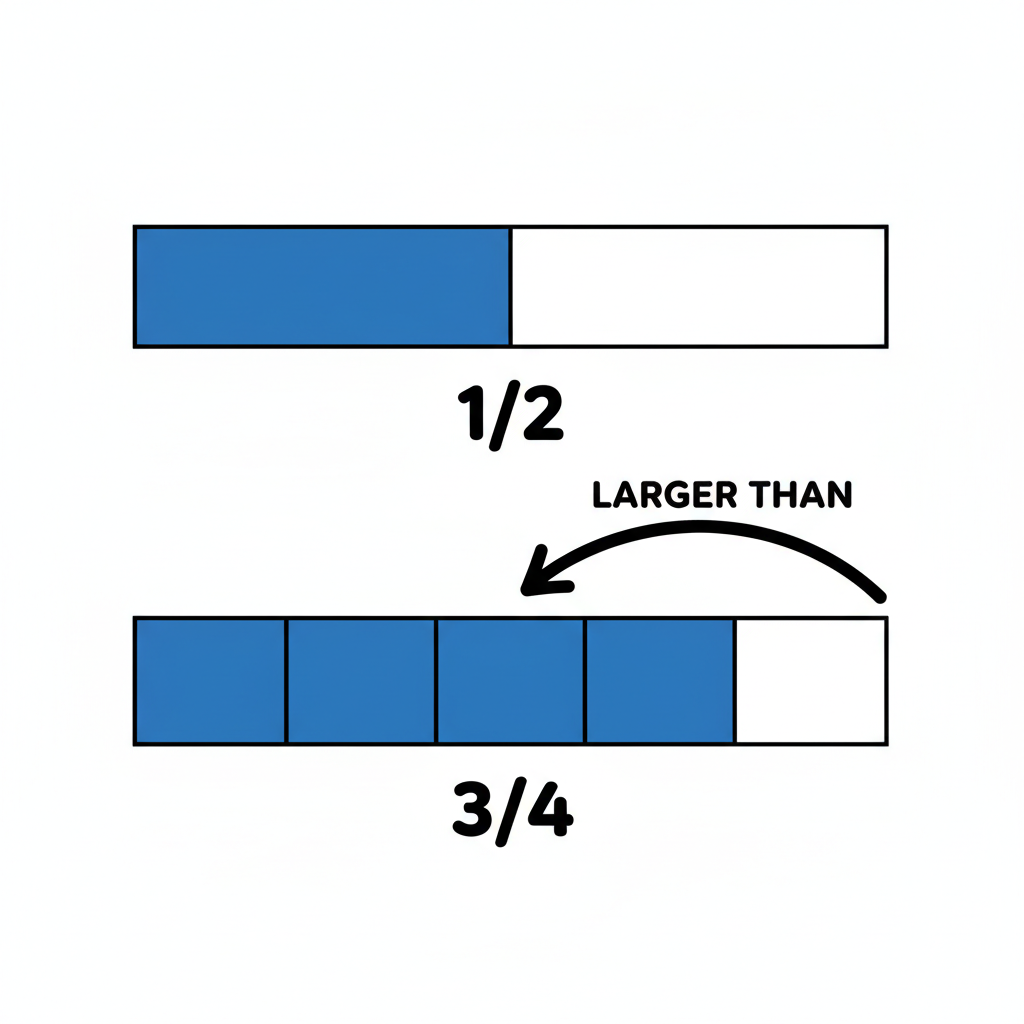
What happens when the numerators AND the denominators are different? For example, comparing 1/2 and 3/4. This is where things get a bit more advanced, but the idea is simple!
To compare them, we want to make them like the first case we discussed – where they have the same denominator. We can do this by changing one or both fractions so they have a common denominator.
Let's look at 1/2 and 3/4. We know that 2 goes into 4. So, we can change 1/2 into a fraction with a denominator of 4.
How do we do that? We ask ourselves: 'What do I multiply 2 by to get 4?' The answer is 2.
If we multiply the denominator (2) by 2, we MUST also multiply the numerator (1) by 2 to keep the fraction's value the same.
- 1/2 becomes (1 * 2) / (2 * 2) = 2/4.
Now we are comparing 2/4 and 3/4. Both have the same denominator (4)!
Since 3 is bigger than 2, 3/4 is bigger than 2/4. Therefore, 3/4 is bigger than 1/2.
Analogy: Imagine you have two identical boxes. One box has 2 big candies (representing 1/2 of the box's capacity). The other box has 3 smaller candies (representing 3/4 of the box's capacity). If you could somehow make the candies in the first box smaller so they fit in the same number of spots as the second box (making the denominators common), you'd see that the second box has more candy.
Key Concepts to Remember
- Same Denominator: The bigger the numerator, the bigger the fraction.
- Same Numerator: The smaller the denominator, the bigger the fraction.
- Different Numerators and Denominators: We can often make the denominators the same to compare them easily!
Keep practicing, and you'll become a fraction-comparing superstar!
Keep learning, free
Create a free Syllabax account to unlock practice questions and games for this topic.
Visual Learning Enhanced! 🚀
To help you master this topic, we use Advanced Syllabax AI to generate detailed diagrams and visual models.
Note on Visuals: The AI sometimes makes spelling errors in image labels. Please refer to the lesson text for the correct terminology.