Introduction & definition (Rational Numbers)
Watch this topic in 60 seconds
Free preview · Lesson 1
Understanding Introduction & definition (Rational Numbers)
Unlocking Rational Numbers: Understanding Parts of a Whole (Grade 7)
Welcome, future mathematicians! Today, we're going to explore a super important family of numbers called Rational Numbers. You've already met many numbers in your life – from counting your toys to figuring out your age. But sometimes, the numbers we already know aren't quite enough. Let's find out why!
Reviewing Our Number Friends So Far
Think of the numbers you know as different sets of building blocks. Each set helps us describe the world in a specific way:
- Natural Numbers (or Counting Numbers): These are the numbers you use to count things: 1, 2, 3, 4, and so on. They're like your fingers and toes – whole and positive.
- Whole Numbers: This set includes all the Natural Numbers, plus one special guest: 0. So, 0, 1, 2, 3, 4... Think of '0' as having nothing, but it's still a specific 'amount' of nothing!
- Integers: Now things get interesting! Integers include all the Whole Numbers, and their negative partners: ..., -3, -2, -1, 0, 1, 2, 3... Integers are great for describing temperatures (like -5 degrees) or money owed (-$10). They're like measuring steps forward (positive) and steps backward (negative) from a starting point (zero).
But what if we need to talk about *parts* of things? What if we want to share a pizza equally among friends? Or bake a cake that calls for 'half a cup' of sugar? Our current number friends (integers) only deal with whole amounts. This is where rational numbers come in!
Introducing Rational Numbers: The Ultimate Sharers!
Imagine you have a delicious chocolate bar, and you want to share it equally with your best friend. You wouldn't say, "I'll give you 1 chocolate bar and I'll take 1 chocolate bar" if there's only one to start with! You'd say, "I'll give you half, and I'll take half." That 'half' is a perfect example of a rational number.
The Official Definition: What Makes a Number Rational?
A rational number is any number that can be written as a fraction, where:
- The top number (called the numerator, let's call it 'p') is an integer.
- The bottom number (called the denominator, let's call it 'q') is also an integer.
- And here's the SUPER important rule: The denominator (q) CANNOT be zero!
So, in simple terms, a rational number is any number that can be expressed in the form p/q, where p and q are integers, and q ≠ 0.
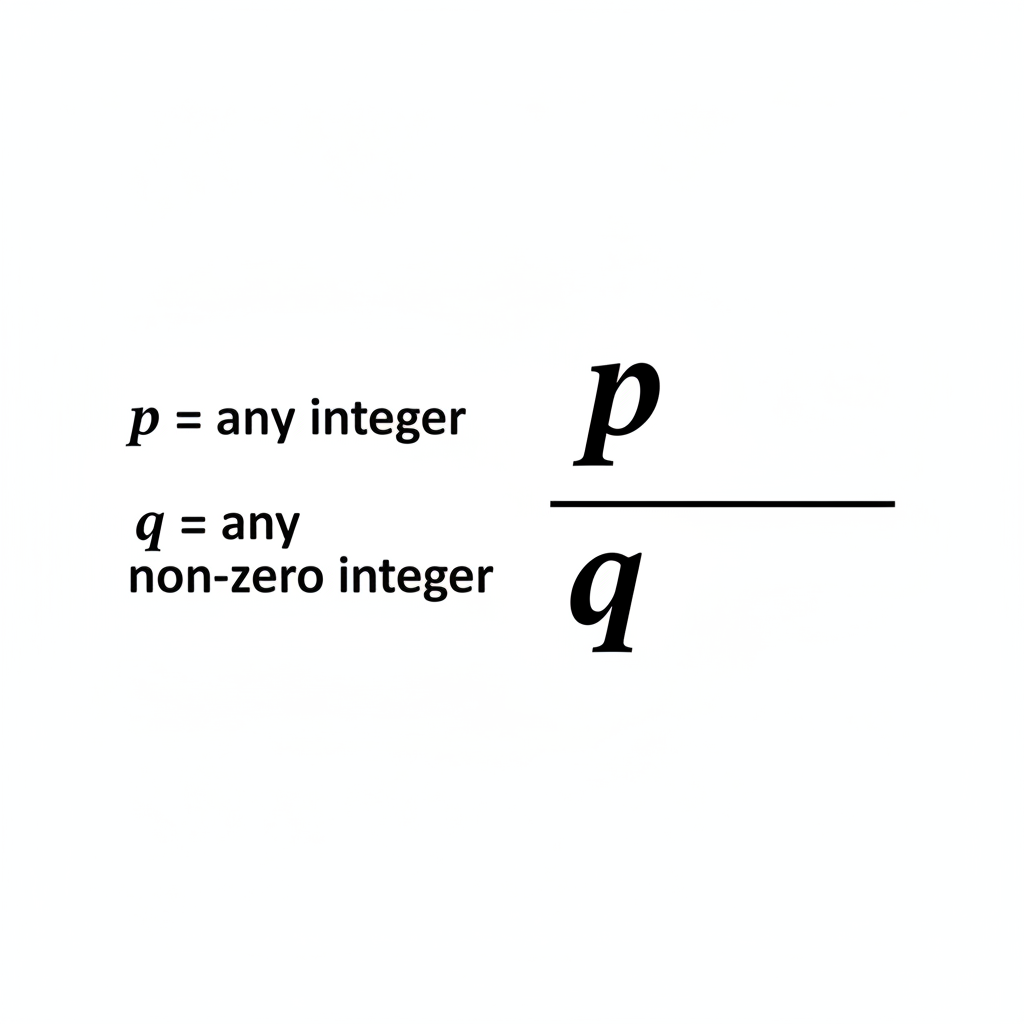
Why Can't the Denominator Be Zero?
This is a crucial point! Dividing by zero is like trying to answer the question: "How many groups of zero can you make from 5 items?" It just doesn't make sense. It's undefined. Imagine trying to share 5 pizzas among 0 people – the pizzas would just sit there, eternally undivided and uneaten, causing mathematical chaos! So, always remember: q ≠ 0!
Who Belongs to the Rational Number Family? (Examples Galore!)
The rational number family is much bigger than you might think! It includes many of your old friends and some new ones too:
1. All Fractions (The Obvious Ones!)
- 1/2: Here, p=1 (an integer), q=2 (an integer, and not zero). So, 1/2 is rational.
- 3/4: p=3, q=4. Rational!
- -5/8: p=-5, q=8. Rational! Yes, negative fractions are rational too!
Analogy: Think of rational numbers as LEGO bricks. Regular fractions are like the standard rectangular bricks – clearly showing their 'p' and 'q' parts.
2. All Integers (They're Just in Disguise!)
This might surprise you! Every integer can be written as a fraction where the denominator is 1.
- 5: Can be written as 5/1. Here, p=5, q=1. Rational!
- -3: Can be written as -3/1. Here, p=-3, q=1. Rational!
- 0: Can be written as 0/1. Here, p=0, q=1. Rational! (Remember, only 'q' cannot be zero; 'p' can be zero).
Analogy: Integers are like superheroes in civilian clothes. They might look like whole numbers, but they have the power to transform into a fraction with a denominator of 1, revealing their rational identity!
3. Terminating Decimals (Decimals That End)
A terminating decimal is a decimal that has a finite number of digits after the decimal point. These can always be written as fractions!
- 0.5: This is the same as 5/10, which simplifies to 1/2. Rational!
- 0.25: This is 25/100, which simplifies to 1/4. Rational!
- -3.75: This is -3 and 75/100, or -375/100. Rational!
Analogy: Think of money. 75 cents is 75/100 of a dollar. You can always write out exactly what part of a whole it is using a fraction.
4. Repeating Decimals (Decimals That Go On and On with a Pattern)
A repeating decimal is a decimal that has a digit or a block of digits that repeat infinitely after the decimal point. Amazingly, these can *also* be written as fractions!
- 0.333...: This is exactly 1/3. Rational!
- 0.161616...: This is 16/99. Rational!
Analogy: Repeating decimals are like a catchy song on repeat – it never ends, but it has a very predictable pattern. Because of this pattern, we can turn them into a neat fraction.
Putting Rational Numbers on the Number Line
Remember how integers filled in the positive and negative whole spots on the number line? Rational numbers go a step further. They fill in all the gaps between those integers. You can find 1/2 right between 0 and 1, and -3/4 between -1 and 0. The number line becomes incredibly dense with rational numbers – you can always find another rational number between any two given rational numbers!
Analogy: Imagine the number line is a long road. Integers are the major cities. Rational numbers are all the houses, shops, and tiny villages in between those cities. They truly fill up the whole road!
What Rational Numbers Are NOT (A Quick Peek)
Just so you know, there are numbers that *cannot* be written as a simple fraction p/q. These are called Irrational Numbers. Famous examples include Pi (π ≈ 3.14159...) and the square root of 2 (√2 ≈ 1.41421...). Their decimals go on forever without repeating any pattern. We'll explore these fascinating numbers later, but for now, just remember they're the 'non-rational' members of the number family!
Key Takeaways
You've now taken your first step into the amazing world of rational numbers! They are the foundation for so much more advanced math you'll learn. Understanding them deeply will make your mathematical journey much smoother.
Keep learning, free
Create a free Syllabax account to unlock practice questions and games for this topic.
Visual Learning Enhanced! 🚀
To help you master this topic, we use Advanced Syllabax AI to generate detailed diagrams and visual models.
Note on Visuals: The AI sometimes makes spelling errors in image labels. Please refer to the lesson text for the correct terminology.