Ecosystems[BIOLOGY]
Watch this topic in 60 seconds
Free preview · Lesson 1
Understanding Ecosystems[BIOLOGY]
Understanding Ecosystems: A World of Interconnected Life
Welcome, future biologists! Today, we're going on an adventure to explore the fascinating world of ecosystems. Don't worry, we'll break down everything into simple, easy-to-understand terms, just like building with LEGO bricks!
What is an Ecosystem? Imagine a Giant House Party!
Think about a house party. You have people (the guests), music, food, drinks, decorations, and even the temperature of the room. Everyone and everything interacts, right? The music affects how people dance, the food gets eaten, and maybe someone turns up the air conditioning because it's too warm.
An ecosystem is just like that house party, but on a much grander scale. It's a community of living organisms interacting with each other and with their non-living environment. It could be as small as a puddle or as vast as an ocean or a rainforest. The key idea is interaction.
Definition: An ecosystem is a biological community of interacting organisms and their physical environment.
The Two Main Guests at Our Ecosystem Party: Biotic and Abiotic Factors
Every ecosystem has two fundamental types of components that make it work, much like how a party needs both guests and the actual house it's held in.
1. Biotic Factors: The Living Stars of the Show
These are all the living or once-living parts of an ecosystem. Think of them as the 'actors' in our ecosystem play. They are the plants, animals, fungi, and microscopic organisms like bacteria. If it breathes, grows, eats, or reproduces, it's biotic!
Let's Meet the Main Biotic Characters:
-
Producers (Autotrophs): The Super Chefs!
Imagine a chef who can make delicious food out of just sunlight, water, and air. That's a producer! These are organisms, mainly plants and algae, that produce their own food using energy from the sun (photosynthesis). They form the base of every ecosystem, providing energy for almost all other life. Think of them as the starting ingredients for our ecosystem's food supply. -
Consumers (Heterotrophs): The Hungry Diners!
Consumers are organisms that cannot produce their own food. They have to eat other organisms to get energy, just like you might buy food from a restaurant instead of growing it yourself. We can further categorize consumers:- Herbivores: The Vegans! These eat only plants (e.g., rabbits, cows, deer).
- Carnivores: The Meat Eaters! These eat only other animals (e.g., lions, wolves, eagles).
- Omnivores: The Eat-It-Alls! These eat both plants and animals (e.g., humans, bears, raccoons).
-
Decomposers: The Recycling Crew!
What happens when plants and animals die? They don't just pile up forever! That's where decomposers come in. These are organisms like bacteria and fungi that break down dead organic matter, returning essential nutrients back to the soil. Think of them as the ultimate recycling team, cleaning up the ecosystem and making sure nothing goes to waste. They turn dead leaves and animals into nutrient-rich soil that new plants can use to grow. It's a full-circle service!
2. Abiotic Factors: The Stage and Setting of the Party
These are all the non-living physical and chemical parts of an ecosystem. They are the 'stage props' or 'environment settings' that influence where and how living organisms can exist. They don't breathe or grow, but they are absolutely essential for life.
- Sunlight: The Ultimate Energy Source! Without the sun's energy, producers couldn't make food, and the entire food chain would collapse.
- Water: The Drink of Life! All living organisms need water to survive. It's crucial for everything from photosynthesis to regulating body temperature.
- Soil: The Foundation! Soil provides nutrients and a place for plants to anchor themselves. It's also home to countless microorganisms.
- Air/Atmosphere: The Breath of Life! Oxygen for breathing, carbon dioxide for photosynthesis – the gases in the air are vital.
- Temperature: The Climate Controller! Too hot or too cold, and many organisms can't survive. Temperature ranges define what types of plants and animals can live in an area.
- Minerals/Nutrients: The Building Blocks! Essential elements like nitrogen, phosphorus, and potassium found in soil and water are crucial for growth and life processes.
So, biotic factors (the living organisms) constantly interact with and are influenced by abiotic factors (the non-living environment). It's like the guests at a party (biotic) being affected by the temperature, music, and food available (abiotic).
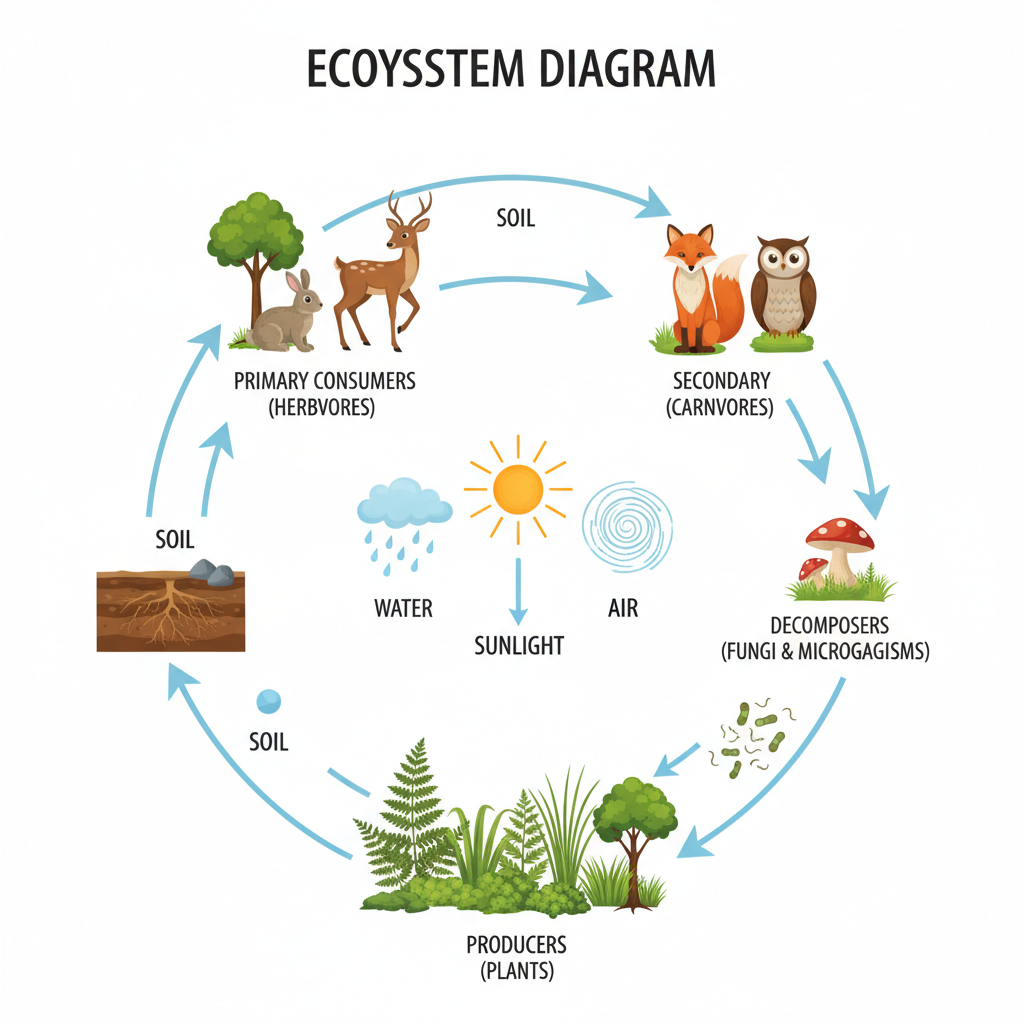 ⚠️ This picture may have spelling mistakes. Trust the words in the lesson.
How Energy Flows: The Food Chain and Food Web
Energy is what makes an ecosystem run, just like electricity powers your house. This energy flows from one organism to another in specific pathways.
Food Chain: A Straight Line of Energy Transfer
Imagine a series of dominoes falling one after another. That's a food chain! It shows a simple, linear path of how energy is transferred from one organism to another by eating. It always starts with a producer.
Example: Sun → Grass (Producer) → Rabbit (Primary Consumer - eats plants) → Fox (Secondary Consumer - eats rabbit)
In this chain, the grass gets energy from the sun. The rabbit gets energy by eating the grass. The fox gets energy by eating the rabbit. Each step is called a trophic level.
Food Web: The Interconnected Network of Life
Now, imagine many different domino lines, all crisscrossing and connecting with each other. That's a food web! Real ecosystems are much more complex than simple food chains. Most organisms eat more than one type of food, and they are eaten by more than one type of predator.
A food web shows all the interconnected food chains in an ecosystem, illustrating how energy flows through multiple pathways. It's like a giant, intricate tapestry where every thread (organism) is connected to many others. This complexity makes ecosystems more stable; if one food source disappears, an animal might have others to rely on.
The 10% Rule of Energy Transfer: Not All Energy Makes It!
When energy moves from one trophic level to the next (e.g., from grass to rabbit), a lot of it is lost! Only about 10% of the energy from one level is transferred to the next. The rest is used by the organism for its own life processes (like movement, heat, breathing) or lost as waste.
Think of it like trying to save money: you earn a certain amount, but you spend most of it on rent, food, and fun. Only a small percentage might go into savings. This is why there are usually many more producers than consumers, and fewer top predators in any ecosystem.
The Importance of Ecosystems: Why Should We Care?
Ecosystems are not just interesting to study; they are absolutely vital for our survival and the health of the planet. They provide us with:
- Oxygen: Produced by plants.
- Clean Water: Filtered by soil and vegetation.
- Food: All our food comes from ecosystems.
- Medicine: Many medicines are derived from plants and animals.
- Climate Regulation: Forests absorb carbon dioxide, helping to regulate global temperatures.
- Habitat: They provide homes for countless species, maintaining biodiversity.
An ecosystem works like a well-tuned orchestra. Every instrument (organism or abiotic factor) has a role, and if one part is missing or out of tune, the whole performance suffers. Protecting ecosystems means protecting our own future!
Recap: Your Ecosystem Toolbox
You've learned that ecosystems are complex communities where living things interact with each other and their non-living surroundings. You now know about the vital roles of producers, consumers, and decomposers, and how energy flows through food chains and webs. Remember, everything in an ecosystem is connected, and understanding these connections helps us appreciate and protect the natural world around us.
Keep learning, free
Create a free Syllabax account to unlock practice questions and games for this topic.
Visual Learning Enhanced! 🚀
To help you master this topic, we use Advanced Syllabax AI to generate detailed diagrams and visual models.
Note on Visuals: The AI sometimes makes spelling errors in image labels. Please refer to the lesson text for the correct terminology.