Shape patterns [Symmetry & Patterns]
Watch this topic in 60 seconds
Free preview · Lesson 1
Understanding Shape patterns [Symmetry & Patterns]
Shape Patterns: Symmetry and Patterns - A 5th Grade Adventure!
Hello young mathematicians! Today, we're going on an exciting journey to explore the wonderful world of Shape Patterns, focusing on two super important ideas: Symmetry and Patterns. Imagine you're a detective looking for clues, or an artist creating something beautiful. You'll see how these ideas are all around us, from the nature we see outside to the toys we play with!
What is a Pattern?
Let's start with patterns. A pattern is like a secret code or a repeating design. It's a sequence of things that happens over and over again in a predictable way. Think about a brick wall. Each brick is the same, and they are laid in a line. That's a pattern!
Analogy Time: Music! Imagine your favorite song. It has a rhythm, right? A beat that repeats. Maybe a certain melody comes back again and again. That's a musical pattern! In math, patterns can involve numbers, shapes, colors, or even movements. We are going to focus on shape patterns today.
Types of Shape Patterns:
- Repeating Patterns: These are the most common. They go like this: A, B, A, B, A, B... or A, B, C, A, B, C... The same group of shapes keeps repeating.
- Growing Patterns: These patterns get bigger or more complex over time. For example, one square, then two squares, then three squares.
For now, we will focus on repeating shape patterns.
What is Symmetry?
Now, let's talk about symmetry. Symmetry is like a special kind of balance. If something has symmetry, it means you can divide it into two parts that are exactly the same, like mirror images. Imagine folding a piece of paper in half and drawing a heart on it. When you unfold it, you have a perfect heart because both sides match!
Analogy Time: Butterfly Wings! A butterfly is a beautiful example of symmetry. If you draw a line down the middle of its body, you'll see that its left wing is almost exactly the same as its right wing. They are mirror images of each other.
Lines of Symmetry:
The imaginary line that divides a symmetrical shape into two equal, matching halves is called the line of symmetry. Think of it as a mirror line.
- A square has 4 lines of symmetry.
- A rectangle has 2 lines of symmetry.
- An isosceles triangle (a triangle with two equal sides) has 1 line of symmetry.
- A circle has an infinite number of lines of symmetry! You can draw a line through its center in any direction, and it will divide the circle into two equal halves.
Some shapes don't have any lines of symmetry, like a letter 'F' or a scalene triangle (a triangle with all different sides).
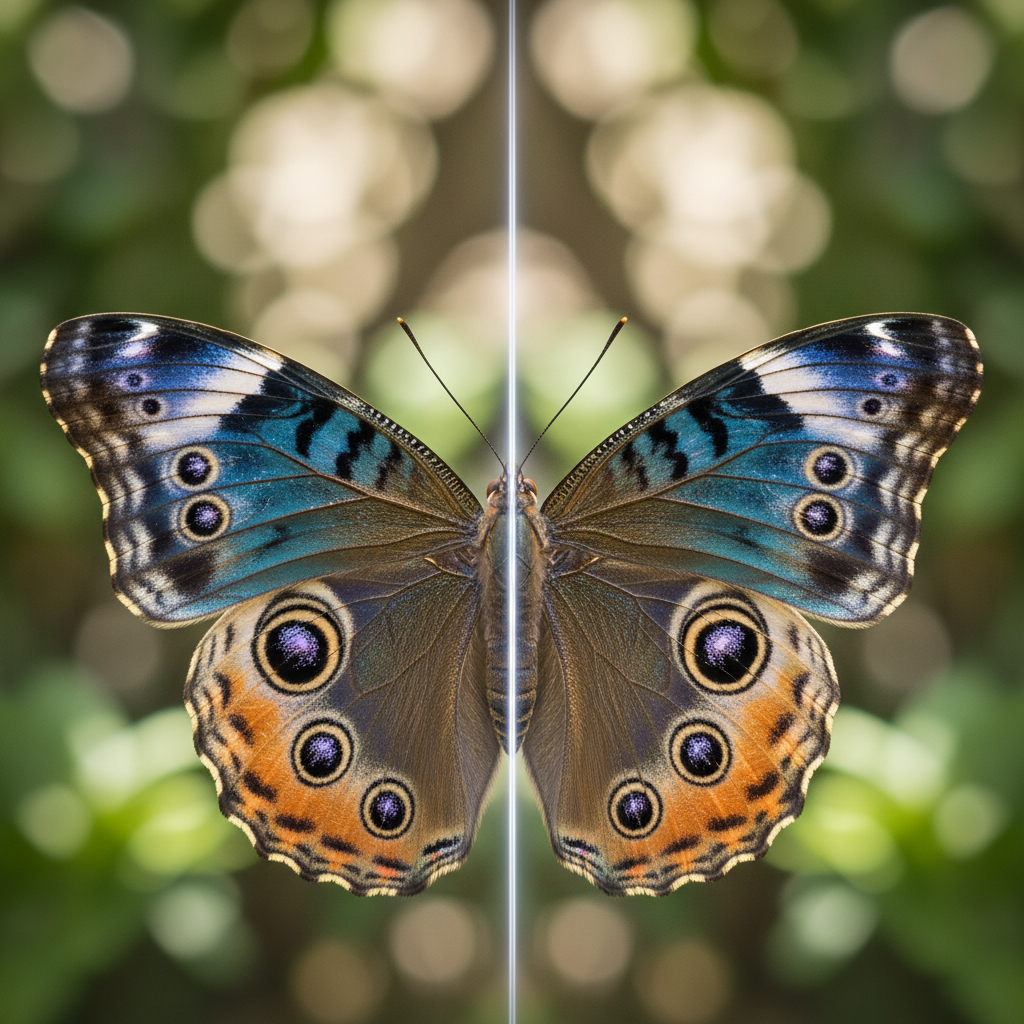 ⚠️ This picture may have spelling mistakes. Trust the words in the lesson.
Connecting Patterns and Symmetry
How do patterns and symmetry work together? Well, sometimes patterns are created using symmetrical shapes! For example, a pattern that goes:
Square, Circle, Square, Circle, Square, Circle...
Each 'Square' and each 'Circle' is a symmetrical shape. The arrangement of these shapes creates a repeating pattern.
Think about a tiled floor. Often, the tiles themselves have symmetrical designs, and then these tiles are arranged in a repeating pattern to cover the whole floor. Or consider a quilt! Many quilts use squares, triangles, and other shapes that might be symmetrical, and they arrange them in beautiful, repeating patterns to make a cozy blanket.
More on Repeating Shape Patterns
Let's look at some repeating shape patterns. A pattern is defined by its core or unit – the smallest set of shapes that repeats.
Example 1:
Circle, Square, Circle, Square, Circle, Square...
The core of this pattern is 'Circle, Square'. It repeats over and over.
Example 2:
Triangle, Star, Triangle, Star, Triangle, Star...
The core is 'Triangle, Star'.
Example 3:
Circle, Circle, Square, Circle, Circle, Square, Circle, Circle, Square...
The core here is 'Circle, Circle, Square'. It's a pattern of three shapes.
Example 4:
Red Square, Blue Circle, Red Square, Blue Circle...
Here, the pattern is based on both shape and color!
We can even have patterns with three different shapes:
Square, Triangle, Circle, Square, Triangle, Circle, Square, Triangle, Circle...
The core is 'Square, Triangle, Circle'.
Let's Practice Identifying Patterns!
To be a great pattern detective, ask yourself:
- What shapes are used?
- What is the order of the shapes?
- Does a group of shapes repeat? What is that group?
Identifying the core of the pattern helps us predict what comes next. If the pattern is Circle, Square, Triangle, Circle, Square, Triangle..., and you've just seen a Triangle, what shape do you expect to see next? That's right, a Circle!
Symmetry in Everyday Life
Symmetry isn't just in math class; it's everywhere!
- Nature: Many flowers, leaves, insects, and even animals have symmetrical features.
- Buildings: Many buildings are designed with symmetry to look balanced and pleasing. Think of a house with a door in the middle and windows on either side.
- Objects: A teacup, a spoon, a book, a stop sign – many everyday objects have symmetry.
Understanding symmetry helps us appreciate the beauty and order in the world around us. It also helps artists and designers create balanced and harmonious works.
Summary of Key Ideas
We've learned that:
- Patterns are repeating sequences or designs.
- Symmetry is a type of balance where a shape can be divided into two identical mirror images by a line of symmetry.
- We can find both patterns and symmetry in nature, art, and everyday objects.
- Repeating shape patterns have a core group of shapes that appear over and over.
Keep your eyes open for patterns and symmetry wherever you go!
Keep learning, free
Create a free Syllabax account to unlock practice questions and games for this topic.
Visual Learning Enhanced! 🚀
To help you master this topic, we use Advanced Syllabax AI to generate detailed diagrams and visual models.
Note on Visuals: The AI sometimes makes spelling errors in image labels. Please refer to the lesson text for the correct terminology.