What is work? (simple understanding) (Force & Work )
Watch this topic in 60 seconds
Free preview · Lesson 1
Understanding What is work? (simple understanding) (Force & Work )
Understanding Work: When We Make Things Move!
Hello, young scientists! Today, we're going to explore a very interesting idea in science called "Work." Now, when your parents ask you to do "work" around the house, like cleaning your room, that's one kind of work. But in science, "work" has a special meaning!
What is a Force?
Before we talk about "work," we need to understand something called a "force." A force is just a push or a pull! That's it! Every time you push something or pull something, you are using a force.
- When you push a toy car across the floor, you're using a pushing force.
- When you pull your friend on a wagon, you're using a pulling force.
- When you kick a soccer ball, you're using a pushing force.
- When you open a door, you might push it or pull it – both are forces!
So, a force makes things start moving, stop moving, or change direction. It's like the invisible hand that makes things happen!
What is "Work" in Science?
Here's the super important part! In science, for "work" to happen, two things MUST happen together:
- You must use a force (a push or a pull).
- The object you are pushing or pulling MUST move a distance in the same direction as your push or pull.
Think of it like a magical science formula: Force + Movement = Work! If either one is missing, then no work is done in science.
Let's look at some examples where "Work" IS Done:
- Pushing a Shopping Cart: Imagine you're at the grocery store, and you push the shopping cart from one aisle to the next. You are using a force (a push), and the cart is moving a distance. Yes! Work is being done!
- Kicking a Soccer Ball: When you kick a soccer ball, your foot applies a force (a push), and the ball flies through the air (moves a distance). Double yes! Work is being done!
- Lifting a Toy: If your favorite toy falls on the floor, and you bend down to pick it up, you are using a force (an upward pull) to lift it, and the toy moves from the floor up to your hand. Work is being done!
Here’s an example of work being done:
In this picture, the child is applying a push to the toy car, and the car is moving. This is a perfect example of work happening!
When is NO Work Done? (This is a little tricky!)
Sometimes, we try really, really hard to move something, but it just won't budge. In science, even if you're trying your best and feel tired, if the object doesn't move, then NO work is done!
- Pushing a Big Wall: Imagine you try to push a giant brick wall. You push with all your might! You use a lot of force, and you might get very tired. But does the wall move? No! Since the wall doesn't move a distance, no work is done in science. Your muscles might be working, but the wall isn't moving, so no scientific "work."
- Holding a Heavy Backpack: If you hold your heavy backpack perfectly still for a long time, you are using a lot of force to keep it from falling. You're trying hard! But is the backpack moving a distance? No, it's just sitting there in your hands. So, in science, no work is done.
- Trying to Open a Stuck Jar: You might twist and turn with all your strength to open a jar of pickles, but if the lid doesn't budge, then even though you used a lot of force, no work was done because it didn't move!
Here’s another example, showing that movement is key for work:
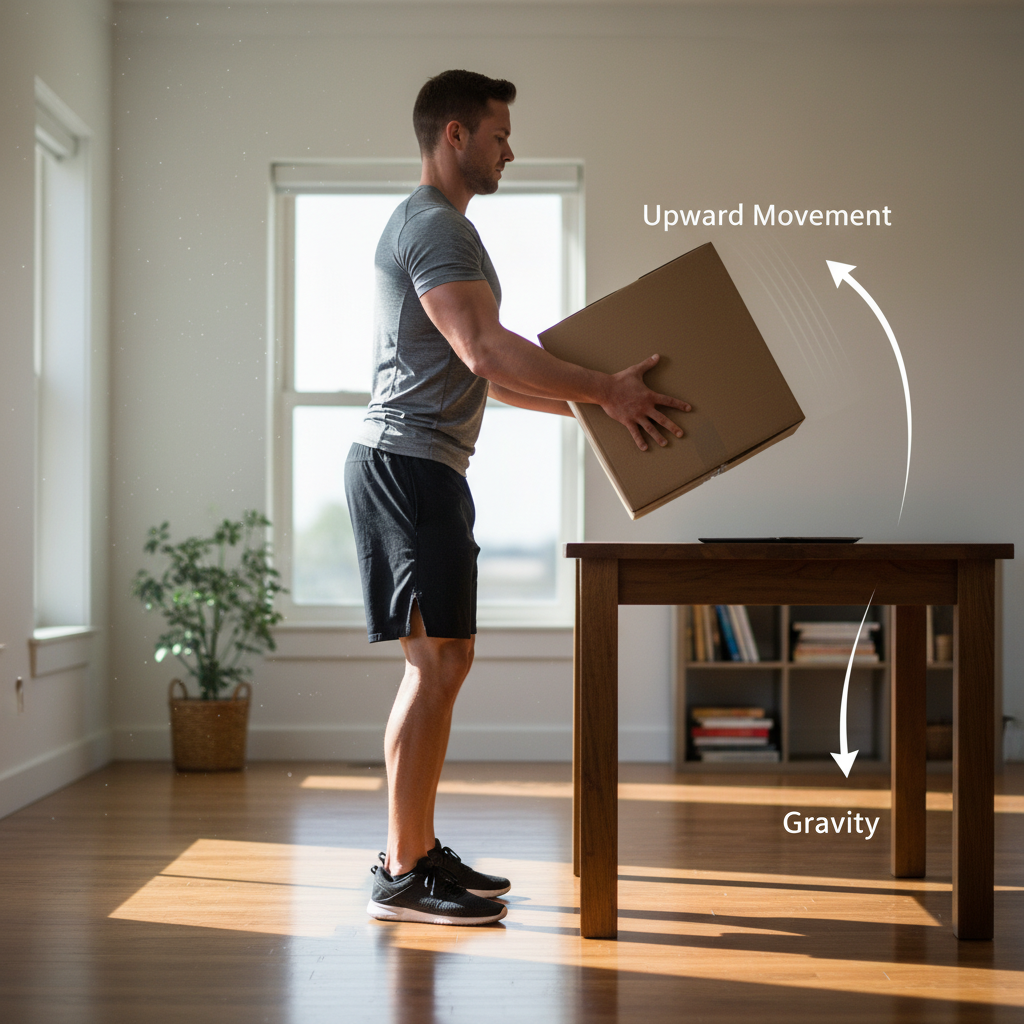
When you lift a box from the floor to a table, you are applying an upward force, and the box moves upward. This is another clear example where work is being done.
Let's Review Our Simple Rule:
Remember, for work to be done in science, you need both a push or a pull AND movement over a distance in the same direction! If you just push or pull without anything moving, or if something moves without a push or pull (like a ball rolling downhill by itself), then you're not doing scientific "work."
Now you know the secret of scientific work! It's all about making things move with a force!
Keep learning, free
Create a free Syllabax account to unlock practice questions and games for this topic.
Visual Learning Enhanced! 🚀
To help you master this topic, we use Advanced Syllabax AI to generate detailed diagrams and visual models.
Note on Visuals: The AI sometimes makes spelling errors in image labels. Please refer to the lesson text for the correct terminology.