Degree of polynomial (Polynominals)
Watch this topic in 60 seconds
Free preview · Lesson 1
Understanding Degree of polynomial (Polynominals)
Understanding the Degree of a Polynomial: Your Foundational Guide (Grade 9)
Welcome, young mathematicians! Today, we're going to unlock a key concept in algebra: the "degree of a polynomial." Don't let the fancy words scare you – we'll break it down into simple, easy-to-understand pieces, using lots of everyday analogies. Think of this as learning the secret code to identify the most important part of a mathematical expression!
What is a Polynomial Anyway? Think of it as a Math Recipe!
Before we talk about degree, let's make sure we know what a polynomial is. Imagine you're baking a cake. A recipe tells you what ingredients to use and how much of each. A polynomial is very much like a mathematical recipe!
- It uses numbers (like 3, -5, 1/2)
- It uses variables (usually letters like 'x', 'y', 'a') which are like placeholders for unknown numbers.
- It involves only addition, subtraction, and multiplication.
- Crucially, variables in a polynomial cannot have negative exponents or be in the denominator of a fraction (like 1/x), and they can't be under a square root sign. They must have whole number exponents (0, 1, 2, 3, ...).
Analogy: If a polynomial is a cake recipe, then variables like 'x' and 'y' are your main ingredients (flour, sugar), and numbers are the measurements (2 cups of flour, 1 cup of sugar).
Here are some examples of polynomials:
5x + 32x2 - 4x + 7y3 + 2y2 - y - 10-7a412(Yes, even a single number can be a polynomial!)
And here are some things that are NOT polynomials:
3/x(variable in the denominator)x-2 + 5(negative exponent)sqrt(x) + 1(variable under a square root, which means x1/2 - fractional exponent)
Breaking Down the Recipe: Understanding "Terms"
Just like a recipe has different ingredients listed, a polynomial is made up of individual "terms." Each term is a single part of the polynomial, separated by addition or subtraction signs.
Analogy: In our cake recipe, "2 cups of flour," "1 cup of sugar," and "3 eggs" are all separate ingredients, or terms.
Let's look at the polynomial 4x3 - 2x2 + 7x - 5:
- The first term is
4x3 - The second term is
-2x2(the minus sign belongs to the term!) - The third term is
7x - The fourth term is
-5
Ingredients in Detail: Variables, Coefficients, and Exponents
Inside each term, we often find three important parts:
1. Variables (The Mystery Ingredient)
These are the letters (like 'x', 'y', 'a', 'b') that represent unknown values. They are the core items we're working with.
Analogy: In a "mystery soup" recipe, 'x' might be the amount of "secret spice" you add.
Example: In 7x2, 'x' is the variable.
2. Coefficients (How Much of That Ingredient?)
This is the number multiplied by the variable(s) in a term. It tells you "how many" of that variable part you have.
Analogy: If your recipe says "2 cups of sugar," '2' is the coefficient for 'sugar'. If it just says 'x', the coefficient is an invisible '1' (like "1 cup of flour").
Example: In 7x2, '7' is the coefficient. In -x3, the coefficient is '-1'. In x, the coefficient is '1'.
3. Exponents (The Power Level of the Ingredient!)
This is the small number written above and to the right of a variable. It tells you how many times the variable is multiplied by itself.
x2meansx * xx3meansx * x * x- If there's no exponent written, it's an invisible '1' (like
x1). - If a term is just a number (like '5'), it has an invisible variable with an exponent of '0' (like
5x0, because anything to the power of 0 is 1).
Analogy: Think of exponents as the "strength setting" or "level of processing" for an ingredient. 'x' is raw flour, 'x2' might be toasted flour, and 'x3' could be superfine flour. Each has a different 'power' or characteristic.
Example: In 7x2, '2' is the exponent. In 5y, the exponent on 'y' is '1'. In -10, the variable (which is hidden) has an exponent of '0'.
The Main Event: What is the "Degree" of a Polynomial?
Now that we understand terms, coefficients, and exponents, we're ready for the star of the show: the "degree." The degree helps us classify and understand polynomials, much like knowing if a cake is a "two-layer" or "three-layer" cake tells you about its complexity.
Step 1: Find the "Degree of Each Term" (The Strength of Each Ingredient)
To find the degree of a single term, you look at its variable(s) and their exponents:
-
If a term has only one variable: The degree of the term is simply the exponent of that variable.
8x3: The exponent is 3, so the degree of this term is 3.-2y5: The exponent is 5, so the degree of this term is 5.9x(which is9x1): The exponent is 1, so the degree of this term is 1.
-
If a term has no variable (it's just a number, like a constant): The degree of the term is 0.
15: No variable, so the degree of this term is 0. (Think of it as15x0)-7: No variable, so the degree of this term is 0.
-
If a term has multiple variables: You add up all the exponents of the variables in that term. (This part is often introduced later, but it's good to know for a foundational understanding if the student encounters it).
6x2y3: The exponents are 2 (for x) and 3 (for y). Add them: 2 + 3 = 5. So the degree of this term is 5.-4abc2: The exponents are 1 (for a), 1 (for b), and 2 (for c). Add them: 1 + 1 + 2 = 4. So the degree of this term is 4.
Analogy: The degree of a term is like how much "spice" or "power" an individual ingredient brings to the recipe. A term with x5 is a much "spicier" ingredient than one with just x.
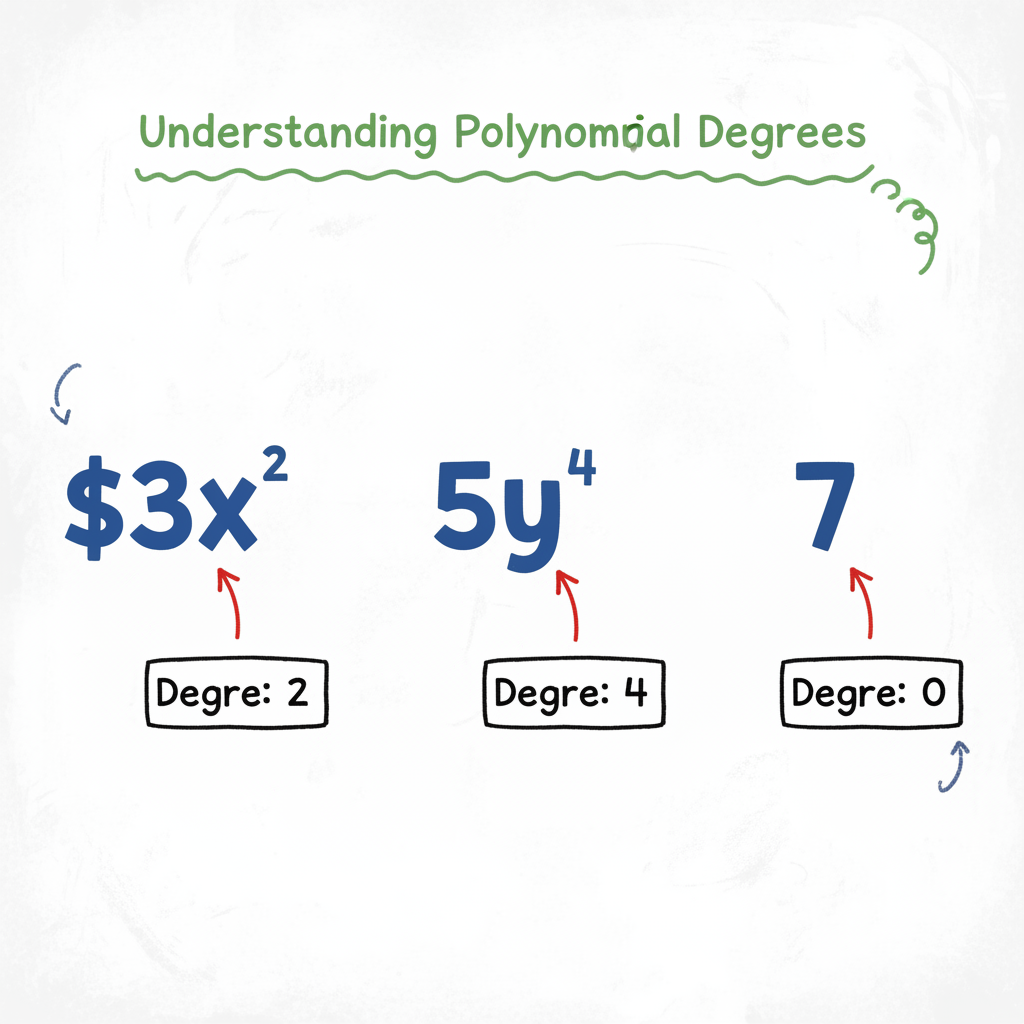 ⚠️ This picture may have spelling mistakes. Trust the words in the lesson.
Step 2: Find the "Degree of the Polynomial" (The Biggest Spice in the Recipe!)
Once you've found the degree of each individual term in the polynomial, the "degree of the polynomial" itself is simply the highest degree among all those terms.
Analogy: If you're making a chili, and you have mild peppers (degree 1), medium peppers (degree 2), and super-hot peppers (degree 5), the overall "hotness" of your chili is determined by the super-hot peppers. Even if you have lots of mild peppers, the degree of hotness is still 5! Similarly, the degree of a polynomial is determined by its "spiciest" term.
Let's try an example: Find the degree of 5x3 - 2x4 + 7x - 10
- Identify each term:
- Term 1:
5x3 - Term 2:
-2x4 - Term 3:
7x - Term 4:
-10
- Term 1:
- Find the degree of each term:
- Degree of
5x3: The exponent is 3. So, 3. - Degree of
-2x4: The exponent is 4. So, 4. - Degree of
7x(which is7x1): The exponent is 1. So, 1. - Degree of
-10: No variable. So, 0.
- Degree of
- Find the highest degree among all terms:
- The degrees we found are 3, 4, 1, and 0.
- The highest among these is 4.
Therefore, the degree of the polynomial 5x3 - 2x4 + 7x - 10 is 4.
Another example: Find the degree of y5 + 3y2 - 8
- Terms:
y5,3y2,-8 - Degrees of terms:
y5: degree 53y2: degree 2-8: degree 0
- Highest degree: The degrees are 5, 2, 0. The highest is 5.
So, the degree of the polynomial y5 + 3y2 - 8 is 5.
What about simple polynomials?
9x + 2: Terms are9x(degree 1) and2(degree 0). Highest is 1. Degree = 1. (These are called "linear" polynomials, like a straight line!)-3x2: Only one term. Its degree is 2. Degree = 2. (These are called "quadratic" polynomials, often making a U-shape graph!)17: Only one term, a constant. Its degree is 0. Degree = 0.
Why is the Degree Important? (Knowing Your Math Machine!)
The degree of a polynomial isn't just a random number; it's like a blueprint detail that tells us a lot about the polynomial's behavior and shape when graphed. Different degrees lead to different kinds of mathematical 'machines' or 'stories'.
- A polynomial of degree 1 (like
2x + 1) will always graph as a straight line. - A polynomial of degree 2 (like
x2 + 3x - 5) will always graph as a parabola (a U-shaped curve). - Higher degrees create more complex curves and shapes!
By understanding the degree, you're gaining insight into the fundamental nature of these mathematical expressions, which will be incredibly useful as you advance in algebra and beyond!
Summary of Our Journey to Degree Mastery
You've just learned to identify the "power level" of any polynomial. Remember, it's all about finding the individual "ingredient strengths" (term degrees) and then picking the "strongest ingredient" (highest term degree) to define the whole "dish" (polynomial).
Keep practicing, and you'll become an expert at spotting the degree of any polynomial that comes your way!
Keep learning, free
Create a free Syllabax account to unlock practice questions and games for this topic.
Visual Learning Enhanced! 🚀
To help you master this topic, we use Advanced Syllabax AI to generate detailed diagrams and visual models.
Note on Visuals: The AI sometimes makes spelling errors in image labels. Please refer to the lesson text for the correct terminology.