Learning Journey
Free preview · Lesson 1
Understanding Number bonds (pairs making 10) (Mental Calculations )
Learning Resource: Number Bonds to 10 - Your First Math Superpower!
Hello, young mathematicians! Today, we're going on an exciting adventure to discover a special secret in numbers. It's called 'Number Bonds,' and it's all about finding pairs of numbers that love to add up to 10. Think of it like finding best friends for each number so they can make a perfect team of 10!
What are Number Bonds?
Imagine you have a box of 10 colorful crayons. Sometimes, you might want to pick out a few to draw a rainbow. Number bonds help us understand how different groups of crayons can be chosen to make a total of 10. For example, if you pick 3 red crayons, how many more do you need to have 10 crayons in total? That's where number bonds come in!
A number bond is like a team of two numbers that always stick together to make a bigger number. In our case, the bigger number we want to make is 10. So, we are looking for pairs of numbers that add up to 10. It's like a secret handshake between numbers!
Why is 10 So Special?
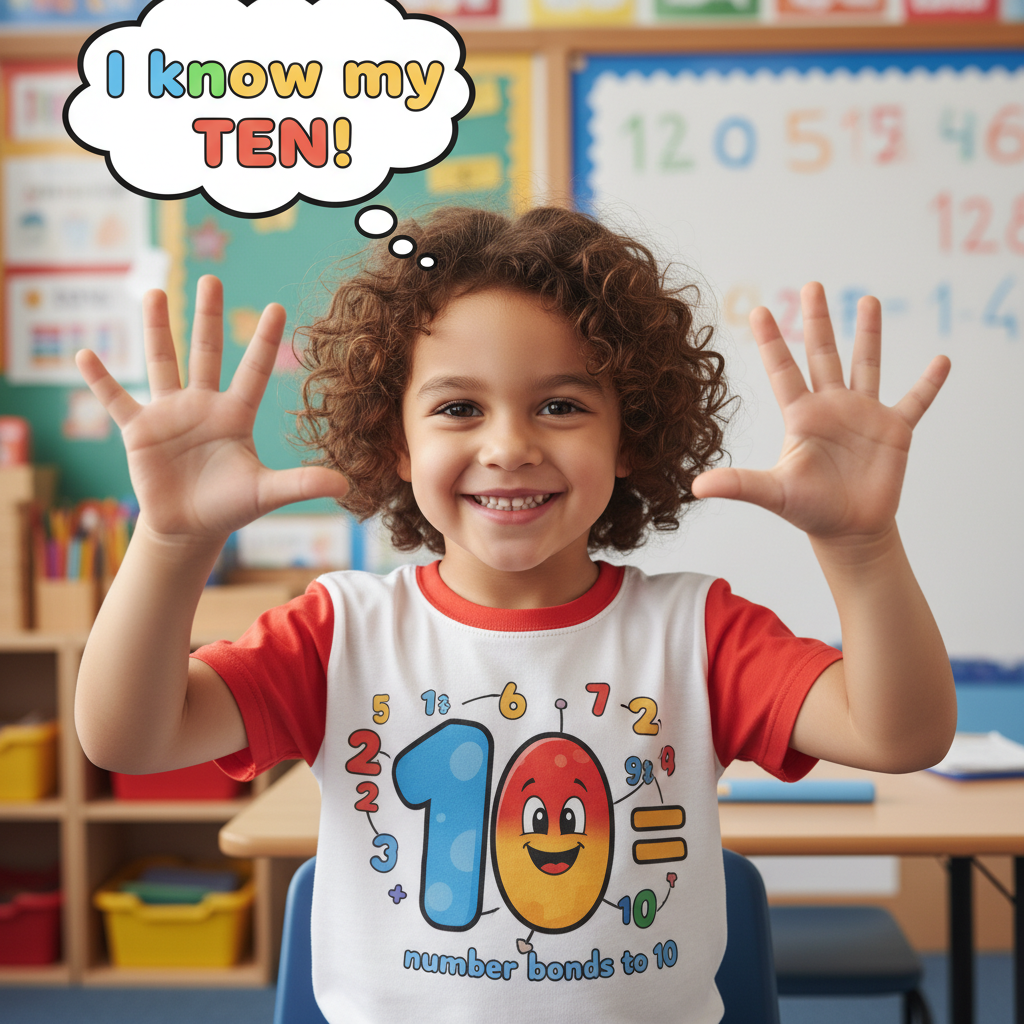
The number 10 is super important because it's how we count most things in the world! We have 10 fingers and 10 toes. When we count using numbers, we often group things in tens. Understanding number bonds to 10 is like learning the alphabet of numbers. Once you know your number bonds to 10, you can do lots of amazing math tricks in your head!
Let's Find the Number Bonds to 10!
Let's start with the smallest number, 0. What number needs to be its best friend to make 10?
0 + ? = 10. If you have 0 fingers up, you need 10 fingers up to make a total of 10. So, 0 and 10 are a number bond pair!
Now, let's try 1. What number is friends with 1 to make 10?
1 + ? = 10. Imagine you have 1 cookie. How many more cookies do you need to have 10 cookies? You need 9 more! So, 1 and 9 are a number bond pair!
How about 2? What number is friends with 2 to make 10?
2 + ? = 10. If you have 2 toy cars, how many more do you need to have 10 cars? You need 8 more! So, 2 and 8 are a number bond pair!
Let's keep going!
- 3 + ? = 10. The friend of 3 is 7. (3 and 7 make 10)
- 4 + ? = 10. The friend of 4 is 6. (4 and 6 make 10)
- 5 + ? = 10. The friend of 5 is 5. (5 and 5 make 10)
Look! We've found so many pairs! Notice how the numbers start to repeat in a way? We found 3 and 7, and now we'll find 7 and 3. It's like saying 'hello' and 'goodbye' – both mean you're connecting!
- 6 + ? = 10. The friend of 6 is 4. (6 and 4 make 10)
- 7 + ? = 10. The friend of 7 is 3. (7 and 3 make 10)
- 8 + ? = 10. The friend of 8 is 2. (8 and 2 make 10)
- 9 + ? = 10. The friend of 9 is 1. (9 and 1 make 10)
- 10 + ? = 10. The friend of 10 is 0. (10 and 0 make 10)
Let's Visualize!
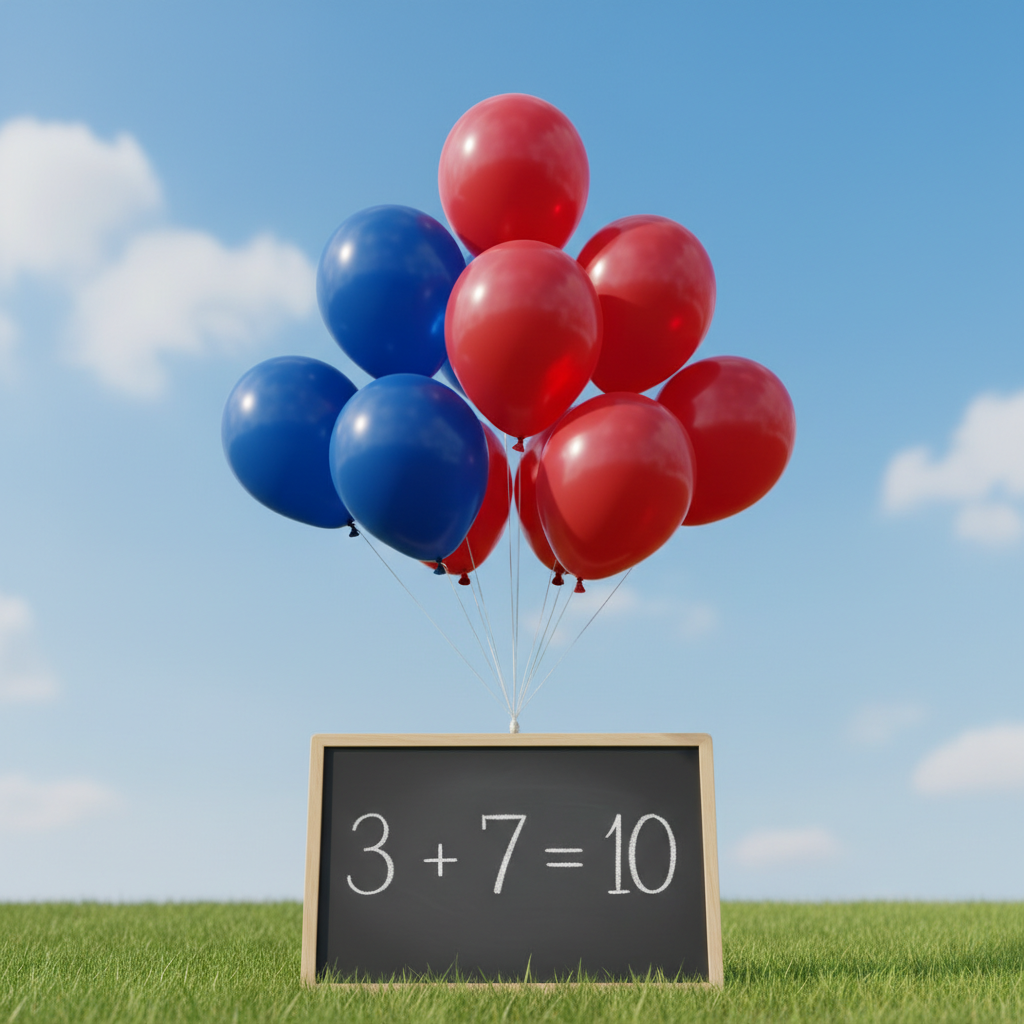
Imagine you have 10 balloons. You can tie them together in different ways to make groups.
You could have 1 blue balloon and 9 red balloons. That's 1 + 9 = 10!
You could have 2 yellow balloons and 8 green balloons. That's 2 + 8 = 10!
You could have 5 purple balloons and 5 orange balloons. That's 5 + 5 = 10!
These pairs are the number bonds to 10. They are like secret codes that unlock how numbers fit together.
 ⚠️ This picture may have spelling mistakes. Trust the words in the lesson.
Why are Number Bonds Useful? (Mental Math Magic!)
Knowing your number bonds to 10 is like having a superpower for doing math in your head! When you see a math problem like 8 + 2, you can instantly think, "Oh, 8 and 2 are friends that make 10!" This helps you solve problems much faster without even needing to count on your fingers.
It's also helpful for bigger numbers. If you have to solve 15 - 5, you can think, "Hmm, 15 is 10 and 5. I need to take away the 5. What's left? The 10!" Because you know 5 and 5 make 10, you can easily solve that problem.
Think of it like learning to ride a bike. At first, you might need training wheels (like counting on your fingers), but once you learn to balance (understand number bonds), you can ride smoothly and quickly all by yourself!
 ⚠️ This picture may have spelling mistakes. Trust the words in the lesson.
Let's Recap Our Number Bonds to 10!
Here are all the pairs of numbers that love to add up to 10:
- 0 + 10 = 10
- 1 + 9 = 10
- 2 + 8 = 10
- 3 + 7 = 10
- 4 + 6 = 10
- 5 + 5 = 10
- 6 + 4 = 10
- 7 + 3 = 10
- 8 + 2 = 10
- 9 + 1 = 10
- 10 + 0 = 10
Practice saying these pairs out loud. You can draw pictures, use blocks, or even sing songs about them. The more you practice, the stronger your number bond superpower will become!
Keep learning, free
Create a free Syllabax account to unlock practice questions and games for this topic.
Visual Learning Enhanced! 🚀
To help you master this topic, we use Advanced Syllabax AI to generate detailed diagrams and visual models.
Note on Visuals: The AI sometimes makes spelling errors in image labels. Please refer to the lesson text for the correct terminology.