Shopping & bill calculation (Real-Life Math)
Watch this topic in 60 seconds
Free preview · Lesson 1
Understanding Shopping & bill calculation (Real-Life Math)
Shopping Smart: Your Guide to Math in the Store!
Imagine you're going to the toy store or the grocery store. You see so many amazing things you want! But how do you make sure you have enough money? That's where math comes in! Shopping and figuring out bills is a super useful skill, and we're going to learn all about it today. It's like being a detective, but instead of solving mysteries, you're solving money puzzles!
What is Shopping?
Shopping is when you go to a store (or online!) and choose items you want or need. Think about buying your favorite cereal, a cool new book, or maybe a gift for a friend. You exchange money for these items. It's a way we get the things that make our lives easier and more fun.
What is a Bill?
A bill is like a receipt or a list that tells you how much money you owe for the things you bought. Sometimes, when you buy many things, the cashier adds them all up for you. That total is the bill! It's important to know how to read a bill so you know you're paying the right amount.
Understanding Prices: The Heart of Shopping Math
Everything in a store has a price. This price is the amount of money you need to give the store to get that item. Prices are usually shown in dollars ($) and cents (¢).
Dollars and Cents: Our Money Friends
Think of a dollar as a whole pizza. A cent is like a tiny slice of that pizza. There are 100 cents in one dollar. So, if something costs $1.50, it means it costs one whole dollar and 50 tiny slices of another dollar.
Analogy: The Candy Jar
Imagine you have a big candy jar. Each whole dollar is like a full bag of 100 candies. Cents are the individual candies. If a toy costs $3.75, it means you need 3 full bags of 100 candies, plus 75 more individual candies.
Adding Prices: When You Buy More Than One Thing
When you buy more than one item, you need to add their prices together to find the total cost. This is just like putting your LEGO bricks together to build something bigger!
Let's say you want to buy:
- A yummy apple for $0.75
- A delicious banana for $0.50
To find the total cost, we add them up:
Analogy: Stacking Blocks
Imagine you have two stacks of blocks. One stack is 75 centimeters tall (that's like
Calculating the Total: The Grand Sum!
When you go to the checkout, the cashier scans all your items. The scanner is like a super-fast calculator! It adds up the price of each item to give you the total amount you need to pay. This total is your bill.
Example: Party Supplies!
You're planning a party and need:
- Balloons: $4.50
- Cake: $12.75
- Juice boxes: $3.25
Let's add them up:
It's easier to add if we line up the decimal points (the little dots):
  $ 4.50
  $12.75
+ $ 3.25
-------
Add the cents first (the numbers after the decimal point): 50 + 75 + 25 = 150 cents. Since 100 cents make a dollar, that's
Now add the dollars (the numbers before the decimal point), including the carried-over $1:
So, the total bill is $20.50!
Checking Your Change: Are You Getting the Right Amount Back?
When you pay with cash, you might get some money back. This is called change. You give the cashier more money than the bill, and they give you the difference back.
Example: Paying for a Book
You buy a book for
To find your change, you subtract the cost of the book from the money you paid:
  $10.00
-  $7.50
-------
Subtracting the cents: 00 - 50. We can't do that, so we borrow from the dollars. The 10 becomes a 9, and the first 0 becomes 10. Now we have 100 cents - 50 cents = 50 cents.
Subtracting the dollars:
Your change is $2.50!
Analogy: Sharing Cookies
Imagine you have 10 cookies (that's
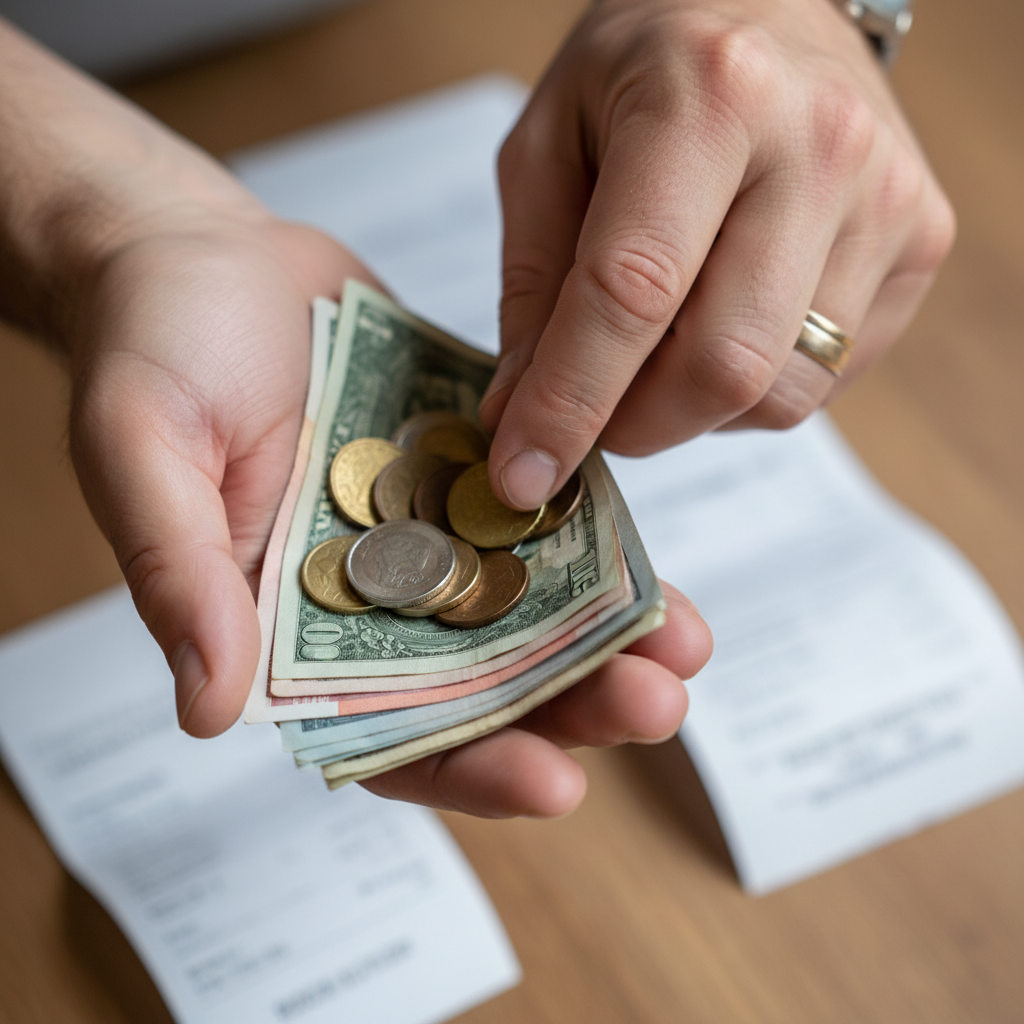 ⚠️ This picture may have spelling mistakes. Trust the words in the lesson.
Why is this important?
Knowing how to calculate prices and check your change helps you:
- Stay on Budget: Make sure you only spend the money you have.
- Avoid Mistakes: Check if the cashier gave you the correct change.
- Become Independent: You can go shopping for yourself!
- Be a Smart Consumer: Understand the value of money.
Shopping math is all around us, from buying snacks to planning a big event. Practice these skills, and you'll be a shopping whiz in no time!
Keep learning, free
Create a free Syllabax account to unlock practice questions and games for this topic.
Visual Learning Enhanced! 🚀
To help you master this topic, we use Advanced Syllabax AI to generate detailed diagrams and visual models.
Note on Visuals: The AI sometimes makes spelling errors in image labels. Please refer to the lesson text for the correct terminology.