Learning Journey
Watch this topic in 60 seconds
Free preview · Lesson 1
Understanding Adolescence & puberty[BIOLOGY]
Understanding Adolescence and Puberty: A Biological Journey
Welcome to a fascinating chapter in your life! You're entering a time called adolescence, which is like a bridge connecting childhood to adulthood. The most visible part of this journey is puberty, a period of rapid physical and emotional changes that happen as your body matures. Think of it like a construction site where your body is getting a major upgrade to prepare you for the future!
What is Adolescence?
Adolescence is a broad term that refers to the period of life between childhood and adulthood. It's a time of immense growth, not just physically, but also mentally, socially, and emotionally. You might notice yourself thinking about the world in new ways, forming stronger friendships, and figuring out who you are. It's a time of discovery and learning!
What is Puberty? The Body's Big Changes
Puberty is the biological process that makes you sexually mature. It's driven by special chemical messengers in your body called hormones. Hormones are like tiny messengers that travel through your bloodstream, telling different parts of your body what to do and when to do it. During puberty, your brain signals your glands (like the pituitary gland, often called the 'master gland') to release more of these hormones, kicking off a cascade of changes.
Hormones: The Body's Chemical Messengers
Imagine your body is a very busy city. Hormones are like the delivery trucks and radio signals that coordinate all the different services. They carry important instructions from one part of the city (your brain or glands) to another (your organs or tissues).
For girls: The main hormones involved are estrogen and progesterone. These hormones are like the directors for changes specific to female development.
For boys: The main hormone is testosterone. This is like the main conductor for changes specific to male development.
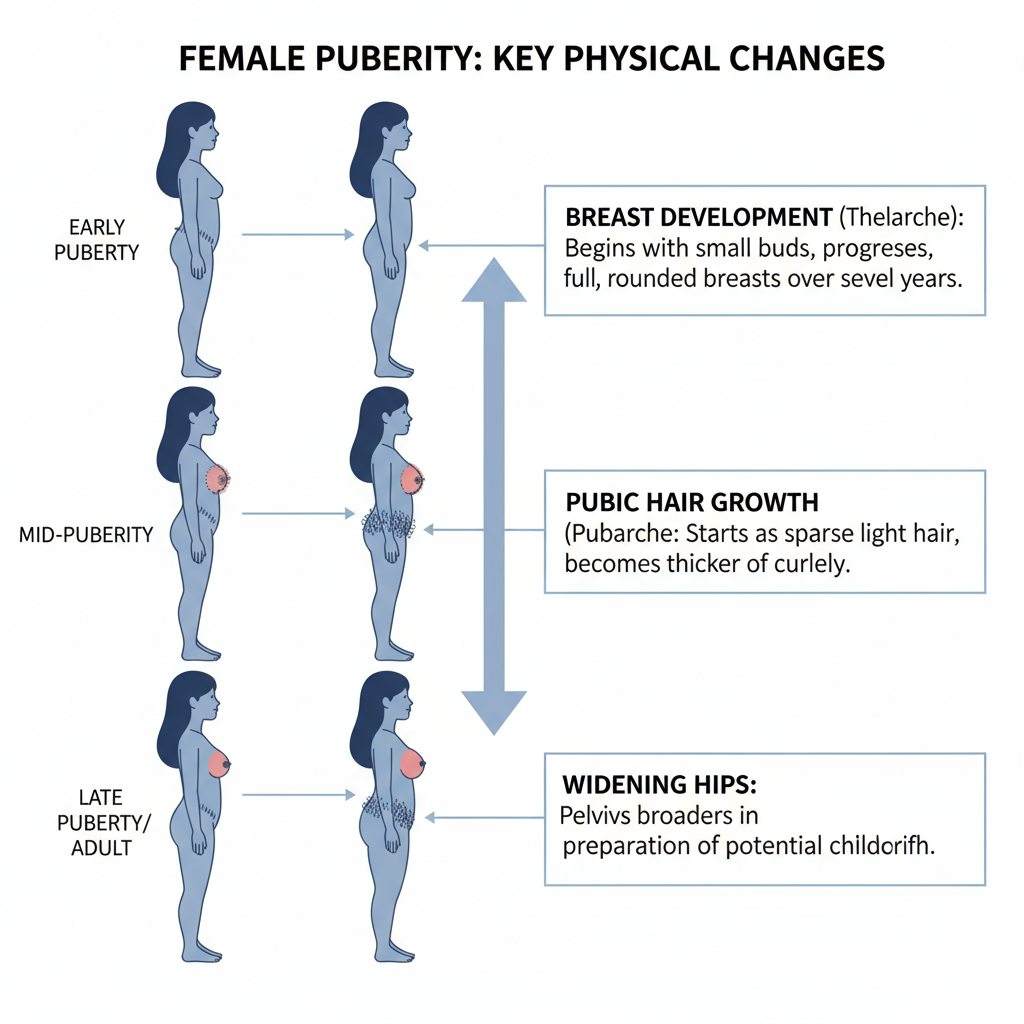
Changes in Girls
Puberty typically starts for girls between the ages of 8 and 13. The changes are guided by hormones like estrogen and progesterone.
- Breast Development: This is often one of the first signs. Your breasts will start to grow, which is completely normal. Think of it like building new rooms in your body's house.
- Pubic and Underarm Hair Growth: Hair will start to grow in these areas. This is like adding protective coverings in new places.
- Growth Spurt: You'll likely experience a rapid increase in height and weight. It's like your body is stretching and filling out.
- Menstruation (Period): This is a crucial part of female reproductive development. Your uterus (a special organ inside your body) prepares for a possible pregnancy each month. If pregnancy doesn't happen, the lining of the uterus sheds, which is called menstruation or a period. It's like the body cleaning out a room that wasn't used that month.
- Changes in Body Shape: Your hips may widen, and your body will start to develop curves.
Changes in Boys
Puberty typically starts for boys between the ages of 9 and 14. Testosterone is the key hormone driving these changes.
- Testicular and Penis Growth: Your testicles (where sperm are made) and penis will start to grow larger. This is the development of the reproductive organs.
- Pubic, Underarm, and Facial Hair Growth: Hair will appear in these areas. Facial hair (like a mustache or beard) starts to grow, and your voice might deepen. This is like your body adding different types of armor and changing its sound.
- Growth Spurt: Boys often have a later but sometimes more significant growth spurt than girls, leading to increased height and muscle mass. It's like your body is bulking up and growing taller.
- Voice Deepening: Your voice box (larynx) grows, causing your voice to crack and then deepen. It's like changing the pitch of your vocal instrument.
- Muscle Development: You'll notice an increase in muscle size and strength.
- Sperm Production: Your body begins producing sperm, which are the cells needed to create a baby.
Emotional and Social Changes
Puberty isn't just about physical changes. It's also a time of big emotional and social shifts. You might experience a wider range of emotions, feel more sensitive, and become more interested in friendships and romantic relationships. Your brain is also developing, helping you think more abstractly and make more complex decisions. This is like your internal software getting a major update!
It's normal to feel a mix of excitement, confusion, and even embarrassment during this time. Everyone experiences these changes differently and at their own pace. Talking to trusted adults like parents, guardians, or teachers can be very helpful.
Key Concepts Recap
- Adolescence: The period between childhood and adulthood, involving physical, mental, and social changes.
- Puberty: The biological process of sexual maturation during adolescence.
- Hormones: Chemical messengers that control bodily functions and development (e.g., estrogen, progesterone, testosterone).
- Growth Spurt: A period of rapid increase in height and weight.
- Menstruation: The monthly shedding of the uterine lining in girls.
This is a natural and important part of growing up. Embrace the changes, ask questions, and remember you're not alone on this journey!
Keep learning, free
Create a free Syllabax account to unlock practice questions and games for this topic.
Visual Learning Enhanced! 🚀
To help you master this topic, we use Advanced Syllabax AI to generate detailed diagrams and visual models.
Note on Visuals: The AI sometimes makes spelling errors in image labels. Please refer to the lesson text for the correct terminology.