Geometrical patterns [Patterns & Sequences]
Watch this topic in 60 seconds
Free preview · Lesson 1
Understanding Geometrical patterns [Patterns & Sequences]
Geometrical Patterns: Seeing the Shapes that Repeat!
Have you ever noticed how things around you often repeat in a special way? Think about the tiles on the floor, the bricks on a wall, or even the way petals grow on a flower. These are all examples of patterns! In math, we love to study patterns, and today we're going to focus on geometrical patterns. These are patterns made using shapes.
What is a Pattern?
A pattern is something that repeats in a predictable way. Imagine a simple song where a line is sung, and then it's sung again. That's a pattern! In geometry, patterns are made by arranging shapes in a certain order, and that order keeps going.
Why are Geometrical Patterns Important?
Understanding geometrical patterns helps us see the order and beauty in the world around us. It helps us predict what might come next in a sequence of shapes. Think of it like solving a puzzle – once you see the rule, you can figure out the missing pieces!
Types of Geometrical Patterns
Geometrical patterns can be as simple as repeating a single shape, or they can involve a combination of shapes and colors that follow a specific rule.
1. Repeating Patterns
This is the most basic type of geometrical pattern. It's like a phrase in a song that keeps repeating. For example, a pattern might be a circle, then a square, then a circle, then a square, and so on. The rule here is simple: "Circle, Square". This unit of shapes (Circle, Square) is called the core or unit of repeat. It's the smallest part of the pattern that keeps showing up.
Analogy: Think of a row of traffic lights. Red, Yellow, Green, Red, Yellow, Green. The core is "Red, Yellow, Green".
2. Alternating Patterns
These patterns involve two different shapes or arrangements that switch back and forth. It's like a game of "Simon Says" where one instruction is given, then another, and they alternate. For instance, you might see a triangle, then a star, then a triangle, then a star. The rule is to switch between the triangle and the star.
Analogy: Imagine clapping your hands, then stomping your feet, then clapping, then stomping. You are alternating between two actions.
3. Growing Patterns
Growing patterns are a bit more exciting! In these patterns, the shapes or the number of shapes change or grow with each step. It's like a plant growing taller each day. For example, a pattern might start with one square, then two squares, then three squares, and then four squares. The rule is "add one square each time".
Another type of growing pattern could involve shapes that get bigger. Imagine a small circle, then a slightly bigger circle, then an even bigger circle. The rule is to make the circle larger.
Analogy: Think of a stack of blocks. You start with one block, then add another on top, then another. The stack is growing!
Identifying the Rule in a Pattern
The most important part of understanding geometrical patterns is figuring out the rule. The rule tells you how the pattern is made and what comes next.
How to find the rule:
- Look for repetition: Do you see shapes or arrangements that repeat?
- Identify the core: What is the smallest group of shapes that repeats?
- Check for changes: Does the pattern grow? Do shapes change in size or number?
- Describe the change: Can you explain in words how one step leads to the next?
Example:
Look at this sequence of shapes:
⭐ △ ⭐ △ ⭐ △
What do you see repeating?
The shapes are a star (⭐) and a triangle (△).
They appear one after another: Star, Triangle, Star, Triangle...
The rule is to alternate between a star and a triangle.
What shape would come next?
Since the last shape was a triangle, the next shape would be a star (⭐).
Another Example:
Look at this sequence:
● ●● ●●● ●●●●
(Imagine these are circles, or dots)
What is happening here?
We start with one circle. Then we have two circles. Then three circles. Then four circles.
The number of circles is increasing.
The rule is: "Start with one circle, and add one more circle each time." This is a growing pattern.
What would the next step look like?
Following the rule, we would add one more circle to the last group (which had four). So, the next step would have five circles (●●●●●).
Patterns in Nature
Geometrical patterns aren't just in math books; they are everywhere in nature! Look closely, and you'll see them:
- Honeycombs: Bees build honeycombs with hexagonal (six-sided) shapes. This is a very efficient way to store honey!
- Snowflakes: Most snowflakes have six-sided symmetry. They have beautiful, repeating patterns.
- Pinecones: The scales on a pinecone often form spirals that follow mathematical rules.
- Flower Petals: Many flowers have petals arranged in a specific, repeating number or pattern.
By understanding geometrical patterns, we can appreciate the amazing designs that nature creates.
Let's Visualize!
Imagine you are decorating a long banner for a party. You have red squares and blue circles. You want to make a pattern that looks festive and is easy to follow.
You could decide on a repeating pattern: Red Square, Blue Circle, Red Square, Blue Circle...
Or maybe you want a growing pattern: One Red Square, then two Blue Circles, then three Red Squares, then four Blue Circles...
The possibilities are endless, and the fun is in discovering the rule!
Here is an example of a repeating geometrical pattern:
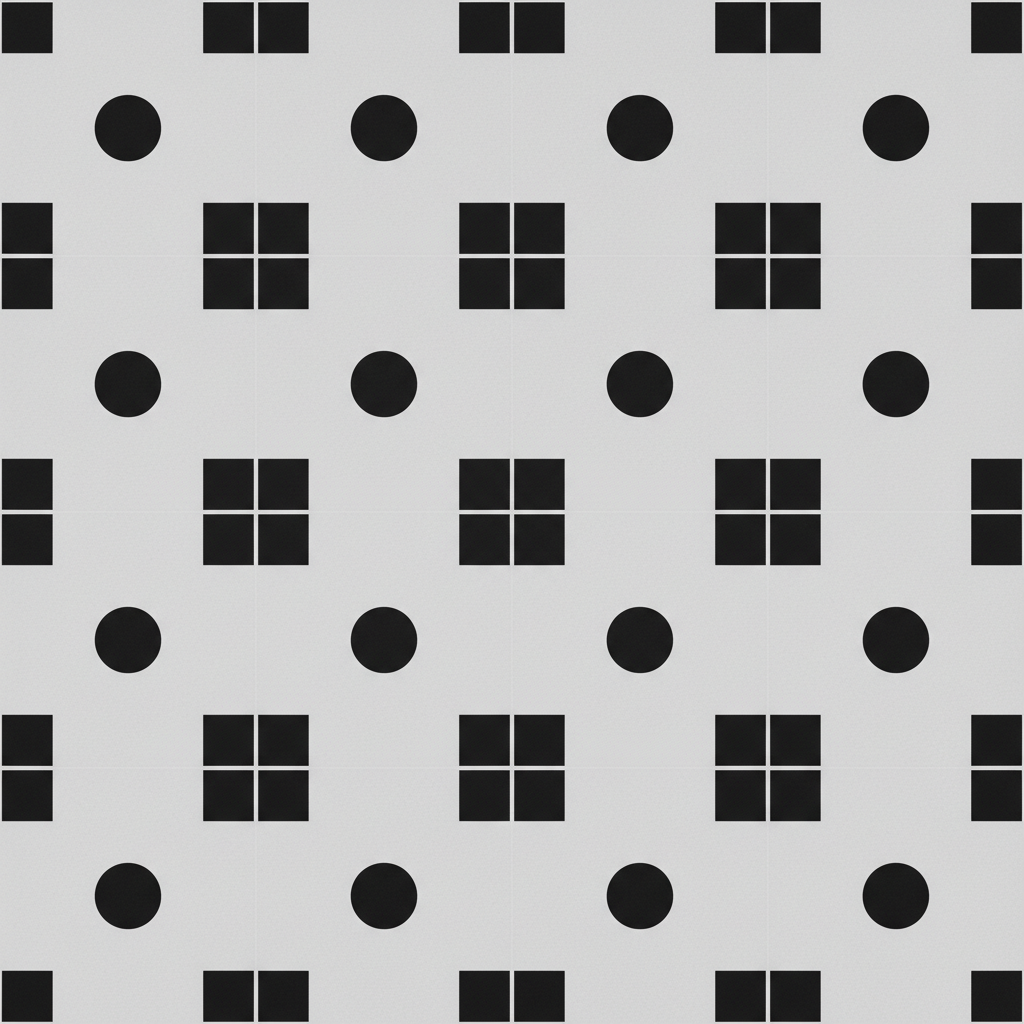
In this image, you can see the core unit is a square followed by a circle. This unit repeats over and over to create the pattern.
Understanding geometrical patterns is like learning a secret code that nature and design use. Once you know the code, you can understand and even create amazing sequences of shapes!
Keep learning, free
Create a free Syllabax account to unlock practice questions and games for this topic.
Visual Learning Enhanced! 🚀
To help you master this topic, we use Advanced Syllabax AI to generate detailed diagrams and visual models.
Note on Visuals: The AI sometimes makes spelling errors in image labels. Please refer to the lesson text for the correct terminology.