Discount & GST (Commercial Math)
Watch this topic in 60 seconds
Free preview · Lesson 1
Understanding Discount & GST (Commercial Math)
Understanding Discount & GST: Your Guide to Commercial Math
Welcome, future financial wizards! In our daily lives, we constantly encounter prices, sales, and taxes. From buying a new pair of shoes to ordering food online, commercial math is all around us. It's not just for shopkeepers or accountants; understanding these concepts helps you make smarter decisions as a consumer and manage your money better. Today, we're going to unlock two super important concepts: Discount and GST (Goods and Services Tax). Don't worry, we'll break it down into simple terms with lots of everyday examples!
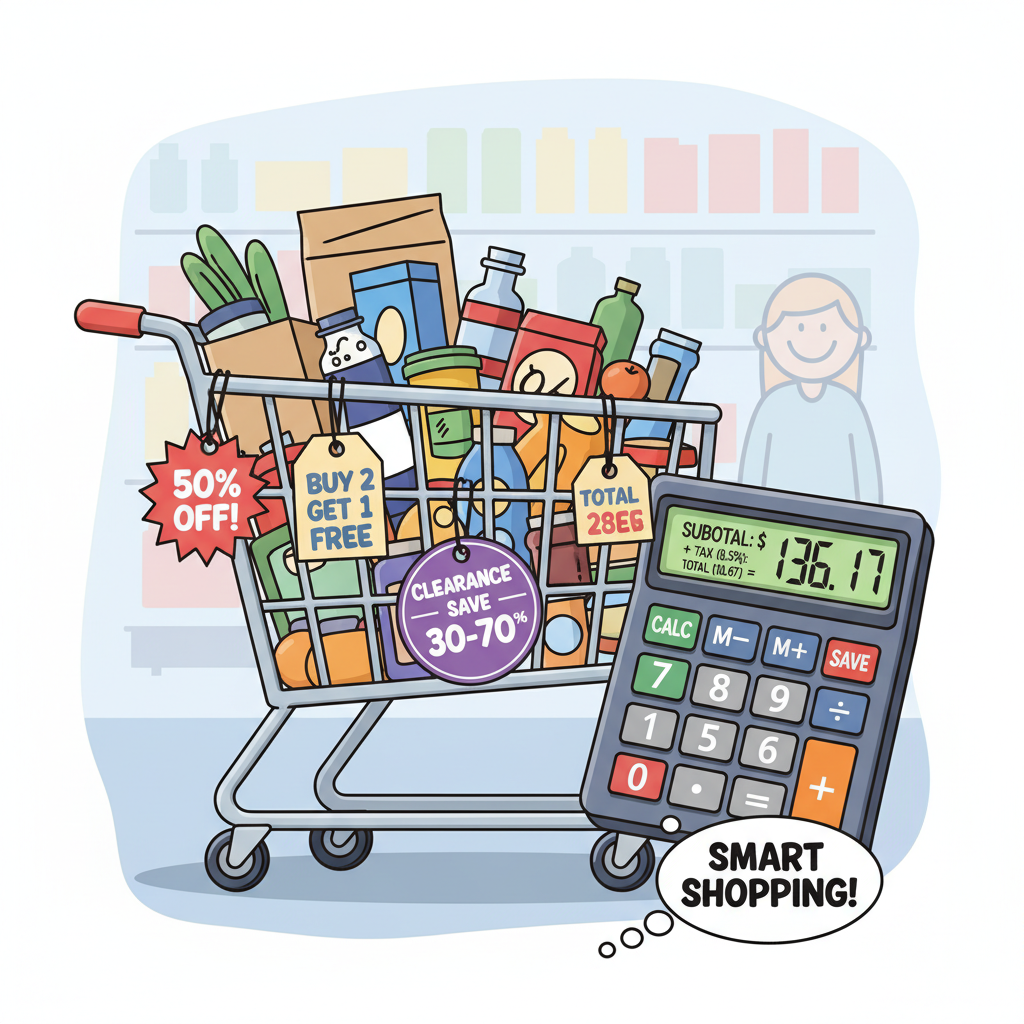 ⚠️ This picture may have spelling mistakes. Trust the words in the lesson.
Part 1: Unraveling the Mystery of Discount
What is a Discount?
Imagine you walk into your favorite clothing store, and you see a big sign that says, "FLAT 20% OFF ALL ITEMS!" That "20% OFF" is a discount. A discount is simply a reduction in the original price of an item. Businesses offer discounts to attract customers, clear old stock, or during festive seasons. Think of it like a special treat or a reward for shopping!
Analogy: Think of a discount as a coupon you're given at a restaurant. If your meal costs
Key Terms related to Discount:
- Marked Price (MP) / List Price: This is the original price of an item, often printed on the price tag or listed in a catalogue. It's the price the seller *initially* wants to sell the item for.
- Selling Price (SP): This is the actual price at which an item is sold to the customer *after* the discount has been applied. It's what you pay at the cash counter.
- Discount Amount: This is the actual amount of money reduced from the Marked Price.
- Discount Percentage: This tells us what portion of the Marked Price was reduced, expressed as a percentage. Discounts are most often given as a percentage.
Analogy: This is like the full price printed on the menu at a restaurant before any special offers or coupons are applied.
Analogy: This is the final amount you pay for your meal *after* the coupon has been deducted.
Formula: Discount Amount = Marked Price - Selling Price
Formula: Discount Percentage = (Discount Amount / Marked Price) * 100%
We can also find the Selling Price directly if we know the Marked Price and Discount Percentage:
Formula: Selling Price = Marked Price * (1 - Discount Percentage / 100)
Example with Discount:
A toy car has a Marked Price of $500. The shop offers a 10% discount.
- Calculate the Discount Amount:
Discount = 10% of - Calculate the Selling Price:
Selling Price = Marked Price - Discount Amount =
So, you pay $450 for the toy car.
Part 2: Decoding GST (Goods and Services Tax)
What is GST?
Now, let's talk about something that gets *added* to the price instead of taken away: Tax. Specifically, we'll focus on GST (Goods and Services Tax). GST is a single tax levied by the government on the sale of most goods and services. It's an indirect tax, meaning it's collected by the seller from the buyer and then passed on to the government.
Analogy: Imagine you're at a concert, and to use the restroom, you have to pay a small fee. That fee goes towards maintaining the facilities for everyone. Similarly, GST is a fee on goods and services that goes towards government services like building roads, schools, hospitals, and maintaining public services.
Key Terms related to GST:
- Taxable Value: This is the price of the good or service *before* GST is added. Often, this is the Selling Price after any discounts.
- GST Rate: This is the percentage at which GST is charged. It can vary depending on the type of good or service (e.g., 5%, 12%, 18%, 28% in some countries).
- GST Amount: This is the actual amount of money added as tax to the Taxable Value.
- Final Price / Invoice Price: This is the total price the customer pays, which includes the Taxable Value plus the GST Amount.
Analogy: This is the price of your meal at the restaurant *after* your coupon has been applied, but *before* the tip is calculated.
Formula: GST Amount = (GST Rate / 100) * Taxable Value
Formula: Final Price = Taxable Value + GST Amount
We can also find the Final Price directly:
Formula: Final Price = Taxable Value * (1 + GST Rate / 100)
Example with GST:
You buy a book for $300. An 18% GST is applicable.
- Calculate the GST Amount:
GST Amount = 18% of - Calculate the Final Price:
Final Price = Book Price + GST Amount =
So, you pay $354 for the book.
Part 3: Putting it All Together – Discount THEN GST
In most real-world scenarios, if both a discount and GST are involved, the discount is applied first, and then GST is calculated on the discounted price. This is because the government taxes the actual value of the good or service being sold.
Analogy: Imagine buying a new smartphone. First, the store gives you a holiday discount on its original price. You get a cheaper price, right? NOW, the government adds tax (GST) on *that cheaper price* you're actually paying, not the original, higher price. It's a two-step process!
Combined Example:
A smart watch has a Marked Price of $2000. It is offered with a 20% discount, and then a 12% GST is applicable on the discounted price.
- Step 1: Calculate the Discount Amount and Selling Price (after discount).
Marked Price = - Step 2: Calculate the GST Amount on the Selling Price.
Taxable Value = - Step 3: Calculate the Final Price.
Final Price = Selling Price + GST Amount =
So, you will pay a total of $1792 for the smart watch after the discount and GST.
Conclusion
Understanding discount and GST is more than just solving math problems; it's about being an informed consumer and making smart financial choices. Whether you're shopping for groceries, buying gadgets, or planning a trip, these concepts are fundamental to navigating the real world of commerce. Keep practicing, and you'll become a pro at understanding every price tag and bill!
Keep learning, free
Create a free Syllabax account to unlock practice questions and games for this topic.
Visual Learning Enhanced! 🚀
To help you master this topic, we use Advanced Syllabax AI to generate detailed diagrams and visual models.
Note on Visuals: The AI sometimes makes spelling errors in image labels. Please refer to the lesson text for the correct terminology.