Cube (Surface Area)
Watch this topic in 60 seconds
Free preview · Lesson 1
Understanding Cube (Surface Area)
Understanding the Surface Area of a Cube: Your Foundational Guide
Hey future mathematicians! Today, we're going to embark on a fun journey into the world of three-dimensional shapes, specifically focusing on a very familiar one: the cube. Think of a standard dice, a sugar cube, or even a Rubik's cube – these are all perfect examples of cubes! Our mission is to understand what 'surface area' means for a cube and how to calculate it.
What Exactly IS a Cube? Let's Get Acquainted!
Before we dive into surface area, let's make sure we're all on the same page about what a cube is. Imagine a perfectly symmetrical box. That's essentially a cube!
- Faces: A cube has 6 faces. Think of a face as one of the flat sides of the cube. If you're holding a dice, each number (1 through 6) is on a different face. The cool thing about a cube is that ALL its faces are identical perfect squares!
- Edges: A cube has 12 edges. An edge is where two faces meet. Imagine the lines where the sides of a box connect.
- Vertices: A cube has 8 vertices. A vertex (plural: vertices) is a corner, where three edges meet.
So, remember: 6 square faces, 12 edges, 8 vertices.
Peeling Back the Layers: What is Surface Area?
Now for the main event: surface area! In simple terms, the surface area of a 3D object (like our cube) is the total area of all its outer surfaces combined. Think of it like this:
- Analogy 1: The Gift Wrapper. Imagine you have a cube-shaped gift box. If you want to wrap it completely, the amount of wrapping paper you'd need to cover the entire box without any overlaps or gaps is its surface area. You're covering all the outside 'skin' of the box!
- Analogy 2: The Painter. Picture a giant cube-shaped block that you need to paint. If you paint every single side of the block, the total area you've painted is the surface area of the block.
- Analogy 3: The Sticker Collector. If you're covering a dice with small stickers, and you want to completely cover every single side, the total area of all the stickers needed would be the surface area of the dice.
So, surface area isn't about what's inside the cube (that's volume!), but rather about what's on its outside.
Unfolding the Cube: Meet the 'Net'!
To really understand surface area, it helps to imagine 'unfolding' the cube. If you carefully cut along some of the edges of a cardboard box and lay it flat, what you get is called a net. For a cube, its net will always consist of 6 squares, because, as we learned, a cube has 6 square faces!
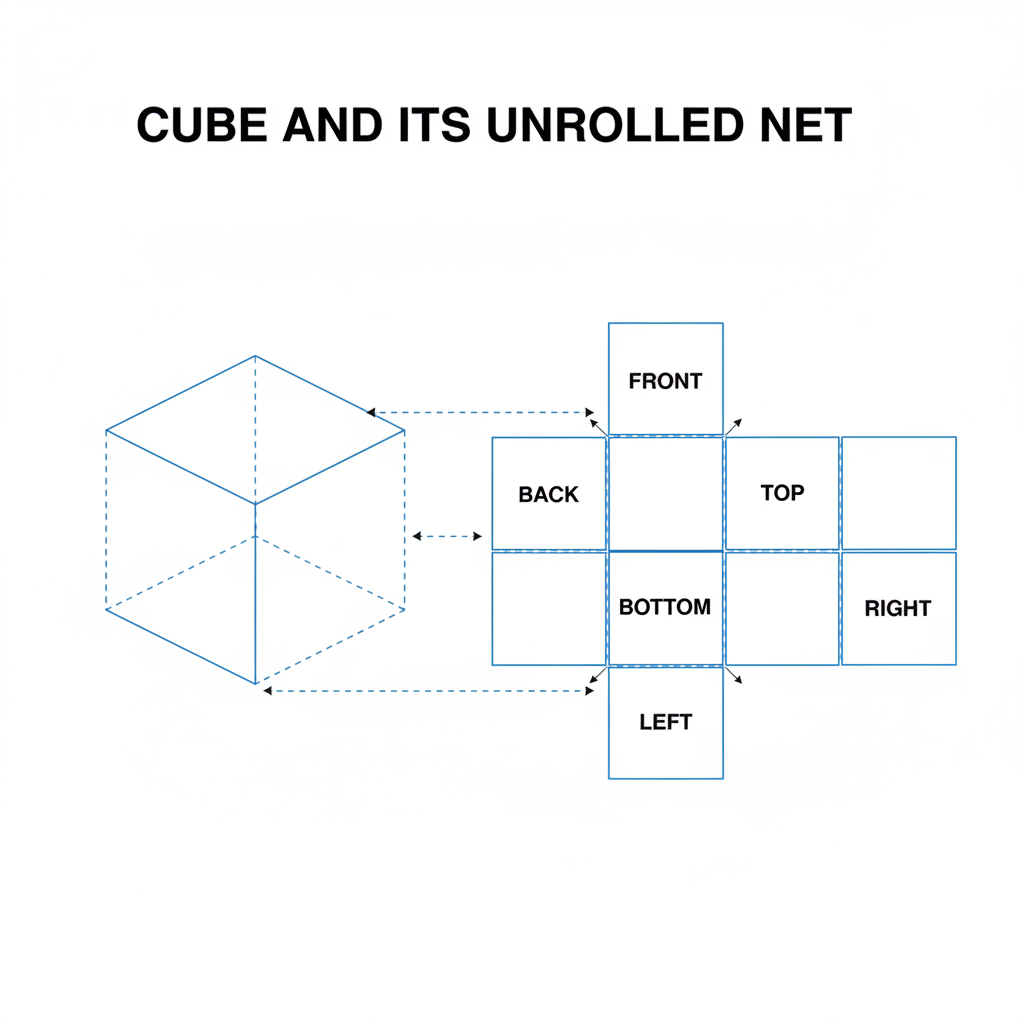
Look at the image above. You can see how the 3D cube transforms into a flat, 2D shape made of six squares. If you calculate the area of each of these six squares and add them all up, you've found the surface area of the original cube!
Calculating the Area of One Face (It's a Square!)
Since all faces of a cube are identical squares, let's recall how to find the area of a single square:
- The area of a square is found by multiplying its side length by itself.
- If we let 's' represent the length of one side of the square face, then the area of one face is s × s, or simply s².
For example, if a cube has a side length of 5 centimeters (cm), then the area of one of its faces is 5 cm × 5 cm = 25 square centimeters (cm²).
Putting It All Together: The Formula for Surface Area of a Cube
We know a cube has 6 identical square faces. We also know how to find the area of one face (s²). So, to find the total surface area, we just need to add up the areas of all 6 faces! Since they are all the same, this is easy:
Surface Area of a Cube = 6 × (Area of one face)
Or, using our 's' for side length:
Surface Area (SA) = 6 × s²
Let's Try an Example!
Imagine you have a building block that is a perfect cube. Each side of the block measures 4 inches.
- Identify the side length (s): s = 4 inches
- Calculate the area of one face: Area of one face = s² = 4 inches × 4 inches = 16 square inches (in²)
- Multiply by 6 (because there are 6 faces): Total Surface Area = 6 × 16 in² = 96 square inches (in²)
So, the surface area of the building block is 96 square inches. This means if you wanted to paint every side of that block, you would be painting a total area of 96 square inches!
Why Does This Matter in the Real World?
Understanding surface area isn't just a math exercise; it has practical uses!
- Packaging: Companies need to know the surface area of their boxes to estimate how much cardboard they need, or how much material for labels.
- Painting/Construction: If you're painting a cubical room or object, you need to calculate the surface area to know how much paint to buy.
- Heat Transfer: In engineering and science, surface area can be crucial for understanding how objects heat up or cool down, as heat transfer often happens through surfaces.
Key Takeaways to Remember!
You've got this! Just remember these core ideas, and you'll be a surface area expert in no time.
Keep learning, free
Create a free Syllabax account to unlock practice questions and games for this topic.
Visual Learning Enhanced! 🚀
To help you master this topic, we use Advanced Syllabax AI to generate detailed diagrams and visual models.
Note on Visuals: The AI sometimes makes spelling errors in image labels. Please refer to the lesson text for the correct terminology.