Counting in Groups
Watch this topic in 60 seconds
Free preview · Lesson 1
Understanding Counting in Groups
Let's Count in Groups! A Fun Way to Count Bigger Numbers!
Hello, young mathematicians! Have you ever had a big pile of cookies, crayons, or toy cars to count? Counting them one by one can take a long, long time, right? Like trying to pick up every single grain of sand on the beach! But what if I told you there's a super-duper secret trick to count faster and easier? It's called Counting in Groups!
What is Counting in Groups?
Imagine you have a big basket of apples. If you count them one by one (1, 2, 3, 4...), it's good, but it can be slow. Now, imagine you put two apples into a small bag, then two more into another bag, and so on. Now you just count the bags! Each bag has 2 apples, so you're counting 'two, four, six, eight...' This is counting in groups!
Counting in groups means putting things into small, equal bunches and counting those bunches instead of each individual item. It's like bundling things together to make them easier to carry or count quickly. We often count in groups of 2, 5, or 10.
Why is Counting in Groups So Helpful?
It's like having a superpower for counting! Here's why:
- It's Faster: Instead of saying "one, two, three, four, five," you can just say "five!"
- It's Easier: Your brain doesn't have to keep track of as many separate things.
- It Helps with Bigger Numbers: When you have lots and lots of things, grouping helps you get to the big answer without getting lost.
- It Helps You See Patterns: Counting in groups shows you how numbers grow in a special way.
Let's Explore Different Groups!
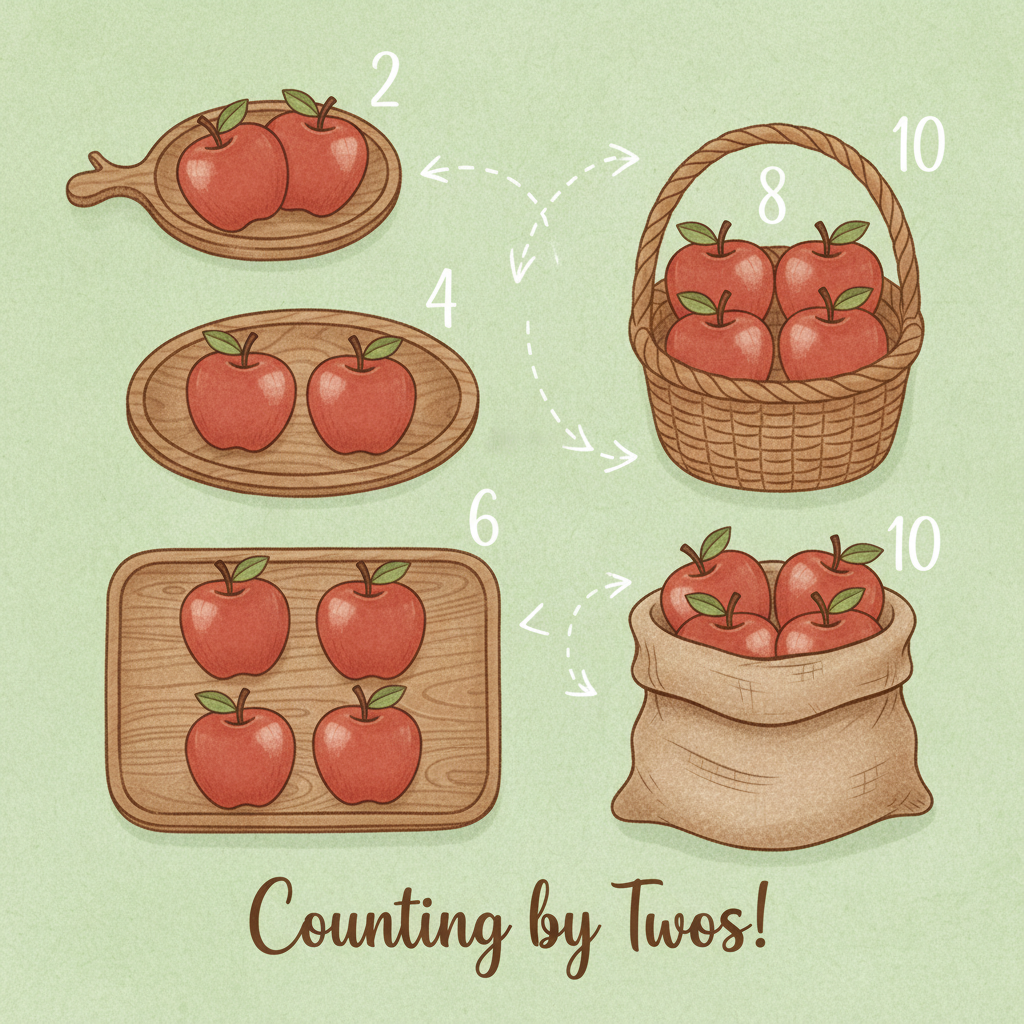
Counting in Groups of 2 (Counting by Twos)
Think about things that naturally come in pairs. Like your shoes! You wear two shoes, one on each foot. Or your socks! You put two socks on. Or your eyes! You have two eyes. When we count by twos, we count like this: 2, 4, 6, 8, 10, 12, and so on.
Analogy: Imagine you have a big pile of socks. Instead of counting "one sock, two socks, three socks...", you can pick them up and make pairs! "One pair (that's 2 socks), two pairs (that's 4 socks), three pairs (that's 6 socks)." See how much faster that is?
Let's try counting these stars by twos:
⭐ ⭐ (2) ⭐ ⭐ (4) ⭐ ⭐ (6) ⭐ ⭐ (8) ⭐ ⭐ (10)
Counting in Groups of 5 (Counting by Fives)
Now, let's think about your hand! How many fingers do you have on one hand? That's right, five! When we count by fives, we count like this: 5, 10, 15, 20, 25, 30, and so on.
Analogy: Imagine you have a bunch of pennies, and you want to know how many you have quickly. If you put them into groups of 5, like a little stack of 5, then another stack of 5. You can count the stacks: "One stack (that's 5 pennies), two stacks (that's 10 pennies), three stacks (that's 15 pennies)." It's like counting how many hands you see!
Let's try counting these flowers by fives:
🌸 🌸 🌸 🌸 🌸 (5) 🌸 🌸 🌸 🌸 🌸 (10) 🌸 🌸 🌸 🌸 🌸 (15) 🌸 🌸 🌸 🌸 🌸 (20)
This is super useful for telling time too, as the big hand on a clock moves in groups of 5 minutes!
Counting in Groups of 10 (Counting by Tens)
This is one of the most powerful ways to count, especially for big numbers! How many fingers do you have on BOTH hands? Ten! When we count by tens, we count like this: 10, 20, 30, 40, 50, 60, 70, 80, 90, 100! This is how we count to a hundred really fast!
Analogy: Think about building with LEGO bricks. If you have 10 bricks of the same color, you can make a long tower of 10. Then you make another tower of 10, and another. Instead of counting each brick, you can count the towers: "One tower (10 bricks), two towers (20 bricks), three towers (30 bricks)." It's like counting bundles of sticks, where each bundle has 10 sticks.
Let's count these cheerful suns by tens:
☀️☀️☀️☀️☀️☀️☀️☀️☀️☀️ (10) ☀️☀️☀️☀️☀️☀️☀️☀️☀️☀️ (20) ☀️☀️☀️☀️☀️☀️☀️☀️☀️☀️ (30)
Putting it all Together!
Counting in groups helps us see the world in an organized way. From counting coins (pennies, nickels, dimes), to counting how many toes are in a room (groups of 10!), to organizing your toys, it's a skill you'll use all the time.
The more you practice, the easier it becomes. Soon, you'll be counting big numbers like a lightning bolt!
Keep learning, free
Create a free Syllabax account to unlock practice questions and games for this topic.
Visual Learning Enhanced! 🚀
To help you master this topic, we use Advanced Syllabax AI to generate detailed diagrams and visual models.
Note on Visuals: The AI sometimes makes spelling errors in image labels. Please refer to the lesson text for the correct terminology.