What is an Average? (Concept)
Watch this topic in 60 seconds
Free preview · Lesson 1
Understanding What is an Average? (Concept)
Understanding Averages: What's a 'Fair Share'?
Hey amazing learners! Have you ever wondered what people mean when they talk about an 'average' score, or the 'average' height of students in your class? It might sound like a tricky math word, but an average is actually a super helpful and quite simple idea once you understand it. Think of it as finding the 'fair share' or the 'middle ground' for a group of numbers or things.
The Cookie Sharing Analogy: Our First Look at Average!
Imagine you and your two friends, Leo and Mia, just baked some delicious chocolate chip cookies. You baked 5 cookies, Leo baked 3 cookies, and Mia baked 7 cookies. Now you have a plate with 5 + 3 + 7 = 15 cookies. If you want to share them fairly so that everyone has an equal amount, how many cookies would each person get?
- You start with 5 cookies.
- Leo has 3 cookies.
- Mia has 7 cookies.
To make it fair, you would gather all 15 cookies together and then deal them out one by one until everyone has the same amount. 15 cookies divided among 3 friends means each person gets 15 ÷ 3 = 5 cookies. That '5 cookies' is the average number of cookies each person has! It’s the 'fair share' when everything is distributed evenly.

What Does 'Average' Really Mean?
The average is a single number that represents a group of numbers. It's like finding a typical or central value. When we find the average, we are trying to answer the question: "What if everything was made equal?" or "What is the 'level' amount if we smoothed everything out?"
Analogy 2: The Seesaw and Balance
Think about a seesaw. If you have a really heavy person on one side and a very light person on the other, the seesaw won't balance. But if you put two people of exactly the same weight on each side, it balances perfectly. The average is like finding that perfect balance point for a group of different weights (or numbers). It's the point where everything evens out and becomes stable.
Let's say you have three boxes that weigh 2 pounds, 6 pounds, and 4 pounds. If you wanted to redistribute the weight so that you had three boxes all weighing the same amount, what would that amount be? You'd add up all the weights (2 + 6 + 4 = 12 pounds) and then divide by the number of boxes (12 ÷ 3 = 4 pounds). So, the average weight is 4 pounds. If each box weighed 4 pounds, they would be perfectly balanced!
Analogy 3: Leveling Water in Different Glasses
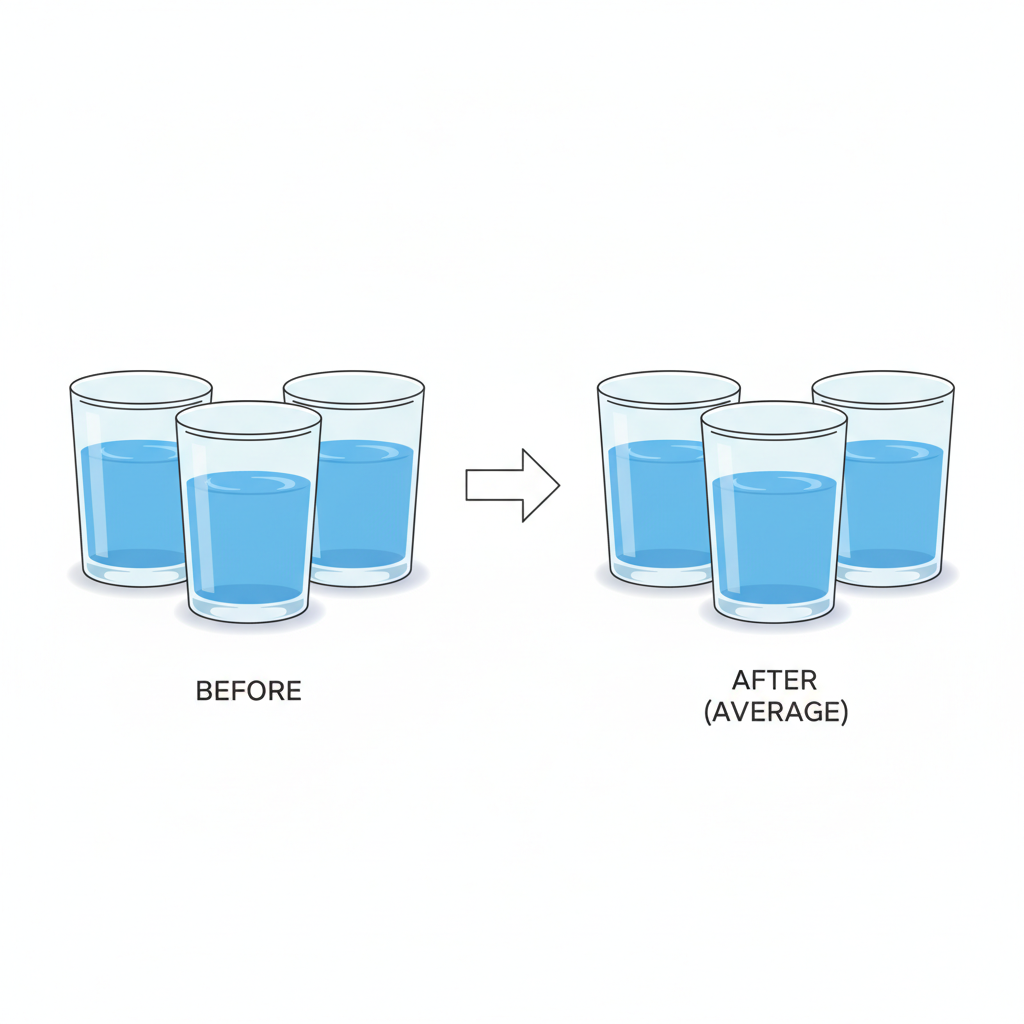
Imagine you have three glasses, and each has a different amount of water. One has a little, one has a medium amount, and one is almost full. If you pour all the water into a big pitcher and then pour it back into the three original glasses, making sure each glass has exactly the same amount, what would that amount be? That's right, it would be the average amount of water per glass! You've 'averaged' the water levels.
Why Do We Use Averages?
Averages are super useful in real life! They help us understand a whole group of things with just one number. Instead of saying "On Monday it was 60 degrees, Tuesday it was 65, Wednesday it was 70, Thursday it was 62, and Friday it was 68," you could say, "The average temperature this week was about 65 degrees." This single number gives you a good idea of what the temperature was generally like.
- To get a general idea: Like the average temperature, it tells us what's 'typical'.
- For fair sharing: Like our cookie example, ensuring everyone gets an equal part.
- To compare groups: You can compare the average score of your class on a test to the average score of another class to see which class generally did better.
Putting It All Together: How Do We Find This 'Fair Share'?
While we're focusing on the *idea* of an average, it's good to know how we actually find it! It's exactly what we did with the cookies, the weights, and the water:
- Add 'em up! You add all the numbers (or quantities) in your group together.
- Divide 'em out! You then divide that total by how many numbers (or items) you had in the first place.
The answer you get from dividing is your average! It's the number that says, "If everything were made equal, this is what each part would be."
Let's Review!
The average is a powerful tool to understand groups of numbers. It helps us find a 'fair share', a 'typical value', or a 'balancing point'. It's all about making things equal or finding what is most common for a collection of data.
Keep learning, free
Create a free Syllabax account to unlock practice questions and games for this topic.
Visual Learning Enhanced! 🚀
To help you master this topic, we use Advanced Syllabax AI to generate detailed diagrams and visual models.
Note on Visuals: The AI sometimes makes spelling errors in image labels. Please refer to the lesson text for the correct terminology.