Safe drinking water (boiling, filtration)[CHEMISTRY]
Watch this topic in 60 seconds
Free preview · Lesson 1
Understanding Safe drinking water (boiling, filtration)[CHEMISTRY]
Safe Drinking Water: Boiling and Filtration (Chemistry Edition!)
Welcome, young scientists! Today, we're diving into a super important topic: how to make sure the water we drink is safe and clean. We often take clean water for granted, but sometimes, especially in places where tap water might not be as clean as we'd like, we need to know how to purify it. This is where some basic chemistry comes in handy! We'll learn about two main ways to make water safe: boiling and filtration. Think of this as being a water detective, figuring out how to remove tiny, invisible troublemakers!
Why Does Water Need to Be Safe?
Imagine water is like a busy city. It looks clear, but sometimes, there are tiny residents that we don't want in our city: germs! These germs are called microorganisms. Some are good, like the ones in your tummy that help you digest food, but others can make us sick. They can be tiny bacteria, viruses, or other little creatures that we can't see without a microscope. When we drink water with these harmful microorganisms, they can cause stomach aches, diarrhea, and other illnesses. Our job is to get rid of them!
Method 1: Boiling - The Heaty-Heaty Way to Kill Germs
Boiling water is like giving it a hot, steamy spa treatment that kills off all the bad germs. You know how when you cook food, high temperatures kill bacteria? Boiling water does the same thing for the tiny germs living in it.
What Happens When We Boil Water?
When you heat water, you're giving its tiny parts, called molecules, lots of energy. These molecules start wiggling and jiggling faster and faster. Eventually, they get so excited that they change from being a liquid (like the water you pour) to a gas called water vapor. This is what you see as steam rising from the pot. This whole process of changing from a liquid to a gas is called boiling.
The Magic Temperature: 100 Degrees Celsius!
Pure water boils at a specific temperature: 100 degrees Celsius (or 212 degrees Fahrenheit). When the water reaches this temperature and you keep it boiling for a little while (usually about 1 minute is enough to kill most common germs), the heat is so intense that it destroys the living parts of the harmful microorganisms. It's like they can't survive the extreme heat!
How to Boil Water Safely for Drinking:
- Find a clean pot or kettle.
- Fill it with the water you want to purify.
- Place it on a stove or heat source.
- Bring the water to a rolling boil. This means you see lots of bubbles rising quickly.
- Let it boil vigorously for at least 1 minute.
- Let the water cool down before drinking it. Hot water can burn you!
Boiling: The Ups and Downs
Pros:
- It's very effective at killing most harmful germs.
- It's a simple method that doesn't require special equipment (just a pot and heat!).
Cons:
- It doesn't remove particles like dirt or sand. If the water is cloudy, boiling won't make it clear.
- It uses energy (like electricity or gas) which costs money and can affect the environment.
- It can change the taste of the water a little.
Method 2: Filtration - The Sieve for Germs!
Filtration is like using a super-fine sieve or a coffee filter to catch unwanted things. Instead of using heat, filtration uses physical barriers to separate the clean water from the yucky stuff.
What is Filtration?
Filtration is a process where you pass a liquid (or gas) through a material that has tiny holes. These holes are so small that they allow the liquid to pass through but trap larger particles. Think about sifting flour for baking – the sifter catches any lumps! A water filter works in a similar way, but on a much, much smaller scale.
How Do Water Filters Work?
Water filters can be made from different materials, like sand, gravel, charcoal, or special synthetic membranes. Each material has a role:
- Sand and Gravel: These act like a first line of defense, catching bigger pieces of dirt, leaves, or sediment. Imagine a big, coarse net.
- Activated Charcoal: This is super important! Charcoal is like a tiny sponge with a huge surface area. It has lots of little pores that can trap not only visible particles but also some dissolved impurities and chemicals that might be causing bad smells or tastes. It's like a super-sticky trap for unwanted molecules.
- Special Membranes: Some advanced filters have membranes with incredibly tiny pores that can even block bacteria and some viruses. These are like super-tight security checkpoints that only let water molecules pass.
So, when water flows through a filter, the different layers or materials grab onto the unwanted bits, leaving cleaner water behind.
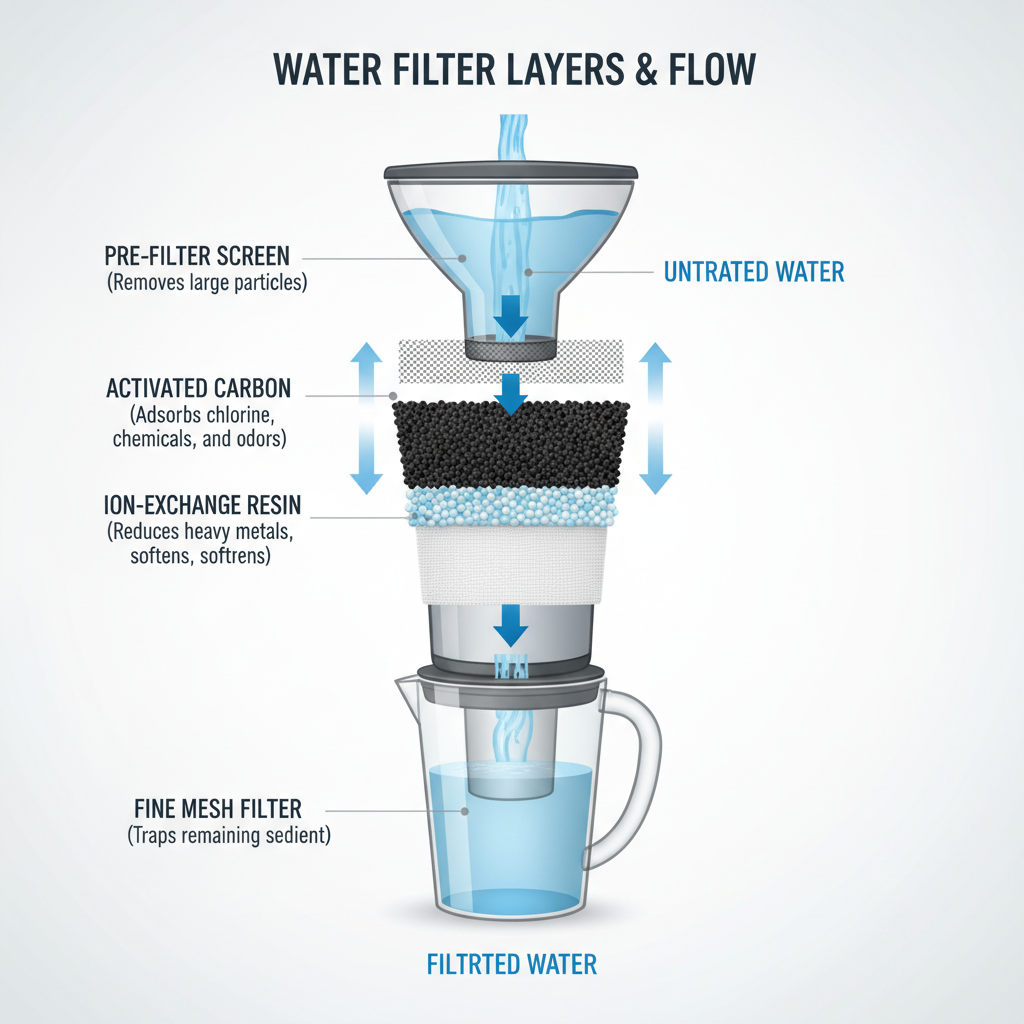 ⚠️ This picture may have spelling mistakes. Trust the words in the lesson.
Filtration: The Ups and Downs
Pros:
- It removes visible particles like dirt, sand, and rust, making the water clear.
- It can improve the taste and smell of water, especially if it uses charcoal.
- It doesn't require electricity or heat.
Cons:
- Simple filters might not remove all harmful microorganisms like bacteria and viruses. You might still need to boil the water if you're not sure about the germ level.
- Filters can get clogged over time and need to be replaced or cleaned.
- More advanced filters can be expensive.
Combining Methods for Super Clean Water!
Often, the best way to get really safe drinking water is to combine methods! For example, you could first filter the water to remove dirt and cloudiness, and then boil it to kill any remaining germs. This is like having both a security guard (filter) and a disinfectant spray (boiling)!
Key Chemistry Concepts Recap:
- Molecules: The tiny building blocks of water (H₂O) and everything else.
- Boiling: When water heats up so much that it turns into steam (gas).
- Water Vapor: The gas form of water.
- Microorganisms: Tiny living things, some of which can make us sick.
- Filtration: Using a material with tiny holes to catch bigger particles.
- Activated Charcoal: A material used in filters that traps impurities and improves taste/smell.
By understanding these simple science concepts, you can become a guardian of safe drinking water for yourself and your family. Stay curious!
Keep learning, free
Create a free Syllabax account to unlock practice questions and games for this topic.
Visual Learning Enhanced! 🚀
To help you master this topic, we use Advanced Syllabax AI to generate detailed diagrams and visual models.
Note on Visuals: The AI sometimes makes spelling errors in image labels. Please refer to the lesson text for the correct terminology.