Structure of the Indian Legal System – Indian Civics
Watch this topic in 60 seconds
Free preview · Lesson 1
Structure of the Indian Legal System – Indian Civics (Foundational)
Structure of the Indian Legal System – Foundational Civics
Welcome to a foundational lesson on the structure of the Indian Legal System. This system is how laws are made, interpreted, and enforced in India. Understanding it is crucial for every citizen.
What is a Legal System?
A legal system is a set of rules and institutions that a society uses to govern itself. It provides a framework for resolving disputes and maintaining order.
The Indian Legal System: A Hierarchy
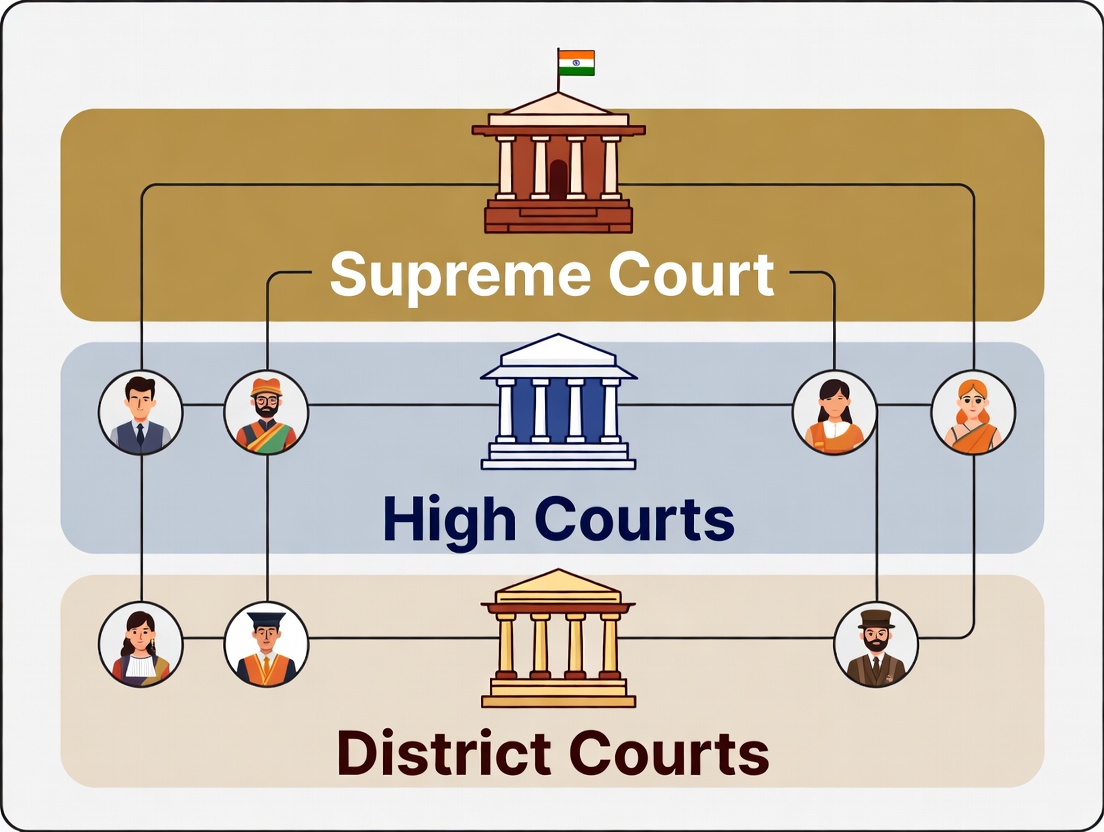
The Indian legal system is structured as a hierarchy, meaning it has different levels of courts with varying powers and jurisdictions. This ensures that laws are applied consistently and fairly across the country.
The Supreme Court of India
At the very top sits the Supreme Court of India. It is the highest court in the country and its decisions are binding on all other courts. The Supreme Court's main functions include:
- Interpreting the Constitution of India.
- Hearing appeals from lower courts.
- Protecting the fundamental rights of citizens.
High Courts
Below the Supreme Court are the High Courts. Each state in India generally has its own High Court. The High Courts have jurisdiction over their respective states and can hear appeals from lower courts within those states. They also have the power to issue writs to protect fundamental rights.
District Courts
At the district level are the District Courts. These courts handle most of the cases that arise in their respective districts. They deal with both civil and criminal matters. Below the District Courts are various subordinate courts, such as Munsif Courts (civil cases) and Magistrate Courts (criminal cases).
Subordinate Courts
Subordinate courts function under the District Courts. These handle a large volume of cases and are crucial for access to justice at the grassroots level. They include courts like:
- Munsif Courts: Primarily handle civil cases of lower value.
- Magistrate Courts: Deal with less serious criminal offences.
Panchayati Raj System (Local Self-Government)
While not strictly part of the formal court hierarchy, the Panchayati Raj system provides a mechanism for resolving disputes at the village level. This system promotes local self-governance and reduces the burden on formal courts for minor disputes. Gram Panchayats can adjudicate specific types of cases.
Types of Cases Handled
The Indian Legal System handles two primary types of cases:
- Civil Cases: Involve disputes between individuals or organizations, such as property disputes, contract breaches, or family matters.
- Criminal Cases: Involve offenses against the state, such as theft, assault, or murder.
Important Concepts
- Jurisdiction: The authority of a court to hear and decide a case.
- Appeal: A request to a higher court to review the decision of a lower court.
- Writ: A formal written order issued by a court.
Keep learning, free
Create a free Syllabax account to unlock practice questions and games for this topic.
Visual Learning Enhanced! 🚀
To help you master this topic, we use Advanced Syllabax AI to generate detailed diagrams and visual models.
Note on Visuals: The AI sometimes makes spelling errors in image labels. Please refer to the lesson text for the correct terminology.