Stratified Sampling
Watch this topic in 60 seconds
Free preview · Lesson 1
Understanding Stratified Sampling
Understanding Stratified Sampling: Getting a True Picture!
Imagine you want to know what all the students in your school think about a new cafeteria menu. It sounds simple, right? Just ask some students! But wait, not all students are the same. A 9th grader might have very different opinions from a 12th grader, and students who eat lunch every day might think differently from those who bring their own. How do you make sure your survey truly captures the opinions of everyone?
This is where sampling comes in. Sampling is like taking a small "taste" of a much larger "dish" (the population) to understand what the whole dish is like. If you want to know if a pot of soup is salty enough, you don't eat the whole pot; you take a small spoonful. In statistics, our "spoonful" is called a sample, and the "whole pot" is the population.
Why Can Simple Random Sampling Fall Short?
One common way to sample is called Simple Random Sampling (SRS). This is like putting every student's name in a giant hat and randomly picking out 100 names. Sounds fair, right? Everyone has an equal chance. And often, it works great!
But sometimes, SRS can lead to problems. Let's go back to our school cafeteria example. What if, by pure chance, you randomly pick 100 students, and 80 of them happen to be 9th graders, and only 5 are 12th graders? Your sample would be heavily skewed towards younger students. Their opinions might not reflect the whole school accurately. It's like trying to judge the flavor of a mixed bag of candies (strawberry, chocolate, mint) by randomly grabbing a handful, and accidentally getting mostly strawberry candies. You wouldn't know much about the chocolate or mint flavors!
This is where Stratified Sampling steps in to save the day!
What is Stratified Sampling? The "Sorted Candy" Approach
Stratified Sampling is a clever way of sampling that ensures different important groups within your population are properly represented in your sample. Think of it like this:
Imagine you have a big jar of candies, but they are all mixed up: some are red, some blue, some green, and some yellow. You want to pick a small handful (your sample) to taste, but you want to make sure you get a good mix of all the colors, not just mostly red ones by chance.
- Step 1: Sort them out! Instead of just randomly grabbing, you would first separate all the red candies into one pile, blue into another, green into another, and yellow into another. These separate piles are called strata (pronounced "STRAH-tuh"). Each stratum is a subgroup that shares a common characteristic (in this case, color).
- Step 2: Pick from each pile. Now, from each of your sorted piles (strata), you carefully pick a few candies. For instance, if there are many more red candies than yellow ones in the jar, you might pick more red candies than yellow candies for your sample to keep the proportions right. This is called proportional stratified sampling.
- Step 3: Combine your picks. Finally, you combine the candies you picked from each pile to form your sample. Now you have a handful that truly represents the different colors in the original jar!
In formal terms, Stratified Sampling is a method where a population is divided into smaller subgroups called strata based on shared characteristics. Then, a random sample is taken from each stratum, and these sub-samples are combined to form the final sample.
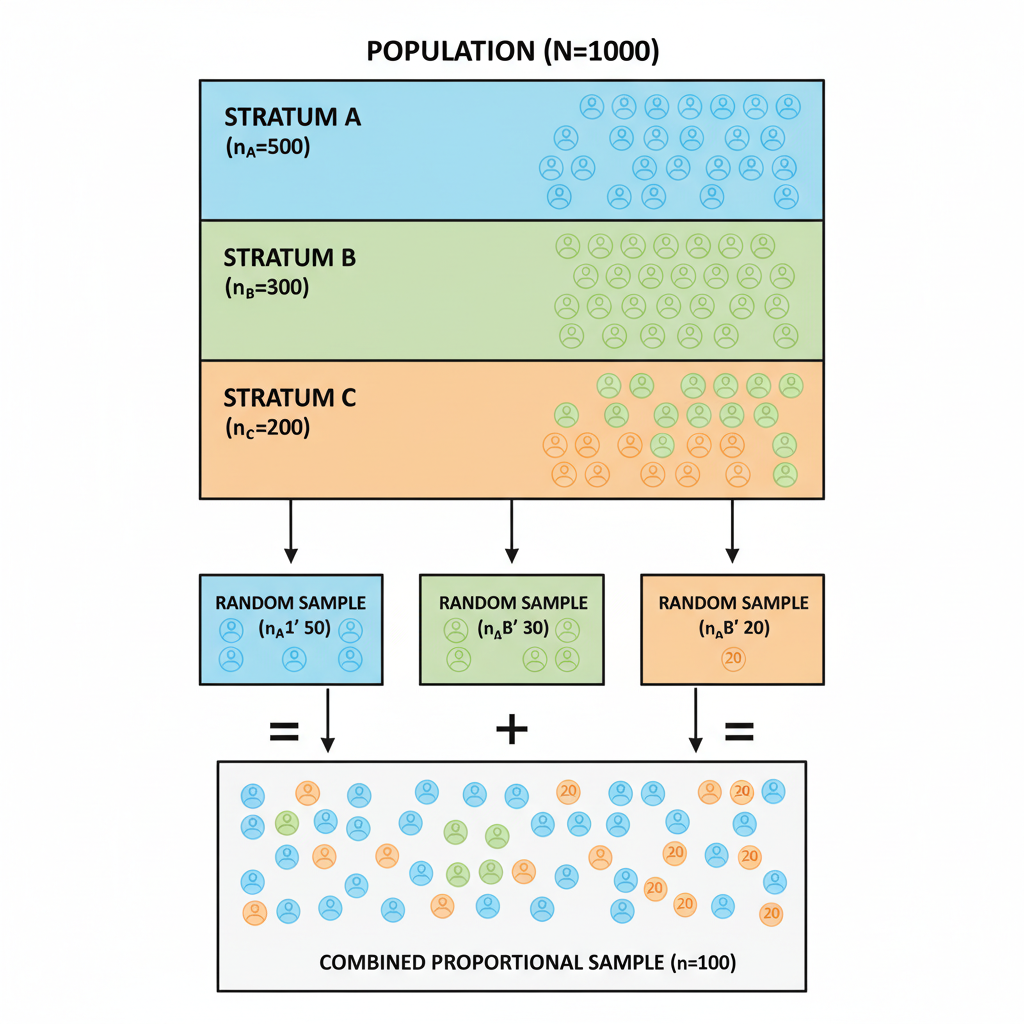
Key Steps of Stratified Sampling in Action
Let's use our school cafeteria survey again, but this time with stratified sampling:
-
Step 1: Define Your Population
Your population is "all students in the school."
-
Step 2: Identify Characteristics for Stratification
What characteristics might make students' opinions different? Their grade level seems important! So, you decide to stratify by grade: 9th, 10th, 11th, and 12th grade.
Analogy: This is like deciding to sort your LEGO bricks not just by color, but also by size, because bigger bricks might be used differently than smaller ones. You're choosing the most relevant categories.
-
Step 3: Divide the Population into Strata
You get a list of all students and divide them into four distinct groups:
- Stratum 1: All 9th graders
- Stratum 2: All 10th graders
- Stratum 3: All 11th graders
- Stratum 4: All 12th graders
Each student belongs to exactly one stratum, and the strata do not overlap.
-
Step 4: Sample from Each Stratum
Now, from each of these grade-level groups, you take a random sample. How many from each? This is important!
- Proportional Stratified Sampling: This is the most common and often best approach. If 30% of your school are 9th graders, you'd make sure 30% of your sample are also 9th graders. If 25% are 10th graders, then 25% of your sample comes from 10th graders, and so on. This ensures your sample perfectly mirrors the proportions of the population.
- Non-Proportional Stratified Sampling: Sometimes, if a certain group is very small but very important, you might choose to sample a larger percentage from that group than its actual proportion in the population. This is less common for general surveys but useful for studying specific small groups in detail. For foundational understanding, focus on proportional sampling.
Analogy: If you're baking a cake and the recipe calls for twice as much flour as sugar, you don't just randomly scoop; you measure out the right proportion of each ingredient to get the perfect cake.
-
Step 5: Combine the Samples
You take all the randomly selected students from the 9th grade, 10th grade, 11th grade, and 12th grade, and put them together. This combined group is your final stratified sample. Now you have a representative sample where every grade level's opinion will be heard in the correct proportion!
Why is Stratified Sampling So Powerful? (Advantages)
Using stratified sampling offers several big advantages:
-
More Representative Samples:
This is the biggest benefit! You guarantee that important subgroups in your population are included in your sample and in their correct proportions (if you use proportional sampling). This avoids the problem of a random sample accidentally missing or under-representing certain groups.
Analogy: It's like making sure your orchestra has violins, cellos, flutes, and trumpets, rather than just randomly inviting musicians and ending up with only violins! Every section is important for a complete sound.
-
Increased Accuracy and Precision:
Because your sample is more representative, the results you get from studying that sample are more likely to be true for the entire population. This leads to more accurate conclusions.
-
Ability to Study Subgroups:
Since you've already divided your population into strata, you can also easily compare results between these groups. For example, you can see if 9th graders genuinely have different opinions about the cafeteria menu than 12th graders.
-
Reduced Sampling Error:
Sampling error is the natural difference between a sample result and the true population result. By carefully constructing your sample, stratified sampling generally reduces this error, giving you more reliable estimates.
When Should You Use Stratified Sampling?
You should consider using stratified sampling whenever:
- Your population can be naturally divided into distinct subgroups.
- You believe these subgroups might have different characteristics or opinions regarding what you are studying.
- You want to ensure that all these important subgroups are adequately represented in your sample.
- You want to make comparisons between these subgroups.
Wrapping Up: Getting the Full Picture
Stratified sampling is a fundamental tool for researchers and statisticians who want to gather accurate data from diverse populations. By thoughtfully dividing a population into meaningful strata and then sampling from each, we move beyond simple chance and deliberately construct a sample that provides a truer, more representative picture of the whole. It's about being smart and organized to get the best possible insights!
Keep learning, free
Create a free Syllabax account to unlock practice questions and games for this topic.
Visual Learning Enhanced! 🚀
To help you master this topic, we use Advanced Syllabax AI to generate detailed diagrams and visual models.
Note on Visuals: The AI sometimes makes spelling errors in image labels. Please refer to the lesson text for the correct terminology.