Fossil fuels[CHEMISTRY]
Watch this topic in 60 seconds
Free preview · Lesson 1
Understanding Fossil fuels[CHEMISTRY]
What Are Fossil Fuels? The Earth's Buried Treasure!
Imagine the Earth as a giant pantry filled with energy. For millions of years, plants and tiny sea creatures lived, died, and then got buried under layers of soil, rock, and water. Over incredibly long periods – think millions and millions of years! – the immense pressure and heat from being buried deep underground transformed these organic remains into what we call fossil fuels. They are like ancient sunlight, captured and stored for us to use today!
The Three Main Types of Fossil Fuels
There are three main kinds of fossil fuels, each formed from different types of ancient life and found in different places:
1. Coal: The Solid Black Gold
Coal is formed from ancient plants, like ferns and trees, that grew in swampy areas millions of years ago. When these plants died, they sank to the bottom of the swamps, and instead of fully decaying, they got buried under mud and sand. Over time, the pressure and heat turned them into layers of a black, combustible rock we call coal.
Analogy: Think of making a really, really thick and compressed hamburger patty. The plant matter is the ground beef, and the layers of soil and rock are the press, squeezing it down into a solid, energy-rich form over a super long time.
Coal is mostly made of carbon, along with some hydrogen, sulfur, oxygen, and nitrogen. When we burn coal, it releases energy, which we can use to generate electricity.
2. Petroleum (Oil): The "Black Gold" Liquid
Petroleum, or crude oil, is formed from the remains of tiny marine organisms, like plankton and algae, that lived in ancient oceans. When these tiny creatures died, their bodies settled on the ocean floor and were covered by sediment. The pressure and heat from being buried deep under the seafloor turned them into a thick, gooey liquid – petroleum!
Analogy: Imagine a huge pot of ancient soup made from microscopic sea creatures. Over millions of years, the lid was put on tight, and the heat from deep inside the Earth cooked this soup until it became a thick, oily substance.
Petroleum is a complex mixture of many different hydrocarbons (molecules made of hydrogen and carbon). We don't use crude oil directly; instead, it's refined (heated and separated) into many useful products like gasoline for cars, diesel fuel for trucks and buses, jet fuel for airplanes, and even materials used to make plastics!
3. Natural Gas: The Invisible Fuel
Natural gas is often found alongside petroleum deposits or in separate underground pockets. It's also formed from the remains of ancient marine organisms, similar to oil, but under slightly different conditions that favored the formation of gases. It's primarily composed of methane (CH₄), a simple hydrocarbon.
Analogy: Think of squeezing an orange. The juice is like oil, and the tiny bubbles of air and vapor that escape are like natural gas – it's a lighter, gaseous byproduct that can be trapped.
Natural gas is a very clean-burning fossil fuel compared to coal and oil. It's used for heating homes, cooking, and generating electricity.
How Do We Get Fossil Fuels?
Extracting fossil fuels involves mining (for coal) or drilling (for oil and natural gas). This process can be complex and sometimes has environmental impacts.
Why Are Fossil Fuels Important?
Fossil fuels have powered much of the world's development for the last few centuries. They provide a concentrated source of energy that is relatively easy to transport and use.
Think of it like this: Fossil fuels are like the batteries for our modern world. They store a lot of energy in a small package, allowing us to power cars, factories, and homes.
The Chemistry Behind Fossil Fuels (Simplified)
At their core, fossil fuels are made up of molecules called hydrocarbons. These are molecules made from just two elements: carbon (C) and hydrogen (H).
- Coal is mainly a solid form of carbon, with some attached hydrogen.
- Petroleum is a mixture of many different hydrocarbon molecules, some small and light (like gasoline), others larger and heavier (like asphalt).
- Natural gas is mostly methane (CH₄), the simplest hydrocarbon, which has one carbon atom bonded to four hydrogen atoms.
When we burn fossil fuels, we are causing a chemical reaction called combustion. In combustion, the hydrocarbons react with oxygen (O₂) from the air. This reaction releases a lot of energy in the form of heat and light, and it produces new substances, primarily carbon dioxide (CO₂) and water (H₂O).
A very simplified chemical equation for burning methane (natural gas) looks like this:
CH₄ + 2O₂ → CO₂ + 2H₂O + Energy
(Methane + Oxygen → Carbon Dioxide + Water + Energy)
The Downside: Environmental Impact
While fossil fuels have been incredibly useful, burning them also releases substances into the atmosphere that can cause problems. The main concern is carbon dioxide (CO₂), a greenhouse gas. Greenhouse gases trap heat in the Earth's atmosphere, leading to climate change.
Analogy: Imagine wearing a thick, woolly jumper on a warm day. The CO₂ in the atmosphere acts like that jumper, trapping heat and making the Earth warmer than it should be.
Burning coal and oil also releases other pollutants, like sulfur dioxide (SO₂), which can cause acid rain.
Looking Ahead: The Future of Energy
Because of the environmental concerns, scientists and engineers are developing and using other sources of energy, such as solar power, wind power, and hydropower. These are called renewable energy sources because they don't run out and generally produce fewer harmful emissions.
But for now, fossil fuels remain a significant part of how we power our lives!
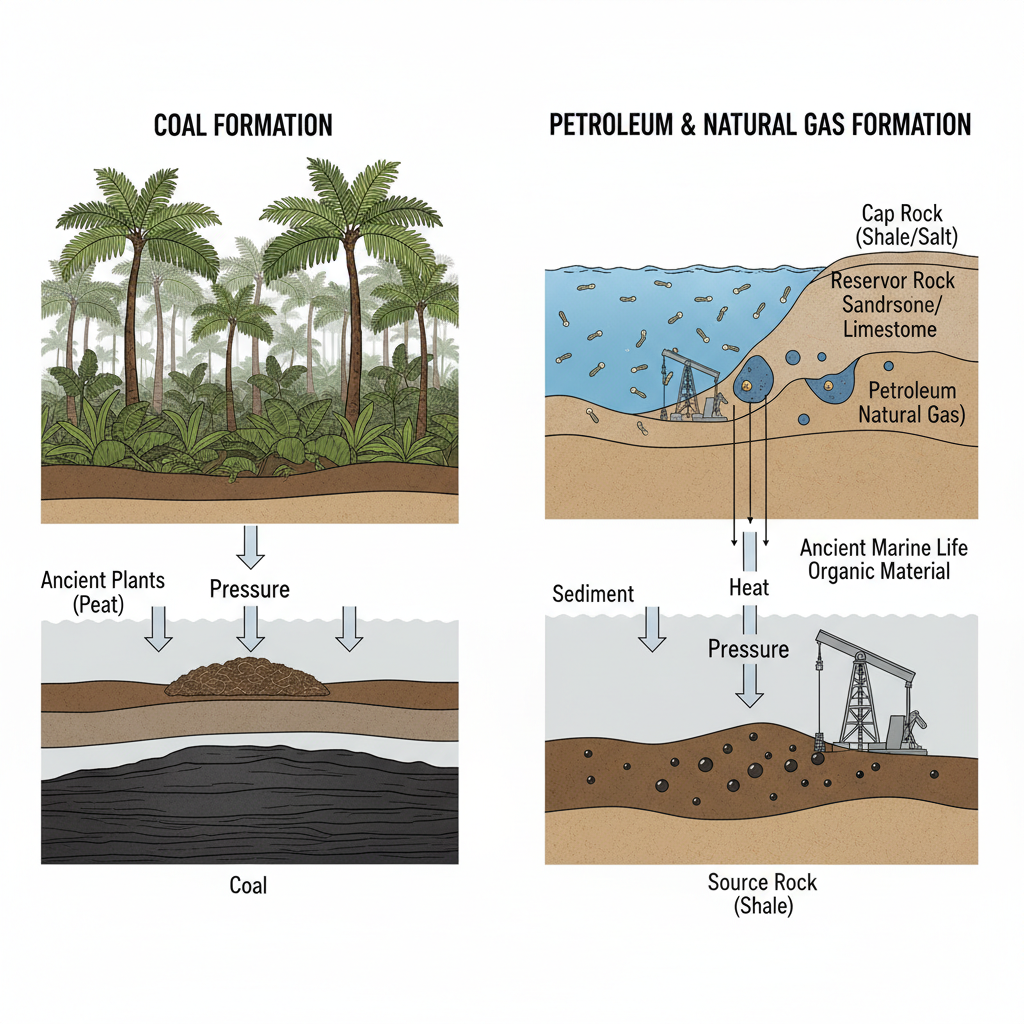 ⚠️ This picture may have spelling mistakes. Trust the words in the lesson.
Keep learning, free
Create a free Syllabax account to unlock practice questions and games for this topic.
Visual Learning Enhanced! 🚀
To help you master this topic, we use Advanced Syllabax AI to generate detailed diagrams and visual models.
Note on Visuals: The AI sometimes makes spelling errors in image labels. Please refer to the lesson text for the correct terminology.