Solutions, suspensions, colloids[CHEMISTRY]
Watch this topic in 60 seconds
Free preview · Lesson 1
Understanding Solutions, suspensions, colloids[CHEMISTRY]
Understanding Mixtures: Solutions, Suspensions, and Colloids (Grade 9 Chemistry)
Welcome, young scientists! Today, we're going on a fascinating journey into the world of mixtures. Imagine you're in the kitchen, making different things. Sometimes, ingredients disappear perfectly, like sugar in tea. Other times, they just float around and then sink, like sand in water. And then there are those mysterious mixtures that look uniform but aren't quite, like milk!
In chemistry, we classify these different ways substances combine into three main categories: Solutions, Suspensions, and Colloids. Understanding these classifications is super important because they help us predict how mixtures will behave, how we can separate them, and even why certain things look the way they do.
What is a Mixture? A Quick Refresher
Before we dive into our main topic, let's quickly remember what a mixture is. A mixture is when two or more substances are combined, but they aren't chemically bonded together. This means each substance keeps its original properties. Think of a fruit salad: you can still see and taste the apples, bananas, and grapes individually, even though they're all mixed together.
Mixtures can be broadly categorized into two types:
- Homogeneous Mixtures: These mixtures look completely uniform throughout. You can't see the individual components, even with a powerful microscope. It's like everything has blended into one single phase. Think of salt dissolved in water – it just looks like clear water.
- Heterogeneous Mixtures: These mixtures are NOT uniform. You can often see the different components with your naked eye, or at least with a magnifying glass. There are distinct parts or phases within the mixture. Think of a bowl of cereal with milk – you can clearly see the cereal pieces and the milk.
Now, let's explore our three main types of mixtures!
1. Solutions: The Ultimate Blend
Imagine stirring sugar into your hot tea. Where does the sugar go? It seems to vanish! What you've made is a solution.
What are Solutions?
- Definition: A solution is a homogeneous mixture where one substance (the solute) is completely dissolved in another substance (the solvent). This means the particles of the solute are spread out so evenly that they become invisible and blend perfectly with the solvent.
- Analogy: Think of a very well-mixed smoothie where all the ingredients are blended into a perfectly smooth, uniform drink. You can't pick out individual chunks of fruit anymore.
Key Characteristics of Solutions:
- Particle Size: The particles of the solute are incredibly tiny – smaller than 1 nanometer (nm)! They are individual atoms, ions, or small molecules. Because they are so small, they can't be seen, even under a microscope.
- Appearance: Solutions are always transparent, meaning light passes straight through them without scattering. They might have a color (like Kool-Aid), but you can see through them clearly.
- Settling: The dissolved particles will never settle out, no matter how long you let the solution sit. The sugar in your tea won't sink to the bottom overnight!
- Filtering: You cannot separate the solute from the solvent by filtering. The particles are too small to be caught by filter paper. If you filter saltwater, you'll still have saltwater on the other side.
- Tyndall Effect: Solutions do NOT scatter light. If you shine a flashlight beam through a clear solution, you won't see the path of the light beam inside the liquid. (More on Tyndall effect when we discuss colloids!)
Examples of Solutions:
- Saltwater: Salt (solute) dissolved in water (solvent).
- Sugar water: Sugar (solute) dissolved in water (solvent).
- Air: A mixture of nitrogen, oxygen, argon, and other gases. Oxygen is 'dissolved' in nitrogen.
- Alloys: Solid solutions like brass (copper and zinc) or steel (iron and carbon). Here, one metal is dissolved into another.
- Vinegar: Acetic acid dissolved in water.
2. Suspensions: The Unstable Blend
Now, imagine mixing sand into a glass of water. What happens? The sand particles swirl around for a bit, but then they quickly start to fall to the bottom. What you have here is a suspension.
What are Suspensions?
- Definition: A suspension is a heterogeneous mixture where solid particles are dispersed in a liquid or gas but are large enough to eventually settle out.
- Analogy: Think of a very pulpy orange juice. You can clearly see the pulp floating around, and if you let it sit for a while, the pulp will sink to the bottom. Or, imagine a snow globe – the "snow" particles float for a bit, then settle.
Key Characteristics of Suspensions:
- Particle Size: The particles in a suspension are relatively large – greater than 100 nanometers (nm), much, much larger than solution particles. They are big enough to be seen with the naked eye or a simple microscope.
- Appearance: Suspensions are typically cloudy, opaque, or turbid. You cannot see through them clearly.
- Settling: This is a defining characteristic! The particles in a suspension will settle out over time due to gravity. This is why you often see a "shake well before use" instruction on medicines that are suspensions.
- Filtering: Because the particles are large, they can easily be separated from the liquid (or gas) by filtration using filter paper.
- Tyndall Effect: Suspensions may scatter light (appearing cloudy), but because the particles are so large and unstable, the light scattering is often irregular, and it's less about a clear beam and more about general cloudiness.
Examples of Suspensions:
- Muddy water: Soil particles suspended in water.
- Freshly squeezed orange juice with pulp.
- Oil and vinegar salad dressing: If left undisturbed, the oil and vinegar layers separate. (Though sometimes considered an emulsion, a type of colloid, the separation aspect fits here for large droplets).
- Some medicines: Many liquid antacids or antibiotics need to be shaken before use because they are suspensions.
- Paint: Pigment particles suspended in a liquid base.
3. Colloids: The "Looks Homogeneous, But Isn't" Blend
Now, let's consider milk. It looks perfectly uniform, right? You can't see any individual particles floating around. It doesn't settle out like muddy water, and you can't filter out anything distinct. Yet, milk isn't a true solution! It's something in between – a colloid.
What are Colloids?
- Definition: A colloid is a heterogeneous mixture where very tiny particles are dispersed evenly throughout another substance. These particles are larger than those in a solution but smaller than those in a suspension, and they don't settle out.
- Analogy: Think of a fine mist or fog. It looks uniform, but it's actually tiny water droplets suspended in air. Or, think of gelatin (Jell-O). It looks solid and uniform, but it's actually a network of protein molecules trapping water.
Key Characteristics of Colloids:
- Particle Size: This is the Goldilocks zone! Colloidal particles are intermediate in size, typically ranging from 1 nm to 100 nm. They are too small to be seen with the naked eye but large enough to scatter light.
- Appearance: Colloids often appear translucent or cloudy, but they don't necessarily look opaque like suspensions. They might appear homogeneous to the naked eye.
- Settling: Colloidal particles do NOT settle out over time. They remain dispersed because they are constantly being bombarded by the molecules of the dispersion medium (a phenomenon called Brownian motion), which keeps them from sinking.
- Filtering: You cannot separate colloidal particles by simple filtration because they are small enough to pass through most filter papers.
- Tyndall Effect: This is the defining characteristic of colloids! Colloidal particles are just the right size to scatter light, making the path of a light beam visible as it passes through the colloid. This is how you can tell a colloid apart from a true solution.
Understanding the Tyndall Effect
The Tyndall effect is named after John Tyndall, who studied this phenomenon. Imagine you are in a dark room, and a beam of sunlight shines through a tiny hole. If there's a lot of dust in the air, you can see the path of the sunlight because the dust particles are scattering the light. This is the Tyndall effect in action!
In a true solution (like clear sugar water), the particles are too small to scatter light, so you wouldn't see the light beam. In a colloid (like milk or fog), the particles are just the right size to bounce the light around, making the beam visible.
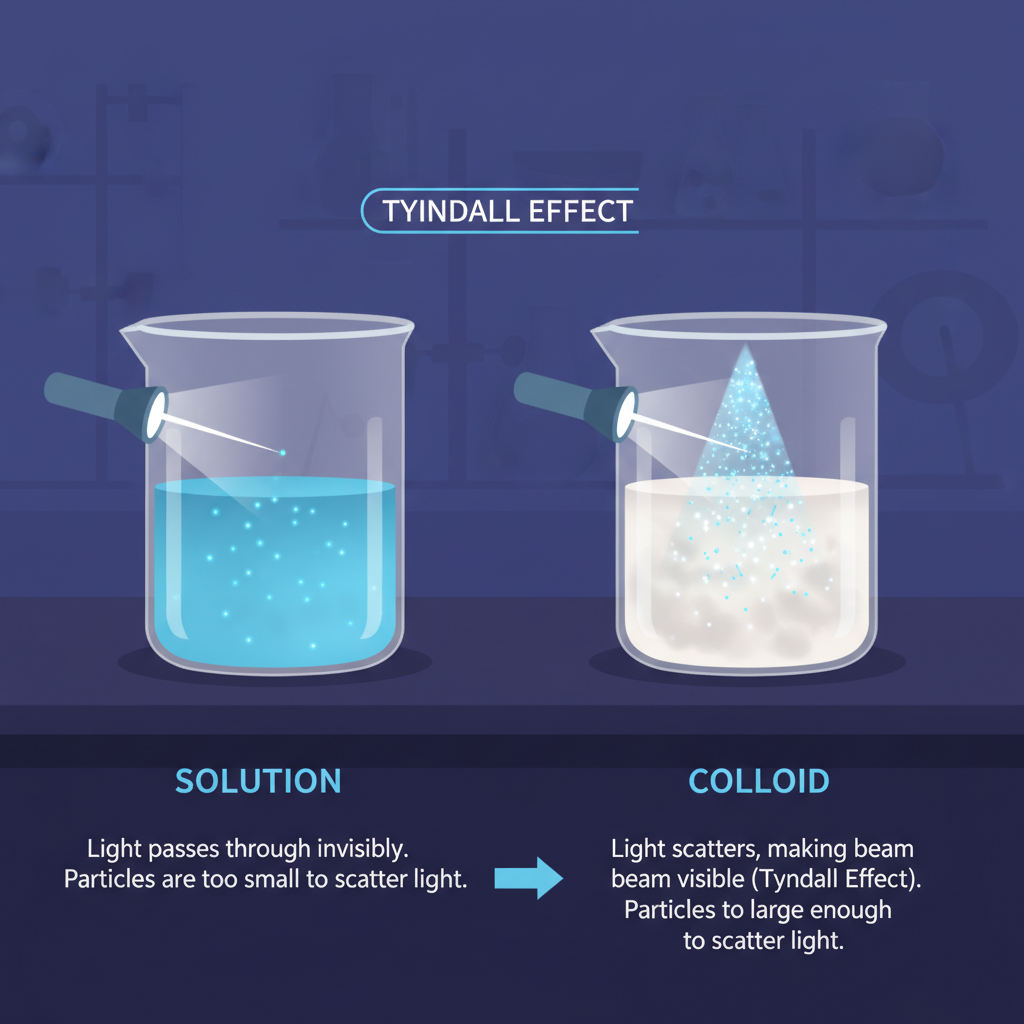 ⚠️ This picture may have spelling mistakes. Trust the words in the lesson.
Examples of Colloids:
- Milk: Tiny fat globules and protein particles dispersed in water.
- Fog/Mist/Clouds: Tiny water droplets dispersed in air.
- Smoke: Solid particles dispersed in air.
- Gelatin (Jell-O): Protein molecules dispersed in water, forming a gel.
- Whipped cream: Air bubbles dispersed in cream.
- Mayonnaise: Oil droplets dispersed in vinegar (stabilized by egg yolk).
- Blood plasma: Contains various proteins in colloidal suspension.
Comparing Solutions, Suspensions, and Colloids: A Quick Overview
Let's put it all together to see the differences at a glance:
| Characteristic | Solution | Colloid | Suspension |
|---|---|---|---|
| Mixture Type | Homogeneous | Heterogeneous (appears homogeneous) | Heterogeneous |
| Particle Size | < 1 nm (very small) | 1 - 100 nm (intermediate) | > 100 nm (large) |
| Appearance | Transparent | Translucent/Cloudy | Opaque/Cloudy |
| Settling | Never settles | Never settles | Settles over time |
| Filtering | Cannot be filtered | Cannot be filtered | Can be filtered |
| Tyndall Effect | Does NOT show | Shows (scatters light) | May scatter light, but often opaque |
| Examples | Saltwater, sugar water, air | Milk, fog, gelatin, smoke | Muddy water, sand in water, pulpy orange juice |
Why is this important?
Understanding these classifications isn't just for tests! It helps us in everyday life and in various industries:
- Medicine: Knowing if a medicine is a solution, suspension, or colloid dictates how it's prepared, stored, and administered. (Think "shake well before use!").
- Food Science: Many foods are colloids (milk, mayonnaise, sauces), and understanding their properties helps in food production and preservation.
- Environmental Science: Pollution often involves particulate matter in the air (smoke, smog, which are colloids or suspensions) or water.
- Manufacturing: Paints, cosmetics, and many other products rely on these principles.
So, the next time you pour a glass of milk, or stir sugar into your coffee, or see fog on a cool morning, you'll know exactly what kind of mixture you're looking at and why it behaves the way it does!
Keep learning, free
Create a free Syllabax account to unlock practice questions and games for this topic.
Visual Learning Enhanced! 🚀
To help you master this topic, we use Advanced Syllabax AI to generate detailed diagrams and visual models.
Note on Visuals: The AI sometimes makes spelling errors in image labels. Please refer to the lesson text for the correct terminology.