Congruence of triangles (Triangle Properties)
Watch this topic in 60 seconds
Free preview · Lesson 1
Understanding Congruence of triangles (Triangle Properties)
Understanding Congruence of Triangles: Identical Twins of Geometry!
Hello, young mathematicians! Get ready to dive into the fascinating world of triangles. You've seen triangles everywhere – from the slice of pizza you love to the roof of a house. Today, we're going to explore a super important idea called "Congruence." Don't worry, it sounds fancy, but it just means things that are exactly the same size and exactly the same shape. Think of it like finding an identical twin in the world of geometry!
What is a Triangle Anyway? (A Quick Review)
Before we talk about identical triangles, let's quickly remember what a triangle is. A triangle is a flat shape with:
- Three Sides: These are the straight lines that form the edges of the triangle.
- Three Vertices: These are the points where the sides meet (the "corners").
- Three Angles: These are the "openings" between the sides at each vertex.
A super cool fact about any triangle is that if you add up the measurements of its three angles, the total will always be 180 degrees! Isn't that neat?
Introducing Congruence: The Idea of Being Identical
Imagine you have two identical puzzle pieces. When you pick them up, they feel exactly the same, they look exactly the same, and if you tried to put one on top of the other, they would perfectly overlap. There would be no part of one sticking out from under the other. That's the essence of congruence!
In mathematics, when two figures are congruent, it means they have the exact same size and the exact same shape. One can be placed perfectly on top of the other, covering it completely.
Analogy Time!
- Think of two identical copies of the same book. They are congruent.
- Think of two identical cookies made with the same cookie cutter. They are congruent.
- Think of two identical LEGO bricks of the same color and shape. They are congruent.
Congruent Line Segments: Same Length
Let's start simple. What does it mean for two line segments to be congruent? A line segment is just a straight line with a beginning and an end.
Two line segments are congruent if they have the exact same length. If you have a ruler and measure two line segments, and both measure 5 centimeters, then they are congruent!
Analogy: Imagine you have two brand-new pencils, both untouched and unsharpened. They have the same length, right? So, those two pencils, when considered as line segments, are congruent!
Congruent Angles: Same Opening
Next, let's think about angles. An angle measures the "opening" between two lines that meet at a point.
Two angles are congruent if they have the exact same measure (in degrees). If you measure two angles with a protractor, and both measure 30 degrees, then they are congruent!
Analogy: Imagine two identical slices of pizza cut from the exact same pizza. If you put one on top of the other, their pointy tips (vertices) would align, and their crusts (sides) would perfectly match up. The "opening" of their slices is the same, so their angles are congruent!
Bringing it Together: Congruent Triangles!
Now for the main event! What makes two triangles congruent? For two triangles to be congruent, all of their corresponding sides must be equal in length, and all of their corresponding angles must be equal in measure.
If you have two triangles, let's call them Triangle ABC and Triangle DEF:
- Side AB must be the same length as Side DE.
- Side BC must be the same length as Side EF.
- Side CA must be the same length as Side FD.
- Angle A must be the same measure as Angle D.
- Angle B must be the same measure as Angle E.
- Angle C must be the same measure as Angle F.
If ALL six of these things are true, then Triangle ABC is congruent to Triangle DEF! We use a special symbol for congruence: ≅. So, we would write: △ABC ≅ △DEF.
Visualizing Congruence
Think of it this way: if you could pick up Triangle ABC and literally move it, rotate it, or flip it, and it would perfectly land on top of Triangle DEF, then they are congruent.
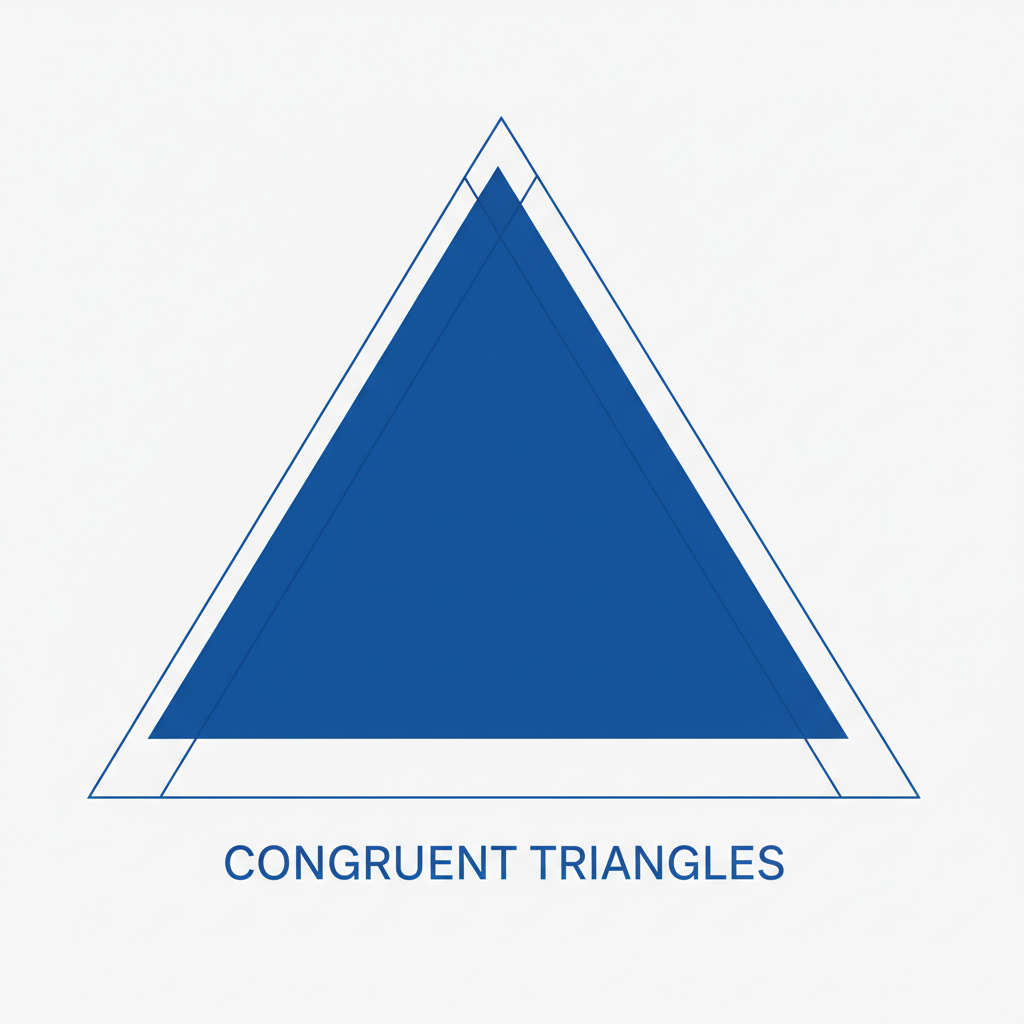
The image above shows two triangles that look exactly the same – same shape, same size. If one could be lifted and placed precisely over the other, they would completely cover each other without any part peeking out. This is a perfect visual representation of congruence!
Understanding "Corresponding Parts"
When we talk about congruent triangles, the word "corresponding" is super important. It means "matching up."
- Corresponding Vertices: These are the "corners" that match up. In △ABC ≅ △DEF, vertex A corresponds to vertex D, B to E, and C to F.
- Corresponding Sides: These are the sides that match up. Side AB corresponds to Side DE, BC to EF, and CA to FD.
- Corresponding Angles: These are the angles that match up. Angle A corresponds to Angle D, B to E, and C to F.
The order in which you write the letters in the congruence statement matters! △ABC ≅ △DEF tells you exactly which parts correspond.
Analogy: Imagine you have two identical pairs of gloves. Your left hand goes into the left glove, and your right hand goes into the right glove. The left glove of one pair corresponds to the left glove of the other pair. You wouldn't say the left glove corresponds to the right glove, even though they're part of the same set, because they don't match up perfectly in terms of how they're used. Similarly, in triangles, parts must match up in their position and role.
Why is Congruence Important? Real-World Connections!
Congruence isn't just a math concept; it's used all around us!
- Construction and Architecture: When buildings are designed, engineers need many parts to be identical (congruent) to ensure stability and proper fitting. Think of all the identical window frames or roof trusses!
- Manufacturing: When you buy two identical chairs, or two copies of the same toy, manufacturers rely on congruence to make sure every item is exactly the same as the others.
- Art and Design: Artists and designers often use congruent shapes to create patterns, symmetry, and balance in their work.
Understanding congruence helps us build things, design things, and understand the symmetry and balance in the world.
Basic Triangle Properties (Beyond Congruence)
While congruence tells us when two triangles are identical, it's also good to remember some basic properties that describe triangles themselves:
- Sum of Angles: As we mentioned, the three angles inside any triangle always add up to 180 degrees. This is a fundamental rule!
- Classifying by Sides:
- Equilateral Triangle: All three sides are equal in length, and all three angles are equal (each 60 degrees).
- Isosceles Triangle: Two sides are equal in length, and the angles opposite those sides are also equal.
- Scalene Triangle: All three sides have different lengths, and all three angles have different measures.
- Classifying by Angles:
- Acute Triangle: All three angles are acute (less than 90 degrees).
- Right Triangle: Exactly one angle is a right angle (exactly 90 degrees). The side opposite the right angle is called the hypotenuse.
- Obtuse Triangle: Exactly one angle is an obtuse angle (greater than 90 degrees).
These properties help us describe and understand individual triangles, which is a great foundation before exploring how different triangles relate to each other, like through congruence!
Congratulations! You've taken your first big step into understanding congruence of triangles. Remember, it's all about being identical – same size, same shape! Keep an eye out for congruent shapes in your everyday life!
Keep learning, free
Create a free Syllabax account to unlock practice questions and games for this topic.
Visual Learning Enhanced! 🚀
To help you master this topic, we use Advanced Syllabax AI to generate detailed diagrams and visual models.
Note on Visuals: The AI sometimes makes spelling errors in image labels. Please refer to the lesson text for the correct terminology.