Time & work (intro) (Speed, Time & Distance)
Watch this topic in 60 seconds
Free preview · Lesson 1
Understanding Time & work (intro) (Speed, Time & Distance)
Welcome to Time, Work, Speed, & Distance!
Ever wondered how construction workers estimate how long it will take to build a house? Or how a delivery driver plans their route to get your package to you on time? These are everyday examples of the concepts we're going to explore: Time & Work and Speed, Time & Distance. Don't worry, we'll break it down into simple, easy-to-understand pieces, using lots of analogies!
Part 1: Time & Work - Getting Things Done!
What is "Work" in this context?
When we talk about "work" here, we don't mean just showing up to school or doing chores. In mathematics, "work" refers to a completed task or a specific job. Think of it as painting a wall, digging a ditch, knitting a sweater, or even eating a pizza!
The Dynamic Trio: Work, Time, and Rate
Imagine you have a big task to do. Let's say, painting your room.
- Work (W): This is the entire job – painting the whole room.
- Time (T): This is how long it takes you to complete the painting, measured in hours, days, or weeks.
- Rate of Work (R) or Efficiency: This is how much work you can do in a specific amount of time. For example, if you paint half a room in one hour, your rate is "half a room per hour." It's your speed at doing the work!
Analogy 1: The Pizza Eating Contest!
Imagine your friend, Alex, loves pizza. He wants to eat one whole pizza (that's the Work). If Alex eats 1/4 of the pizza every 10 minutes (that's his Rate), how long will it take him to eat the whole pizza (that's the Time)?
You can see that:
- If he eats 1/4 in 10 minutes,
- Then in 20 minutes, he eats 1/2.
- In 30 minutes, he eats 3/4.
- And in 40 minutes, he finishes the whole pizza!
So, Work (1 pizza) = Rate (1/4 pizza/10 min) × Time (40 min).
The Golden Formula for Time & Work
This simple relationship can be put into a powerful formula:
Work = Rate × Time
From this, we can find any of the three if we know the other two:
- Rate = Work / Time (How much work per unit of time)
- Time = Work / Rate (How long it takes to finish the work)
Understanding Rate and the Unitary Method
Often, in Time & Work problems, "work" is considered as '1' (representing one complete job). So, if someone can complete a job in 'T' days, their rate of work per day is 1/T. This is called the Unitary Method – finding out how much is done in a single unit of time.
Example: If a painter takes 5 days to paint a house (Work = 1 house), what is his daily rate?
Rate = Work / Time = 1 house / 5 days = 1/5 house per day.
This means he paints 1/5th of the house each day.
The Inverse Relationship: More Workers, Less Time!
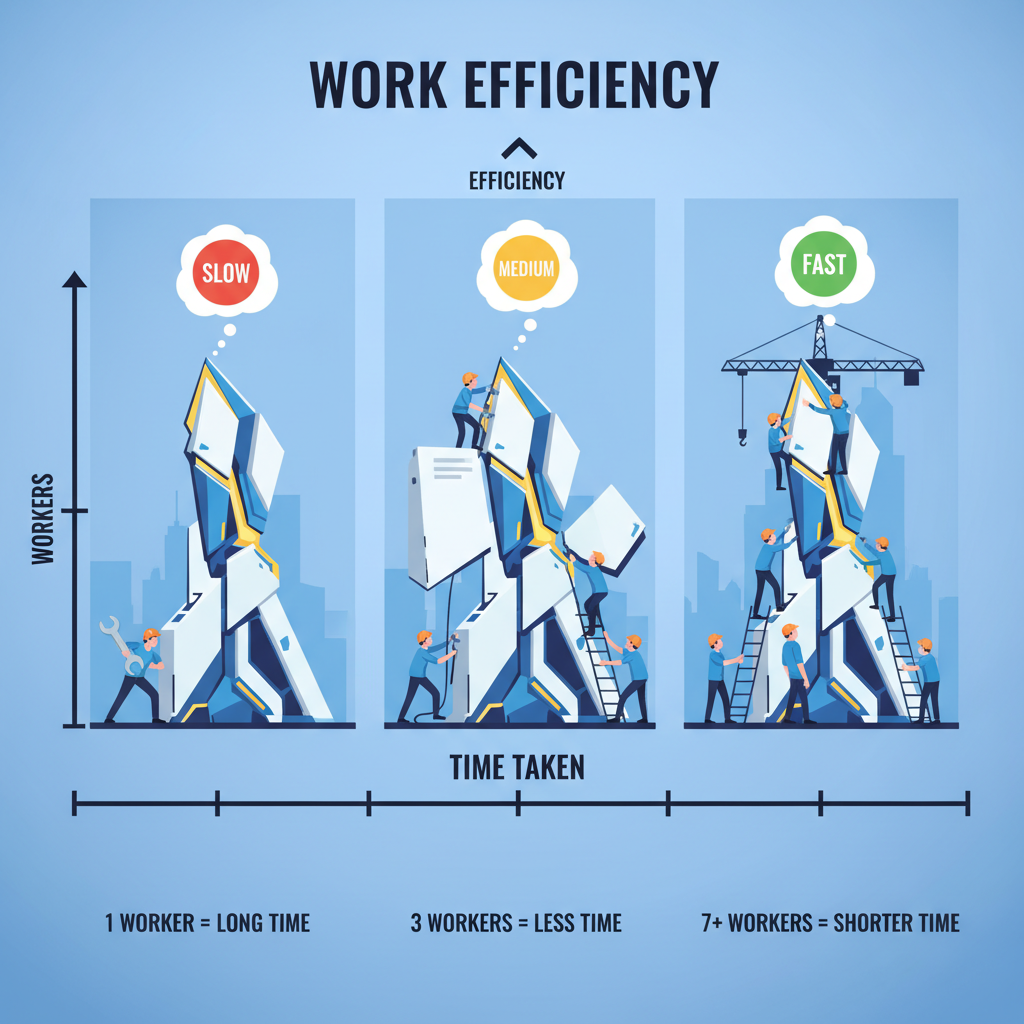
Think about building a sandcastle. If you work alone, it might take you 2 hours. But if you get two friends to help, you'll probably finish much faster, maybe in just 45 minutes! This is an important concept: More workers (or higher rate) generally means less time to complete the same amount of work. They are inversely proportional.
Part 2: Speed, Time & Distance - On the Move!
Now, let's shift gears (pun intended!) and talk about moving objects. The concepts of Speed, Time, and Distance are incredibly similar to Work, Rate, and Time.
Mapping the Concepts:
- Distance (D): This is like our "Work." It's the total path covered or the total journey made (e.g., 100 kilometers, 5 miles).
- Speed (S): This is like our "Rate of Work." It tells us how fast an object is moving – the distance covered per unit of time (e.g., 60 km/hour, 10 meters/second).
- Time (T): This is how long the journey takes (e.g., 2 hours, 30 minutes).
Analogy 2: The School Bus Journey
Imagine your school bus travels at a certain speed to get you to school. If the school is 10 km away (Distance), and the bus travels at 20 km/hour (Speed), how long will it take to reach school (Time)?
If it covers 20 km in 1 hour, then to cover 10 km (half the distance), it will take half the time!
So, Time = 30 minutes (or 0.5 hours).
The Golden Formula for Speed, Time & Distance
Just like with Work, Rate, and Time, we have a main formula:
Distance = Speed × Time
And we can rearrange it to find the other values:
- Speed = Distance / Time (How fast you're moving)
- Time = Distance / Speed (How long your journey takes)
Key Relationships:
- If Distance is Constant: Speed and Time are inversely proportional. This means if you increase your speed, you'll take less time to cover the same distance. (e.g., Driving faster gets you there sooner).
- If Speed is Constant: Distance and Time are directly proportional. This means if you travel for a longer time, you'll cover a greater distance at the same speed. (e.g., Driving for 2 hours covers twice the distance of driving for 1 hour at the same speed).
- If Time is Constant: Distance and Speed are directly proportional. This means if you travel faster for the same amount of time, you'll cover more distance. (e.g., In 1 hour, a car going 80 km/h covers more distance than a car going 50 km/h).
Connecting the Dots: They're All About Rates!
You might have noticed how similar these two topics are. That's because they both deal with the concept of a "rate."
- In Time & Work, the "Rate of Work" tells you how much work is done per unit of time.
- In Speed, Time & Distance, "Speed" tells you how much distance is covered per unit of time.
Mastering one helps you understand the other! The formulas are essentially the same structure: Total Amount = Rate × Duration.
Summary of Core Concepts:
- Work = Rate × Time (for tasks)
- Distance = Speed × Time (for travel)
- Rate/Speed is always the amount per unit of time (e.g., "per day," "per hour").
- Work/Distance is the total amount to be covered or completed.
- Time is the duration taken to complete the work or cover the distance.
- More efficient workers (higher rate) or faster travel (higher speed) means less time for the same task/distance.
You've just taken your first step into understanding these fundamental concepts. With practice, you'll be solving these problems like a pro!
Keep learning, free
Create a free Syllabax account to unlock practice questions and games for this topic.
Visual Learning Enhanced! 🚀
To help you master this topic, we use Advanced Syllabax AI to generate detailed diagrams and visual models.
Note on Visuals: The AI sometimes makes spelling errors in image labels. Please refer to the lesson text for the correct terminology.