British rule and freedom struggle - History of India
Watch this topic in 60 seconds
Free preview · Lesson 1
British rule and freedom struggle - History of India (Foundational)
British Rule and Freedom Struggle - History of India (Foundational)
India, a land of ancient civilizations and rich cultural heritage, experienced a profound transformation under British colonial rule. This period, spanning over two centuries, dramatically reshaped the subcontinent's political, economic, and social landscape, ultimately leading to a powerful freedom struggle that culminated in independence.
Arrival of European Powers and the East India Company
European traders, primarily the Portuguese, Dutch, French, and British, began arriving in India in the 16th and 17th centuries, initially seeking lucrative trade in spices, textiles, and other commodities. The British East India Company, established in 1600, gradually gained prominence. Through a combination of trade, military might, and political maneuvering, it began to assert its influence over various Indian states, often exploiting internal rivalries among local rulers.
Consolidation of British Rule
A pivotal moment was the Battle of Plassey in 1757, where the Company, led by Robert Clive, defeated the Nawab of Bengal. This victory marked the beginning of the Company's political dominance. Over the next century, through a series of wars (like the Anglo-Mysore Wars and Anglo-Maratha Wars) and treaties, the Company expanded its territories, establishing a vast colonial empire. The Uprising of 1857, also known as the Sepoy Mutiny or the First War of Indian Independence, was a major turning point. Though suppressed, it led to the British Crown taking direct control of India from the East India Company in 1858, ushering in the era of the British Raj.
Nature of British Administration and its Impact
British rule was characterized by economic exploitation, primarily aimed at extracting resources and raw materials for British industries and creating a market for British goods. Policies such as land revenue systems (e.g., Permanent Settlement, Ryotwari, Mahalwari) led to agrarian distress and poverty. The British introduced a unified administrative and legal system, modern education (albeit with an aim to create a class of Indian civil servants), and infrastructure like railways, primarily to serve their administrative and economic interests. While these developments had some modernizing effects, they were largely detrimental to indigenous industries and traditional social structures.
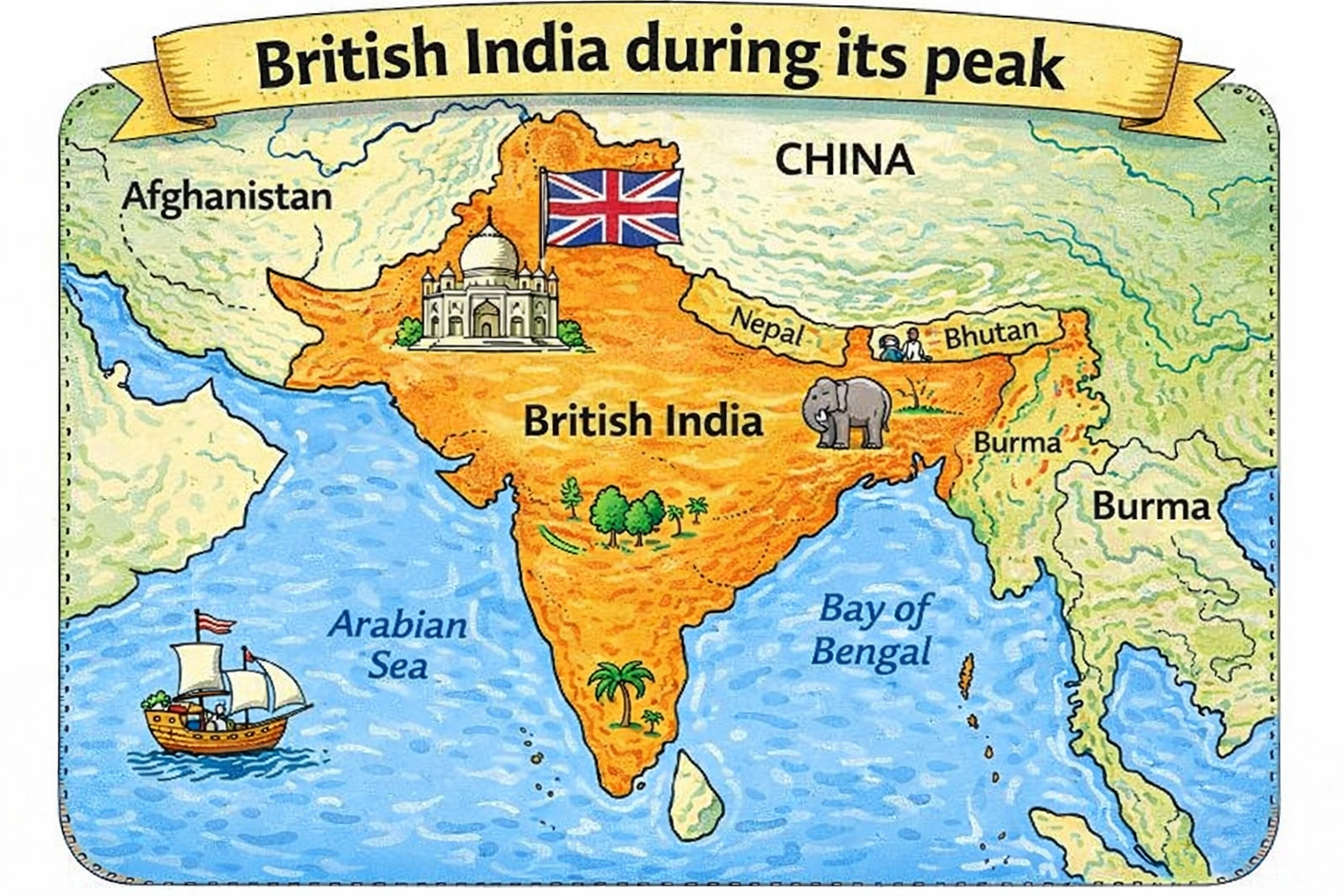 The Rise of Indian Nationalism and the Freedom Struggle
The economic exploitation, racial discrimination, and suppression of political rights fueled a growing sense of nationalism among Indians. The late 19th century saw the formation of various political organizations, most notably the Indian National Congress in 1885. The freedom struggle unfolded in several phases: the early moderate phase (seeking reforms through petitions), the extremist phase (advocating for more assertive methods), and finally, the Gandhian era (early 20th century). Mahatma Gandhi's leadership introduced non-violent civil disobedience (Satyagraha) as a powerful tool. Major movements like the Non-Cooperation Movement (1920-22), the Civil Disobedience Movement (1930-34), and the Quit India Movement (1942) mobilized millions across the country.
Towards Independence and Partition
The relentless struggle, coupled with the weakening of Britain after World War II, made continued colonial rule unsustainable. Despite facing immense challenges, including the rise of communal politics and the demand for a separate Muslim state, India finally gained independence on August 15, 1947. This momentous occasion was, however, accompanied by the tragic partition of the subcontinent into India and Pakistan, leading to widespread violence and displacement.
Keep learning, free
Create a free Syllabax account to unlock the other 1 lesson, practice questions and games.
Visual Learning Enhanced! 🚀
To help you master this topic, we use Advanced Syllabax AI to generate detailed diagrams and visual models.
Note on Visuals: The AI sometimes makes spelling errors in image labels. Please refer to the lesson text for the correct terminology.