Cube (Introduction to 3D Shapes) [Mensuration]
Watch this topic in 60 seconds
Free preview · Lesson 1
Understanding Cube (Introduction to 3D Shapes) [Mensuration]
Welcome to the World of 3D Shapes: Meet the Cube!
Imagine you're drawing on a piece of paper. Everything you draw – a square, a circle, a triangle – lives in a flat world. We call these 2D shapes, short for 'two-dimensional.' They only have length and width. But what about the world around us? The books we read, the balls we play with, the houses we live in – they're not flat! They pop out from the page; they have depth. These are called 3D shapes, or 'three-dimensional' shapes, because they have length, width, and height.
Today, we're going to dive into one of the most fundamental and fascinating 3D shapes: the Cube. Think of it as the 'perfect square' of the 3D world!
What Exactly is a Cube?
At its simplest, a cube is a special type of 3D shape that looks like a box, but a very symmetrical one. All its sides are perfectly square, and all those squares are exactly the same size. If you think about a flat square, a cube is what you get when you stack up many identical squares perfectly on top of each other until it forms a solid block.
Analogy 1: The Building Block!
Think of your building blocks or LEGO bricks. Many of them are perfect cubes! They have flat surfaces, sharp corners, and straight lines. If you try to build a tower, you'll see how neatly they fit together.
The Essential Parts of a Cube: Faces, Edges, and Vertices
Every 3D shape, including our friend the cube, has specific parts that describe its structure. Let's break them down:
-
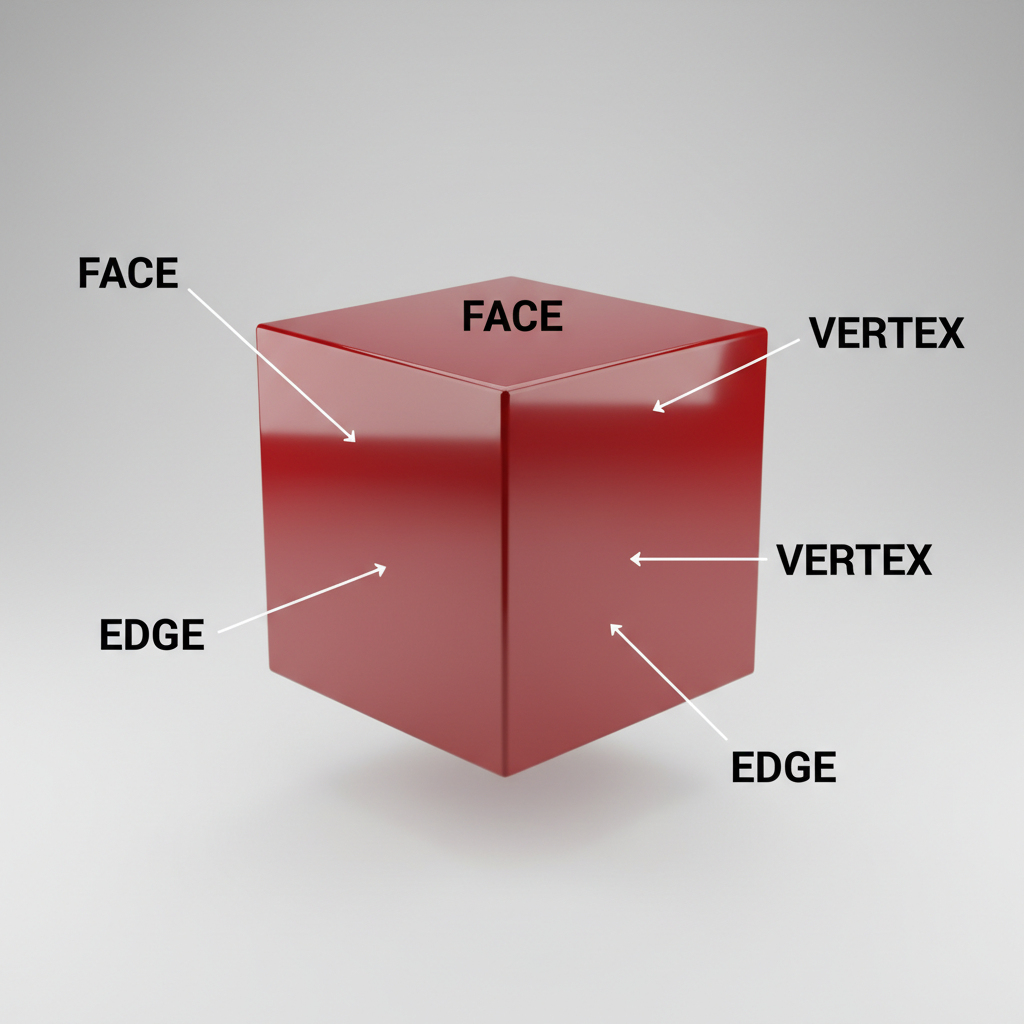
Faces: The Flat Surfaces
Imagine touching the side of a box. That flat surface is called a face. A cube is truly special because all of its faces are perfect squares. How many flat sides does a standard dice have? Count them! One for each number. That's right, a cube has 6 faces.
Analogy 2: The Pages of a Book!
Each face of a cube is like a page in a book, but instead of being thin and bendy, they are solid and flat. If you held a book closed, the front cover, back cover, top, bottom, and the two sides where the pages meet (spine and open side) could give you an idea of faces, though a book isn't perfectly cubic.
-
Edges: Where Two Faces Meet
Now, run your finger along where two faces of the cube join together. That line segment is called an edge. Think of it as the 'seams' or 'lines' of the cube. Since a cube is made up of squares, all its edges are perfectly straight and, importantly, all the same length! If you pick up a Rubik's Cube, you can clearly see these lines. A cube has 12 edges.
Analogy 3: The Frame of a Window!
The edges of a cube are like the wooden or metal frame around a window pane. They define where the flat glass (face) ends and another begins.
-
Vertices: The Pointy Corners
Finally, look at the sharp corners of the cube, where several edges meet. These points are called vertices (the singular is 'vertex'). Imagine the very tip of a sugar cube. That's a vertex! A cube has 8 vertices.
Analogy 4: The Corner of a Room!
Stand in a room and look up at a corner where two walls meet the ceiling. That's a vertex! It's a point where multiple flat surfaces (walls, ceiling) and lines (where walls meet, where wall meets ceiling) come together.
Let's visualize these parts with an image:
Key Properties of a Cube
To summarize, here's what makes a cube, well, a cube:
- It's a 3D shape.
- It has 6 faces, and all of them are perfectly square.
- It has 12 edges, and all of them are equal in length.
- It has 8 vertices.
- Because all its faces are identical squares, all its sides (length, width, and height) are exactly the same measurement! This is a crucial defining feature.
Cubes in the Real World!
You encounter cubes more often than you think! Here are some common examples:
- Dice: The classic example! Used in board games, dice are perfect cubes.
- Rubik's Cube: A famous puzzle that is a large cube made up of smaller cubes.
- Sugar Cubes: Small, compressed sugar shaped like perfect cubes.
- Some Building Blocks: Many children's building toys include cubic blocks.
- Certain Storage Boxes: While many boxes are rectangular, some are designed as perfect cubes.
A Glimpse into Mensuration: Understanding 'Size' for a Cube
When we talk about 'Mensuration,' we're essentially talking about measuring things – how big, how long, how much space something takes up. For 2D shapes, we talk about 'perimeter' (the distance around the edge) and 'area' (the space inside). For 3D shapes like a cube, we introduce new ideas:
-
Dimensions: Length, Width, and Height
A cube has three dimensions that tell us its size: its length (how long it is), its width (how wide it is), and its height (how tall it is). The amazing thing about a cube is that these three measurements are always the same! If a cube is 5 cm long, it's also 5 cm wide and 5 cm tall.
-
Surface Area (The 'Skin' of the Cube)
Imagine you wanted to paint a cube. The amount of paint you'd need would depend on the total area of all its faces. This total area is called the surface area. Since a cube has 6 identical square faces, its surface area is simply the area of one square face multiplied by 6.
-
Volume (The 'Space Inside' the Cube)
Now, imagine filling the cube with water or sand. The amount of water or sand it can hold is called its volume. Volume tells us how much space a 3D object occupies. For a cube, because its length, width, and height are all the same, its volume is calculated by multiplying that single measurement by itself three times (side × side × side).
Don't worry about calculating these values just yet! The main idea for now is to understand that 'mensuration' is about measuring the physical properties of shapes, and for a cube, we can measure its overall dimensions, the area of its outer surfaces, and the space it contains.
Putting it All Together
The cube is a fundamental building block in geometry. Understanding its basic features – its faces, edges, and vertices – is crucial for exploring more complex 3D shapes later on. Remember its perfect symmetry: all square faces, all equal edges. It's truly a marvel of mathematical simplicity and elegance!
Keep learning, free
Create a free Syllabax account to unlock practice questions and games for this topic.
Visual Learning Enhanced! 🚀
To help you master this topic, we use Advanced Syllabax AI to generate detailed diagrams and visual models.
Note on Visuals: The AI sometimes makes spelling errors in image labels. Please refer to the lesson text for the correct terminology.