Chemical vs physical changes[CHEMISTRY]
Watch this topic in 60 seconds
Free preview · Lesson 1
Understanding Chemical vs physical changes[CHEMISTRY]
Understanding Chemical vs. Physical Changes
Everything around us is constantly changing. Some changes are simple and easy to reverse, like crumpling a piece of paper. Others are more dramatic and permanent, like burning that same piece of paper to ash. In the world of chemistry, we categorize these changes into two fundamental types: physical changes and chemical changes. Understanding the difference between them is not just a basic science concept; it helps us explain how the world works, from why sugar dissolves in your tea to how a delicious cake bakes in the oven.
What is a Physical Change?
Imagine you have a big, juicy apple. If you cut that apple into smaller slices, what do you still have? Apple slices! Even though the apple looks different – it's now in pieces instead of whole – it hasn't turned into an orange or a banana. It's still chemically an apple. This is the essence of a physical change.
Definition:
A physical change is a change in the form or appearance of a substance, but not its chemical identity. No new substances are created during a physical change. The original substance retains its chemical composition and properties.
Analogy Time!
-
The LEGO Analogy: Think of LEGO bricks. You can use them to build a tall tower, then take it apart and build a spaceship. The LEGO bricks themselves haven't changed – they're still the same plastic bricks. You've only rearranged them into a different shape. That's exactly how a physical change works!
-
The Clothing Analogy: You can change your clothes from a t-shirt to a jacket, but you are still the same person underneath. Your identity hasn't changed, just your outward appearance.
Common Examples of Physical Changes:
-
Changes of State: This is one of the most common physical changes. Water can exist as a solid (ice), a liquid (water), or a gas (steam). When ice melts into water, or water boils into steam, it's still H₂O molecules. They're just arranged differently or moving at different speeds. No new substance is formed.
- Melting (solid to liquid, e.g., ice melting)
- Freezing (liquid to solid, e.g., water turning into ice)
- Boiling/Evaporation (liquid to gas, e.g., water boiling)
- Condensation (gas to liquid, e.g., dew forming on grass)
- Sublimation (solid to gas, e.g., dry ice 'smoking')
-
Changing Shape or Size:
- Tearing paper into smaller pieces.
- Crushing a soda can.
- Bending a metal wire.
- Grinding coffee beans.
-
Dissolving: When you stir sugar into water, it seems to disappear. But the sugar molecules are still there, just spread out evenly throughout the water. If you evaporate the water, you'll get the sugar back. (Think of it like mixing two different colored types of LEGOs – they're mixed, but still LEGOs.)
-
Mixing (without reacting): Mixing sand and pebbles. You can still easily tell them apart, and they haven't changed into a new substance.
Key Characteristics of Physical Changes:
- No new chemical substances are formed.
- The chemical composition of the substance remains the same.
- Often easily reversible (you can freeze water back into ice).
- Involves changes in state, shape, size, or appearance.
What is a Chemical Change?
Now, let's go back to that piece of paper. What happens if you light it on fire? You get ash, smoke, and heat. Can you turn that ash and smoke back into a clean piece of paper? Absolutely not! The paper is gone, and completely new substances with different properties have taken its place. This is what we call a chemical change.
Definition:
A chemical change (also known as a chemical reaction) results in the formation of one or more new substances with different chemical properties than the original substance(s). The original substance is transformed into something entirely new at a molecular level.
Analogy Time!
-
The Baking Analogy: Think about baking a cake. You start with ingredients like flour, eggs, sugar, and milk. You mix them, heat them, and what do you get? A cake! You can't separate the cake back into individual raw eggs or flour. The original ingredients have undergone a chemical change to form a completely new product with different tastes, textures, and smells.
-
The Puzzle Analogy (Advanced LEGOs): Instead of just rearranging LEGOs, imagine you take those LEGOs, melt them down, and then use the melted plastic to mold completely new, different plastic toys with new shapes and characteristics. The original LEGOs are destroyed in their initial form, and something new is created.
Common Examples of Chemical Changes:
-
Burning: Any form of combustion, like burning wood, paper, or natural gas. The original substance reacts with oxygen and turns into ash, smoke, carbon dioxide, and water vapor.
-
Rusting: When iron is exposed to oxygen and water, it forms iron oxide, which we call rust. Rust has different properties than iron; it's brittle and reddish-brown.
-
Cooking/Baking:
- Frying an egg (the clear liquid protein changes to a solid white).
- Baking bread (ingredients combine and change due to heat and yeast action).
- Caramelizing sugar.
-
Digestion: Your body breaks down complex food molecules into simpler nutrients that your cells can use. This is a series of chemical reactions.
-
Fermentation: Like grapes turning into wine, or milk turning into yogurt, where microorganisms cause chemical transformations.
-
Exploding: Fireworks exploding, or dynamite detonating. These are rapid chemical reactions that produce heat, light, and new gases.
Signs That a Chemical Change Has Occurred (Indicators):
While you can't always *see* molecules changing, there are often clues that a chemical reaction has taken place:
-
Change in Color: A banana turning brown, leaves changing color in autumn, or food spoilage often involve chemical changes.
-
Production of Gas (Bubbles): Mixing baking soda and vinegar produces carbon dioxide bubbles, indicating a chemical reaction.
-
Production of Heat or Light (Energy Change): Burning wood releases heat and light. A glow stick produces light through a chemical reaction. Some reactions can also absorb heat, making the surroundings feel colder (like an instant cold pack).
-
Formation of a Precipitate: If you mix two clear liquids and a solid substance forms and settles at the bottom, that solid is called a precipitate, and it signals a chemical change.
-
Odor Change: The smell of baking bread is very different from the smell of raw dough. The smell of spoiled milk is different from fresh milk.
-
Difficulty in Reversing: Most chemical changes are hard or impossible to reverse using simple physical means (you can't un-burn wood or un-cook an egg).
The Big Difference: A Quick Comparison
Let's sum up the core distinction:
- Physical Change: The substance changes its form or appearance, but its chemical identity stays the same. It's still the same 'stuff'.
- Chemical Change: The substance changes its identity entirely. New substances with new properties are formed. It's now completely different 'stuff'.
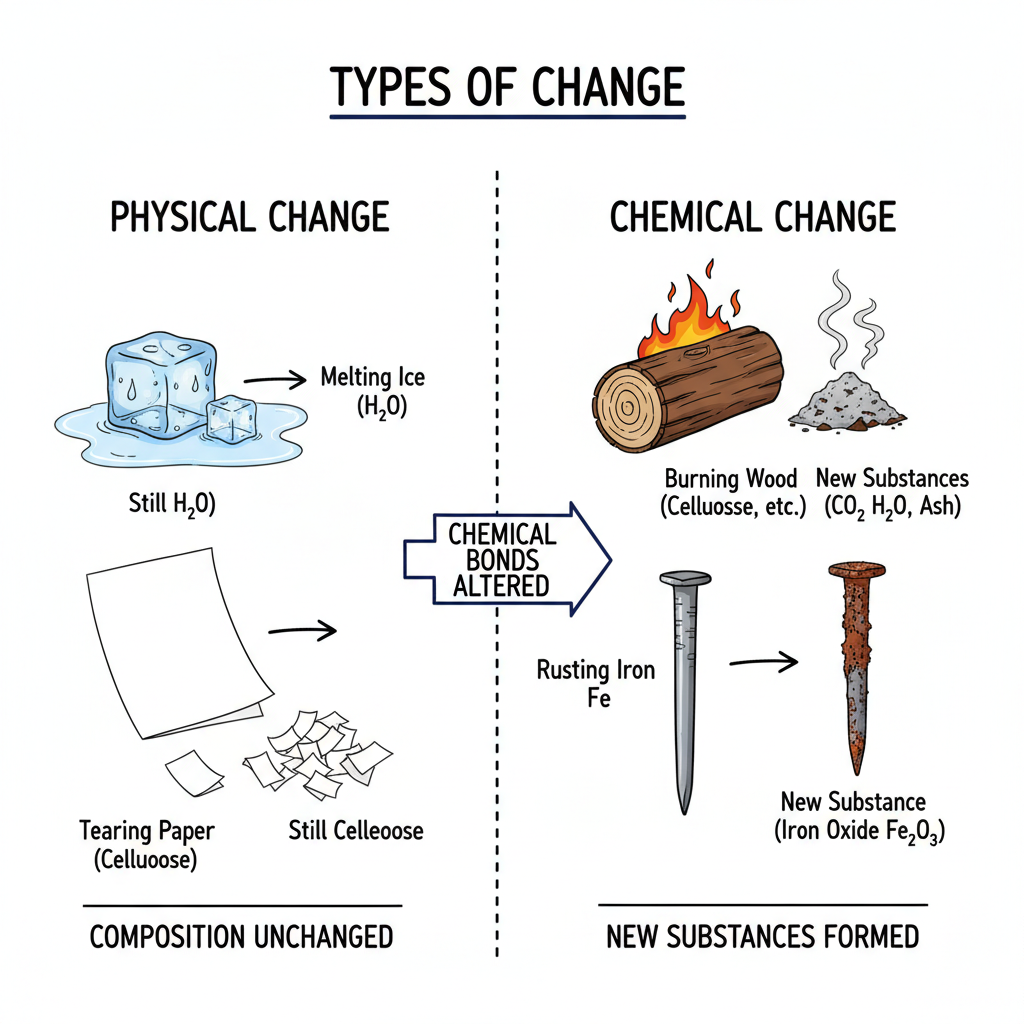 ⚠️ This picture may have spelling mistakes. Trust the words in the lesson.
Think of it like this: a physical change is like rearranging furniture in a room. It looks different, but it's still the same room. A chemical change is like knocking down walls and building an entirely new room in its place.
Why Is This Important in Our Daily Lives?
Understanding physical and chemical changes is fundamental to many aspects of our lives:
- Cooking: Knowing when ingredients are undergoing desired chemical changes (like baking) or just physical changes (like chopping vegetables).
- Safety: Recognizing signs of a dangerous chemical reaction (like gas leaks or fires) versus harmless physical changes.
- Industry: Manufacturing new materials (like plastics, medicines, or fuels) relies heavily on controlling chemical changes. Separating mixtures in factories often involves physical changes like distillation or filtration.
- Environment: Understanding how pollutants chemically react in the atmosphere or how waste breaks down.
- Biology: All living processes, from digestion to breathing, involve complex chemical changes.
By learning to differentiate between these two types of changes, you gain a powerful tool for analyzing and understanding the fascinating world around you!
Keep learning, free
Create a free Syllabax account to unlock practice questions and games for this topic.
Visual Learning Enhanced! 🚀
To help you master this topic, we use Advanced Syllabax AI to generate detailed diagrams and visual models.
Note on Visuals: The AI sometimes makes spelling errors in image labels. Please refer to the lesson text for the correct terminology.