Xylem & phloem[BIOLOGY]
Watch this topic in 60 seconds
Free preview · Lesson 1
Understanding Xylem & phloem[BIOLOGY]
Plants Have Built-in Plumbing: Xylem and Phloem
Imagine a tall skyscraper. How does water get to the very top floor? How does food get delivered to every room? Just like a building has pipes and delivery systems, plants have their own special internal transport network to move things around. This amazing system is made of two key types of tissues: xylem and phloem.
Meet the Water Pipes: Xylem
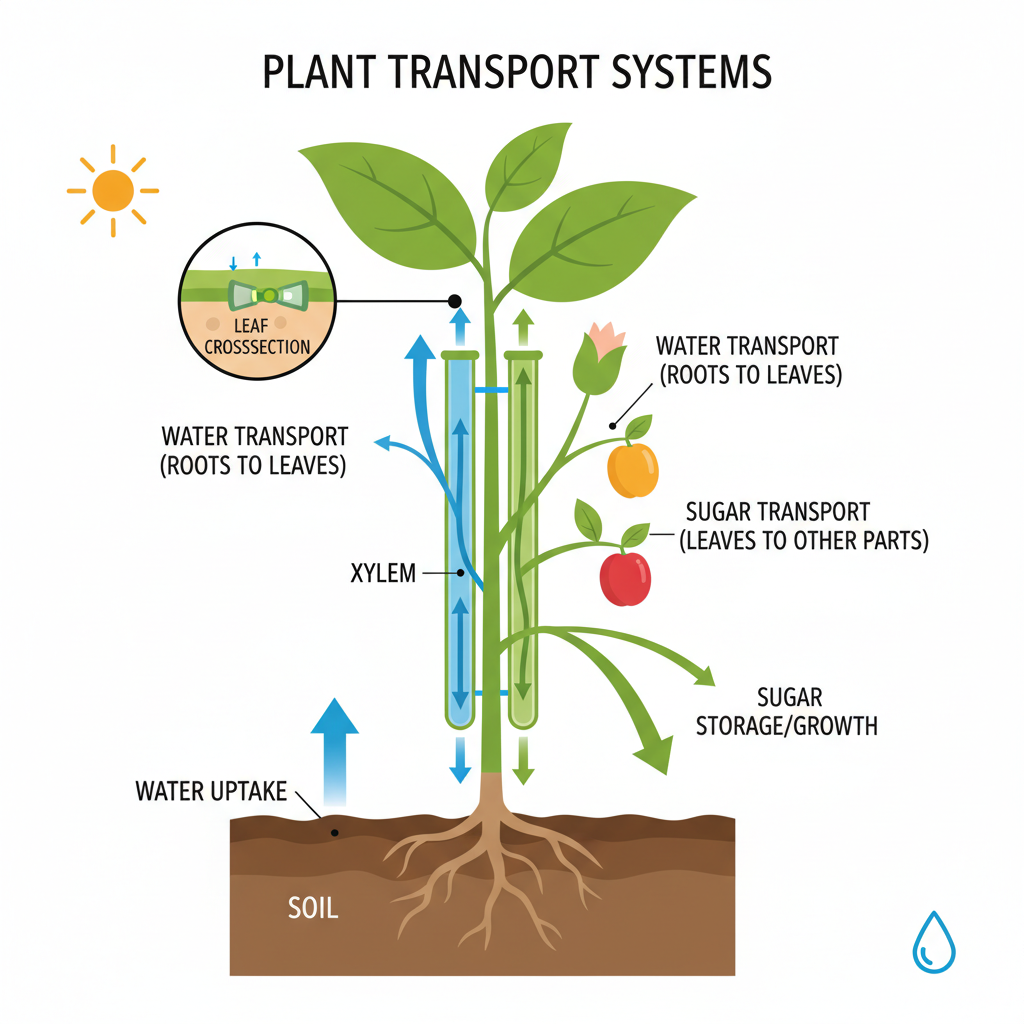
Think of xylem as the plant's plumbing system for water. Its main job is to carry water and dissolved minerals from the roots, all the way up to the leaves. It's like a one-way street, mostly moving upwards.
Where does it start? The journey begins in the roots. Roots are like the plant's straws, soaking up water and nutrients from the soil.
How does it work? Xylem is made of special cells that are actually dead when they are mature! These cells have tough, hollow walls, forming long, continuous tubes. Imagine tiny, empty pipes running from the roots up through the stem and into the leaves. Water is pulled up these tubes through a process called transpiration. Transpiration is like the plant breathing out water vapor from its leaves. As water evaporates from the leaves, it creates a 'pull' that draws more water up from the roots, much like sipping through a straw.
What's inside? The water in the xylem isn't just plain water. It's mixed with important minerals that the plant needs to grow, like nitrogen and phosphorus. These minerals are like vitamins for the plant.
Analogy Time!
- Xylem is like the water pipes in your house that bring fresh water from the main supply to your sink and shower.
- The roots are like the faucet where the water enters.
- Transpiration (water evaporation from leaves) is like the faucet being turned on, creating the flow.
Meet the Food Delivery Trucks: Phloem
If xylem is for water, phloem is for food! Phloem's job is to transport sugars (food) that the plant makes during photosynthesis, from the leaves to other parts of the plant where they are needed for energy or storage. This is like a delivery service.
Where does the food come from? Plants make their own food, a type of sugar called glucose, in their leaves through a process called photosynthesis. This is like the plant's kitchen!
How does it work? Phloem is made of living cells. These cells work together to move the sugary food. Unlike xylem's one-way street, phloem can move food in multiple directions – up, down, and sideways. It's like a flexible delivery network.
What's inside? The main thing transported in phloem is sugar (glucose). This sugar is like the plant's energy bar, providing fuel for growth, repair, and even making fruits and seeds. If there's extra sugar, it can be stored in roots or fruits for later use.
Analogy Time!
- Phloem is like the delivery trucks and roads that carry food to different neighborhoods (parts of the plant).
- The leaves are the food factory where the sugar is made.
- The roots, fruits, and flowers are the customers that receive the food.
Xylem vs. Phloem: The Dynamic Duo
Xylem and phloem are often found together, running side-by-side within the plant. They work in teams to keep the plant healthy and growing.
Key Differences Summarized:
- What they carry: Xylem carries water and minerals; Phloem carries sugars (food).
- Direction of flow: Xylem is mostly one-way (upwards); Phloem is multi-directional (up, down, sideways).
- Cell type: Xylem cells are dead; Phloem cells are living.
- Main function: Xylem is for support and water transport; Phloem is for food transport.
Without these two vital tissues, plants wouldn't be able to survive. They are essential for getting water to the highest leaves and delivering energy to the deepest roots or the developing fruits.
A Visual Aid
Here's a simplified diagram showing how xylem and phloem work within a plant:
 ⚠️ This picture may have spelling mistakes. Trust the words in the lesson.
Why is this important?
Understanding xylem and phloem helps us appreciate how plants function. It's not just about pretty flowers; it's about a complex and efficient internal transportation system that allows plants to grow, thrive, and provide us with food, oxygen, and so much more!
Keep learning, free
Create a free Syllabax account to unlock practice questions and games for this topic.
Visual Learning Enhanced! 🚀
To help you master this topic, we use Advanced Syllabax AI to generate detailed diagrams and visual models.
Note on Visuals: The AI sometimes makes spelling errors in image labels. Please refer to the lesson text for the correct terminology.