Sexual reproduction in plants[BIOLOGY]
Watch this topic in 60 seconds
Free preview · Lesson 1
Understanding Sexual reproduction in plants[BIOLOGY]
Understanding Sexual Reproduction in Plants: The Plant's Love Story!
Welcome, future botanists! Have you ever wondered how plants, like the beautiful rose in your garden or the mighty oak tree, make more of themselves? It's not magic, it's science! Plants have a fascinating way of reproducing, and one of the most common methods is called sexual reproduction. Think of it as the plant world's own love story, where different parts come together to create new life.
In simple terms, sexual reproduction in plants involves two 'parents' (or two different types of cells from one parent) combining their genetic material to create offspring that are unique. This is very similar to how humans and many animals reproduce! The main goal? To make seeds, which are like tiny plant babies, ready to grow into new plants.
The Flower: The Plant's "Love Headquarters"
When we talk about sexual reproduction in flowering plants (and we mostly will!), the star of the show is the flower. You can think of a flower as the plant's special "headquarters" or "workshop" where all the action happens. It's designed perfectly to attract helpers and make new seeds.
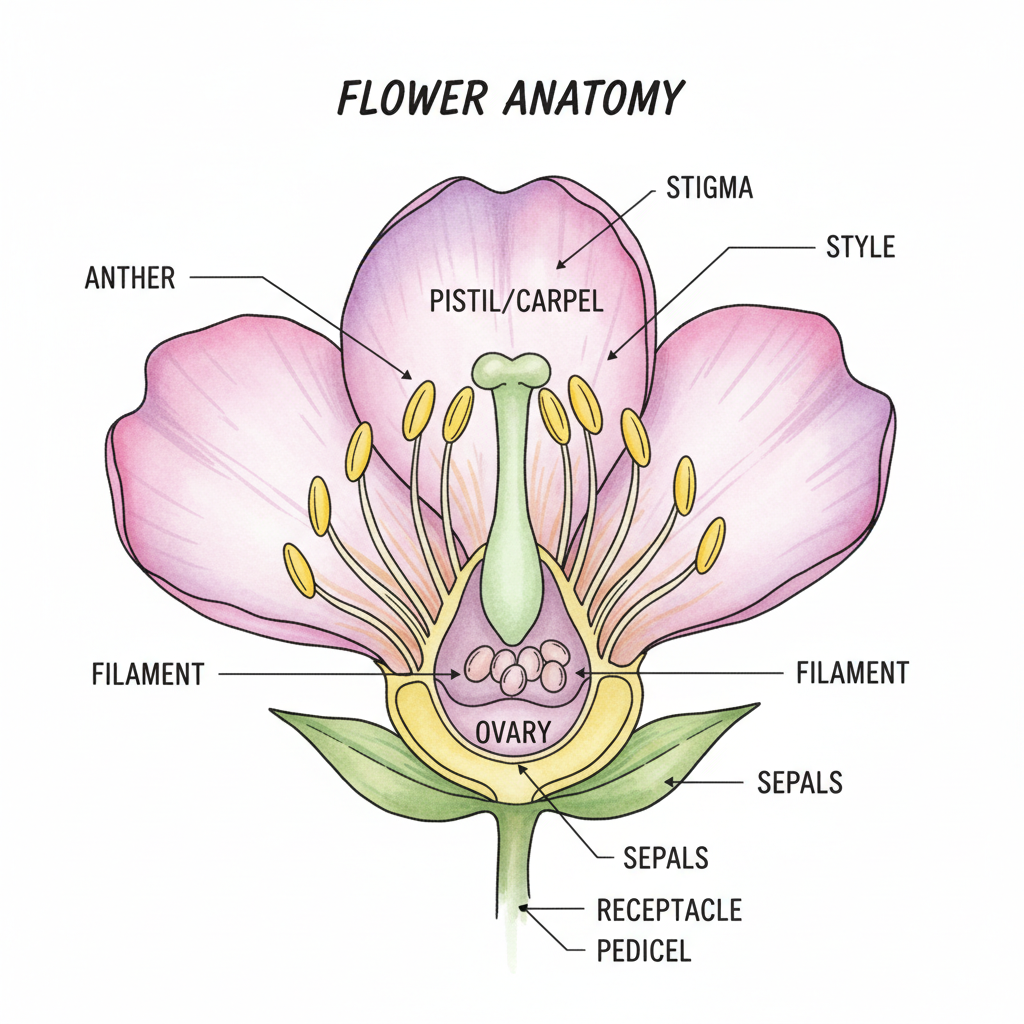
Let's Peek Inside a Flower: Its Key Parts
Imagine a flower is like a finely-tuned machine, with each part playing a crucial role. Let's break down its most important components:
-
Sepals: The Protective Huggers
These are usually green, leaf-like structures found at the base of the flower. They act like a tiny green blanket or a protective coat, shielding the developing flower bud before it opens. Think of them as the flower's bodyguards! -
Petals: The Bright Advertisers
These are often the most colorful and fragrant parts of a flower. Their job is to be super attractive! They are like the flashy advertisements or sweet perfumes that flowers use to grab the attention of pollinators (like bees, butterflies, or even birds). -
Stamen: The Male Powerhouse
This is the male reproductive part of the flower. Each stamen has two main components:-
Anther: The Pollen Factory
The anther sits at the top of the stamen and is like a tiny factory that produces millions of tiny, dust-like particles called pollen grains. Each pollen grain contains the plant's male reproductive cells, kind of like miniature 'sperm packets'. -
Filament: The Anther's Stand
This is a thin stalk that holds the anther up high, making it easy for pollen to be picked up or carried away. It's like a tiny pedestal for the pollen factory.
-
Anther: The Pollen Factory
-
Pistil (or Carpel): The Female Receiver
This is the female reproductive part, usually located in the center of the flower. It's often shaped like a bowling pin or a vase and consists of three main parts:-
Stigma: The Sticky Landing Pad
This is the very top part of the pistil. It's often sticky or feathery, specifically designed to catch and hold onto pollen grains. Think of it as a catcher's mitt waiting for a baseball (pollen). -
Style: The Connecting Bridge
This is the stalk-like structure connecting the stigma to the ovary. It's like a bridge or a hallway that the pollen grains will travel down once they land on the stigma. -
Ovary: The Nursery for Ovules
Located at the base of the pistil, the ovary is a swollen structure that contains one or more tiny structures called ovules. Each ovule contains the female reproductive cell, similar to an 'egg' in animals. The ovary is like a protective nursery for these precious ovules.
-
Stigma: The Sticky Landing Pad
The Big Event: Pollination!
Now that we know the players, let's talk about the first big step in the plant's love story: pollination. Pollination is simply the transfer of pollen grains from the anther (male part) to the stigma (female part) of a flower. It's like sending a crucial 'message' or 'love letter' from the male part to the female part.
Two Ways to Pollinate: Self-Love or New Adventures
-
Self-Pollination: The Solo Act
This happens when pollen from the anther of a flower lands on the stigma of the same flower, or on another flower on the same plant. Imagine a plant giving itself a high-five or talking to itself in the mirror. It's efficient but leads to less genetic variety in the offspring. -
Cross-Pollination: The Social Butterfly
This is when pollen from the anther of one flower is transferred to the stigma of a flower on a different plant of the same species. This is like finding a new friend or partner. Cross-pollination is great because it mixes genetic information, leading to stronger, more diverse offspring that can adapt better to changes in their environment.
Who Helps with Pollination? The "Delivery Drivers"!
Pollen can't usually move by itself. It needs help! These helpers are called pollinators or pollinating agents. They are like the delivery drivers for the plant's pollen messages:
-
Wind: The Invisible Messenger
Some plants, like grasses and many trees, rely on the wind to carry their light, powdery pollen. Imagine a breeze picking up tiny specks of dust and carrying them far away. These flowers usually don't have bright petals or strong scents because they don't need to attract animals. -
Animals (Insects, Birds, Bats): The Busy Bees (and more!)
Many plants depend on animals. Bees are famous pollinators, but butterflies, moths, birds (like hummingbirds), and even bats play a vital role. These animals visit flowers, often for nectar (a sugary treat), and accidentally pick up pollen on their bodies. When they visit another flower, they deposit the pollen there. They are like unwitting postal workers, carrying the plant's 'love letters' from one flower to another! -
Water: The Aquatic Carrier
A few aquatic plants use water currents to transport their pollen.
Fertilization: The 'Meeting' of New Life
Once pollen successfully lands on the stigma, the next crucial step is fertilization. This is where the actual 'joining' of the male and female reproductive cells happens. It's like the moment the 'love letter' is opened and its contents truly merge with the recipient.
-
Pollen Tube Growth: The Tunnel to the Ovule
When a pollen grain lands on the sticky stigma, it absorbs moisture and nutrients. It then grows a tiny tube, called a pollen tube, that tunnels down through the style, heading straight for the ovary and its ovules. Think of it as a tiny, microscopic bridge or pathway being built. -
Fusion: The Moment of Union
The male reproductive cells (from the pollen grain) travel down the pollen tube and reach an ovule inside the ovary. There, one male cell fuses (joins) with the female reproductive cell (egg) inside the ovule. This fusion is called fertilization! It's the moment new genetic material combines to form the beginning of a new plant.
From Flower to Fruit and Seed: New Beginnings
After successful fertilization, amazing transformations begin within the flower:
-
The Ovule becomes a Seed
The fertilized ovule develops into a seed. A seed is like a tiny, protected package containing a young plant (embryo), along with a food supply, all wrapped up in a protective outer coat. It's like a baby plant tucked safely into a small, sturdy box with its own packed lunch. -
The Ovary becomes a Fruit
The entire ovary surrounding the ovules starts to grow and mature, eventually developing into a fruit. Yes, technically, things like tomatoes, cucumbers, and even bell peppers are fruits because they contain seeds! The fruit's main job is to protect the developing seeds and help with their dispersal. Think of the fruit as a delicious, protective wrapper or a carrying case for the seeds inside.
Why is Sexual Reproduction Important?
Sexual reproduction is super important for plants for a few key reasons:
-
Genetic Diversity: The Mix-and-Match Advantage
By combining genetic material from two different sources (even if it's from the same plant, there's still a mix), sexual reproduction creates offspring that are genetically diverse. This means the new plants are not exact copies of the parent plant. This diversity is like having many different tools in a toolbox; it helps plants adapt to changing environments, resist diseases, and evolve over time. -
Evolution: Staying Strong
This diversity is the engine of evolution, allowing plant species to adapt and survive challenges over millions of years. -
Seed Dispersal: Spreading the Family Tree
The production of seeds and fruits helps plants spread their offspring far and wide, preventing overcrowding and allowing them to colonize new areas.
So, the next time you see a flower, remember it's not just a pretty face! It's a complex and vital part of the plant's life cycle, orchestrating a beautiful 'love story' that leads to new life and keeps our planet green and vibrant.
Keep learning, free
Create a free Syllabax account to unlock practice questions and games for this topic.
Visual Learning Enhanced! 🚀
To help you master this topic, we use Advanced Syllabax AI to generate detailed diagrams and visual models.
Note on Visuals: The AI sometimes makes spelling errors in image labels. Please refer to the lesson text for the correct terminology.