Learning Journey
Watch this topic in 60 seconds
Free preview · Lesson 1
Understanding Estimation of sums, differences & products [Fundamental Operations]
Guessing Game: Estimating Sums, Differences, and Products!
Hello amazing mathematicians! Today, we're going on an adventure into the world of estimation. What is estimation? Think of it like making a really smart guess! We use estimation when we don't need the exact answer, but we need a close idea of what the answer should be. It's like guessing how many jellybeans are in a jar – you don't need to count every single one to get a good idea!
Why Estimate?
Estimation is super useful in real life! Imagine you're at the grocery store with your parents. You have a certain amount of money, and you want to buy a few things. You can quickly estimate the total cost to see if you have enough money, without adding up every single item exactly. Or, if you're baking cookies and the recipe calls for 2 cups of flour, but you only see about 1 and a half cups left, you can estimate if you have enough to make half a batch.
In math, estimation helps us:
- Check our work: If we do a big calculation and our estimated answer is way off, we know we probably made a mistake.
- Save time: Sometimes, a quick guess is all we need!
- Understand numbers better: It helps us get a feel for how big or small numbers are.
Estimating Sums (Adding)
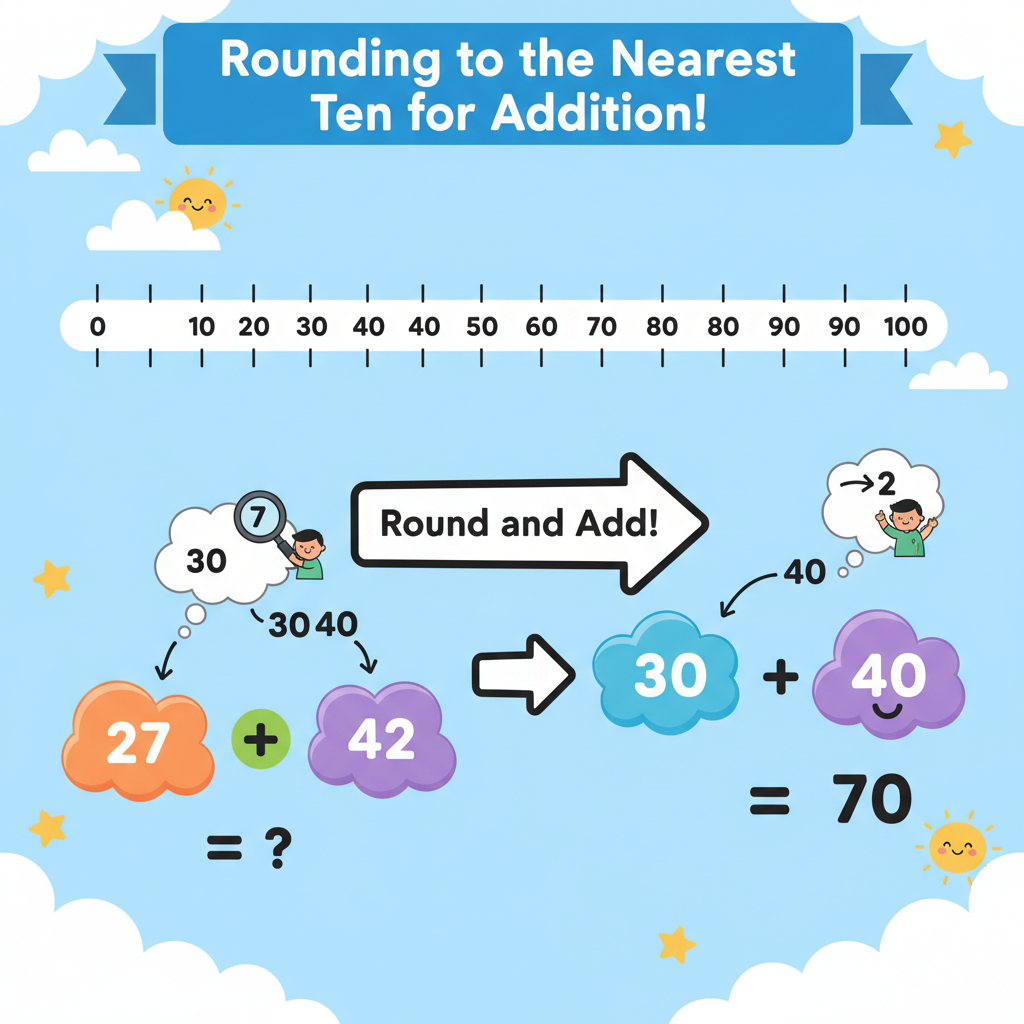
When we estimate sums, we are making a smart guess about the answer to an addition problem. The easiest way to do this is to round the numbers first. Rounding means making a number simpler, usually to the nearest 10 or 100.
Rounding to the Nearest 10
Let's say we want to estimate the sum of 43 + 27.
Step 1: Round each number to the nearest 10.
- For 43: Look at the ones digit (which is 3). If it's 0, 1, 2, 3, or 4, we round down. If it's 5, 6, 7, 8, or 9, we round up. Since 3 is less than 5, we round 43 down to 40.
- For 27: Look at the ones digit (which is 7). Since 7 is 5 or greater, we round 27 up to 30.
Step 2: Add the rounded numbers.
Now we add our rounded numbers: 40 + 30 = 70.
So, our estimated sum of 43 + 27 is 70. The actual sum is 70 (wow, we got it exactly this time!), but estimation gives us a close number even when the actual answer is different.
Analogy: Imagine you're counting your toy cars. You have 43 red cars and 27 blue cars. Instead of counting each one perfectly, you quickly say, "I have about 40 red cars and about 30 blue cars." So, you guess you have about 70 cars in total!
Rounding to the Nearest 100
Sometimes, we need to estimate with bigger numbers. Let's estimate 345 + 582.
Step 1: Round each number to the nearest 100.
- For 345: Look at the tens digit (which is 4). If it's 0, 1, 2, 3, or 4, round down. If it's 5, 6, 7, 8, or 9, round up. Since 4 is less than 5, we round 345 down to 300.
- For 582: Look at the tens digit (which is 8). Since 8 is 5 or greater, we round 582 up to 600.
Step 2: Add the rounded numbers.
Now we add: 300 + 600 = 900.
Our estimated sum is 900. (The actual sum is 927, which is pretty close to 900!).
Estimating Differences (Subtracting)
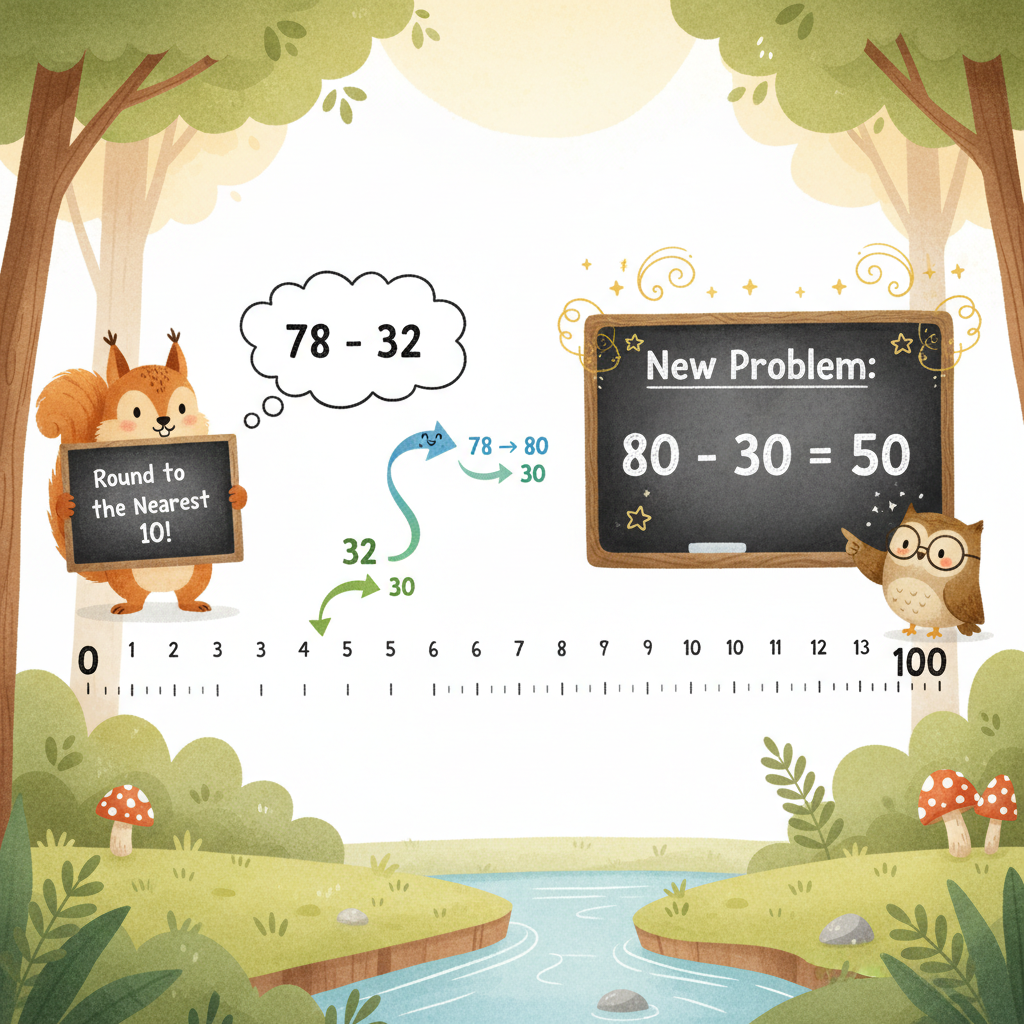
Estimating differences is very similar to estimating sums. We still round the numbers first, and then we subtract the rounded numbers.
Let's estimate the difference of 89 - 31.
Step 1: Round each number to the nearest 10.
- For 89: The ones digit is 9. We round up to 90.
- For 31: The ones digit is 1. We round down to 30.
Step 2: Subtract the rounded numbers.
Now we subtract: 90 - 30 = 60.
Our estimated difference is 60. (The actual difference is 58, which is close to 60!).
Analogy: Imagine you have 89 stickers and you give away 31. You want to know *about* how many you have left. You think, "I started with almost 90 stickers and gave away about 30." So, you guess you have about 60 left!
Let's try another one with rounding to the nearest 100: 752 - 218.
Step 1: Round each number to the nearest 100.
- For 752: The tens digit is 5. We round up to 800.
- For 218: The tens digit is 1. We round down to 200.
Step 2: Subtract the rounded numbers.
Now we subtract: 800 - 200 = 600.
Our estimated difference is 600. (The actual difference is 534, which is in the ballpark of 600!).
Estimating Products (Multiplying)
Estimating products helps us make a smart guess about the answer to a multiplication problem. Again, we start by rounding!
Let's estimate the product of 23 x 7.
Step 1: Round the numbers.
- For 23: We'll round to the nearest 10. The ones digit is 3, so we round down to 20.
- For 7: This is a single-digit number. We can leave it as is, or if we were multiplying by a larger two-digit number, we might round it to the nearest 10 (like 10). In this case, let's leave it as 7 for a slightly more accurate estimate, or round it to 10 to make it super simple. Let's try rounding 7 to 10 for a simpler calculation.
Step 2: Multiply the rounded numbers.
Now we multiply: 20 x 10 = 200.
Our estimated product is 200. (The actual product is 161. Rounding 7 to 10 made our estimate a bit further away, but it's still a good guess! If we had used 23 rounded to 20 and 7 as is, we'd get 20 x 7 = 140, which is closer to 161.)
Analogy: Imagine you're buying 7 T-shirts that cost
Let's try another: 58 x 31.
Step 1: Round the numbers to the nearest 10.
- For 58: The ones digit is 8, so we round up to 60.
- For 31: The ones digit is 1, so we round down to 30.
Step 2: Multiply the rounded numbers.
Now we multiply: 60 x 30 = 1800.
Our estimated product is 1800. (The actual product is 1798. We did a great job estimating this time!)
Key Ideas to Remember:
- Estimation is making a smart guess, not finding the exact answer.
- We often round numbers to make estimation easier.
- Round to the nearest 10 for smaller numbers, and nearest 100 for larger numbers.
- For multiplication, round the numbers and then multiply the rounded numbers.
Keep practicing your estimation skills, and you'll become a super-smart guesser in no time!
Keep learning, free
Create a free Syllabax account to unlock practice questions and games for this topic.
Visual Learning Enhanced! 🚀
To help you master this topic, we use Advanced Syllabax AI to generate detailed diagrams and visual models.
Note on Visuals: The AI sometimes makes spelling errors in image labels. Please refer to the lesson text for the correct terminology.