Changes in state (melting, freezing, evaporation) (CHEMISTRY)
Watch this topic in 60 seconds
Free preview · Lesson 1
Understanding Changes in state (melting, freezing, evaporation) (CHEMISTRY)
Science Sleuths: Unlocking the Secrets of State Changes!
Welcome, brilliant young scientists, to an exciting adventure into the world of chemistry! Today, we're going to become super sleuths and investigate how everyday things can change from one form to another. Have you ever wondered why ice melts on a hot day or why puddles disappear after the rain? These are all examples of amazing changes in state!
What is a "State of Matter"?
Imagine you have a big box of LEGO bricks. You can arrange them in different ways, right? You could keep them all neatly stacked in one pile, or you could spread them out all over the floor. Matter, which is everything around us – like water, rocks, and even the air you breathe – also exists in different "arrangements" called states of matter.
For our adventure today, we'll focus on the three most common states:
- Solids: Think of a solid block of ice. The tiny LEGO bricks (called molecules) are packed super close together, like a neat stack. They don't have much room to move around, so solids keep their shape and size.
- Liquids: Now imagine that ice melts into water. The LEGO bricks are still close, but they have a little more wiggle room. They can slide past each other, like a group of friends holding hands and shuffling around. This is why liquids can flow and take the shape of their container.
- Gases: What happens if you heat water until it becomes steam? The LEGO bricks zoom around super fast, bouncing off everything! They spread out as far as possible, filling up all the space they can. This is like letting all your LEGOs fly off the floor and bounce around the room! Gases have no fixed shape or size.
The Magical Trio: Melting, Freezing, and Evaporation
How do we switch between these states? It all comes down to energy, especially heat! Think of heat as the energy that makes those tiny LEGO molecules jiggle and move.
1. Melting: From Solid to Liquid (The Great Escape!)
Have you ever built a magnificent ice sculpture? What happens if you leave it out in the sun? It starts to drip, doesn't it? That's melting! Melting is the change from a solid to a liquid.
How it works: When you add heat to a solid, the molecules inside start to get more energy. They begin to wiggle and jiggle more and more until they break free from their tight, packed positions. They can then slide past each other, and voilà – you have a liquid!
Analogy Alert! Imagine a group of friends holding hands in a tight circle (a solid). If you start cheering them on and giving them energy drinks (adding heat), they'll start bouncing and wanting to move around. Eventually, they might let go of hands and start dancing and mingling (a liquid).
Real-world examples:
- An ice cube melting in your drink.
- Butter melting in a hot pan.
- Chocolate melting when you hold it in your hand.
2. Freezing: From Liquid to Solid (The Big Freeze!)
Now, let's go the other way! What happens when you put a tray of water in the freezer? It turns into ice! That's freezing! Freezing is the change from a liquid to a solid.
How it works: When you remove heat from a liquid, the molecules lose energy. They slow down their jiggling and wiggling until they settle into those neat, packed positions again. They can no longer slide past each other, and they form a solid!
Analogy Alert! Think back to your dancing friends (a liquid). If you tell them to calm down and turn off the music (removing heat), they'll start to slow down. Eventually, they'll stand still and hold hands tightly again, forming that neat circle (a solid).
Real-world examples:
- Water turning into ice in a freezer.
- Molten lava cooling down and hardening into rock.
- Making homemade popsicles.
3. Evaporation: From Liquid to Gas (The Disappearing Act!)
Have you ever noticed how a wet shirt left out to dry eventually becomes dry? Where did the water go? It turned into a gas called water vapor and floated away into the air! That's evaporation! Evaporation is the change from a liquid to a gas.
How it works: When you add heat to a liquid, the molecules get a lot of energy. Some of the molecules at the surface get enough energy to break completely free from the liquid and float off into the air as a gas. You don't always see this happening, but it's like tiny invisible bubbles of gas escaping!
Analogy Alert! Imagine your friends are dancing and shuffling around (a liquid). If you give them super-duper energy drinks and play super-fast music (adding lots of heat), some of them might get so excited that they jump right out of the dancing circle and start running around the room by themselves (a gas).
Real-world examples:
- Puddles drying up after it rains.
- Clothes drying on a clothesline.
- The steam rising from a hot cup of cocoa.
A quick note: Sometimes, liquids can also turn into gas quickly with a lot of heat, like when water boils into steam. This is called boiling, and it's a faster form of evaporation happening throughout the liquid, not just at the surface.
Here's a little something to help you visualize these changes:
Think about these processes in your everyday life! The world is full of amazing changes happening all the time.
We can also think about how these changes happen by looking at how the particles (those tiny LEGO molecules) are arranged and how they move:
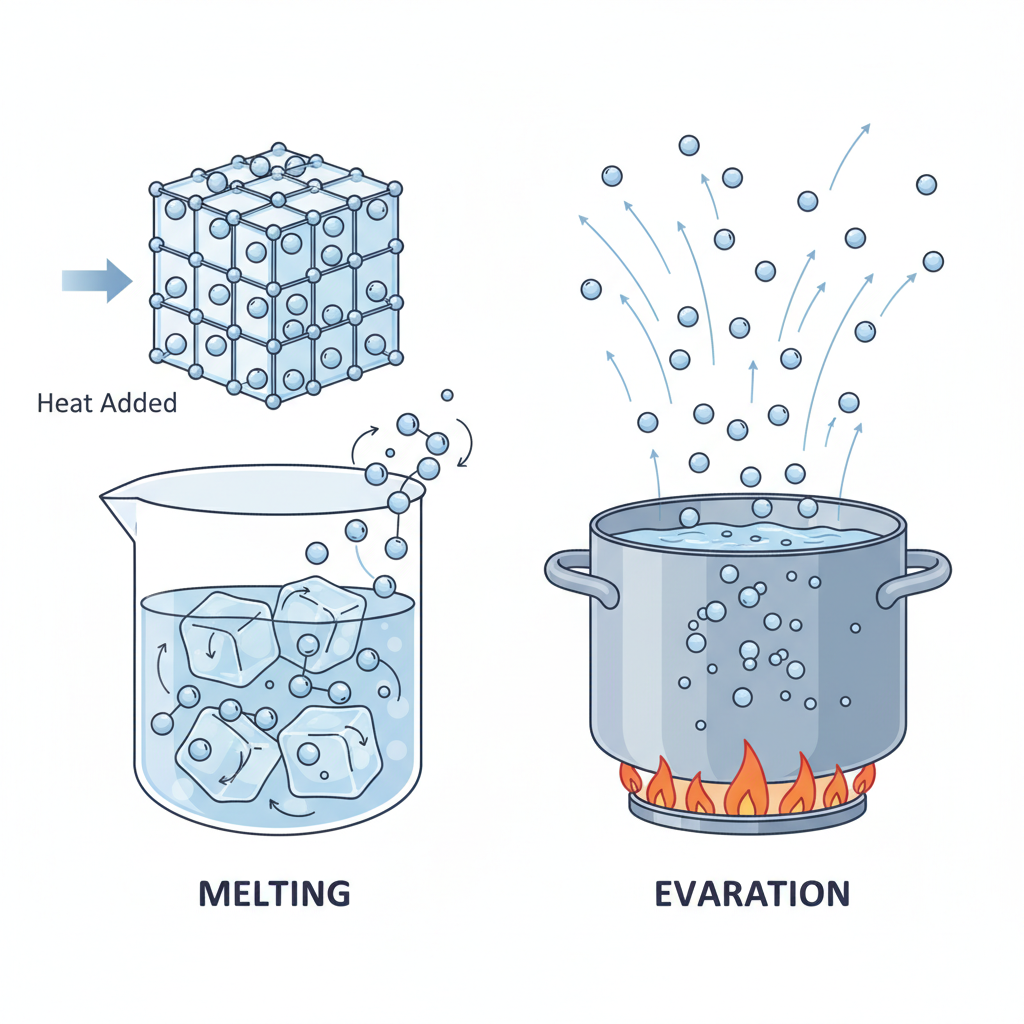 ⚠️ This picture may have spelling mistakes. Trust the words in the lesson.
Review Time!
We've learned about three fantastic ways matter can change:
- Melting: Solid ➔ Liquid (Needs Heat)
- Freezing: Liquid ➔ Solid (Loses Heat)
- Evaporation: Liquid ➔ Gas (Needs Heat)
Keep your eyes open for these changes happening around you. You're now a science sleuth ready to explore the fascinating world of chemistry!
Keep learning, free
Create a free Syllabax account to unlock practice questions and games for this topic.
Visual Learning Enhanced! 🚀
To help you master this topic, we use Advanced Syllabax AI to generate detailed diagrams and visual models.
Note on Visuals: The AI sometimes makes spelling errors in image labels. Please refer to the lesson text for the correct terminology.