Simplification of fractions [Fractions]
Watch this topic in 60 seconds
Free preview · Lesson 1
Understanding Simplification of fractions [Fractions]
Simplifying Fractions: Making Numbers Easier to Understand!
Welcome, young mathematicians! Today, we're going to learn about something super useful called simplifying fractions. Imagine you have a delicious pizza, and you cut it into many slices. Simplifying fractions is like finding a way to describe the same amount of pizza using fewer slices, but making sure you're still talking about the same total amount!
What is a Fraction, Anyway?
Before we simplify, let's quickly remember what a fraction is. A fraction is a way to show a part of a whole thing. Think of it like this:
- The Top Number (Numerator): This tells us how many parts we have.
- The Bottom Number (Denominator): This tells us how many equal parts the whole thing is divided into.
For example, if you have a chocolate bar divided into 8 equal pieces, and you eat 3 of them, you have eaten 3/8 of the chocolate bar. The 3 is the numerator (what you have), and the 8 is the denominator (the total number of equal parts).
Why Do We Simplify Fractions?
Simplifying fractions, also called reducing fractions, makes them easier to work with. It's like when you have a lot of small building blocks, and you can combine them into bigger, identical blocks. The amount you have is still the same, but it's represented in a simpler way.
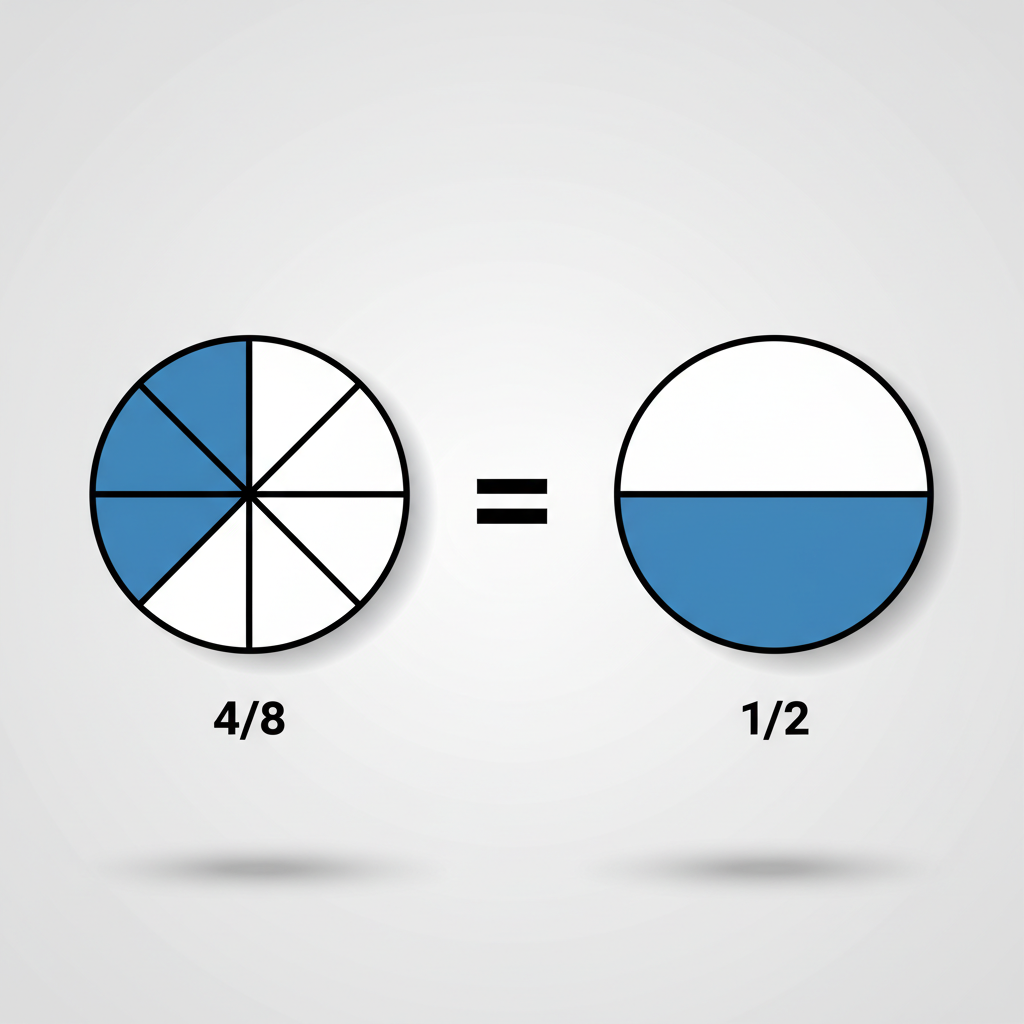
Think about sharing that pizza again. If a pizza is cut into 8 slices, and you eat 4 slices, you've eaten 4/8 of the pizza. But what if the pizza was cut into only 2 slices, and you ate 1 of them? You still ate the exact same amount of pizza! So, 4/8 is the same as 1/2. The fraction 1/2 is simpler than 4/8 because it uses smaller numbers.
How Do We Simplify Fractions? The Secret is the Greatest Common Factor (GCF)!
To simplify a fraction, we need to find a number that can divide both the top number (numerator) and the bottom number (denominator) without leaving any remainder. We want to find the biggest such number, which we call the Greatest Common Factor (GCF).
What is a Factor?
A factor is a number that divides another number exactly. For example, the factors of 6 are 1, 2, 3, and 6 because:
- 6 ÷ 1 = 6
- 6 ÷ 2 = 3
- 6 ÷ 3 = 2
- 6 ÷ 6 = 1
What is a Common Factor?
A common factor is a number that is a factor of two or more numbers. Let's find the common factors of 12 and 18:
- Factors of 12: 1, 2, 3, 4, 6, 12
- Factors of 18: 1, 2, 3, 6, 9, 18
- Common Factors of 12 and 18: 1, 2, 3, 6
What is the Greatest Common Factor (GCF)?
The GCF is the largest number among the common factors. In our example of 12 and 18, the GCF is 6.
The Steps to Simplifying a Fraction:
Now, let's put it all together! Here’s how to simplify a fraction:
- Find the GCF of the numerator and the denominator.
- Divide both the numerator and the denominator by the GCF.
- The new fraction you get is the simplified (or reduced) fraction!
Example 1: Simplify 4/8
Let's use our pizza example. We want to simplify 4/8.
- Find the GCF of 4 and 8:
- Factors of 4: 1, 2, 4
- Factors of 8: 1, 2, 4, 8
- Common Factors: 1, 2, 4
- The GCF is 4.
- Divide the numerator (4) and the denominator (8) by the GCF (4):
- 4 ÷ 4 = 1
- 8 ÷ 4 = 2
- The simplified fraction is 1/2.
So, 4 slices out of 8 is the same as 1 slice out of 2!
 ⚠️ This picture may have spelling mistakes. Trust the words in the lesson.
Example 2: Simplify 6/9
Let's say you have 6 cookies out of a batch of 9. How can we simplify this?
- Find the GCF of 6 and 9:
- Factors of 6: 1, 2, 3, 6
- Factors of 9: 1, 3, 9
- Common Factors: 1, 3
- The GCF is 3.
- Divide the numerator (6) and the denominator (9) by the GCF (3):
- 6 ÷ 3 = 2
- 9 ÷ 3 = 3
- The simplified fraction is 2/3.
This means having 6 out of 9 cookies is the same as having 2 out of 3 cookies.
Example 3: Simplify 10/15
- Find the GCF of 10 and 15:
- Factors of 10: 1, 2, 5, 10
- Factors of 15: 1, 3, 5, 15
- Common Factors: 1, 5
- The GCF is 5.
- Divide the numerator (10) and the denominator (15) by the GCF (5):
- 10 ÷ 5 = 2
- 15 ÷ 5 = 3
- The simplified fraction is 2/3.
What if the Fraction is Already Simplified?
Sometimes, a fraction is already in its simplest form. This happens when the only common factor of the numerator and the denominator is 1. For example, consider the fraction 3/5:
- Factors of 3: 1, 3
- Factors of 5: 1, 5
- The only common factor is 1.
Since the GCF is 1, the fraction 3/5 cannot be simplified further. It's already as simple as it can get!
Practice Time!
Now it's your turn to practice simplifying fractions. Remember to find the GCF and divide both the top and bottom numbers by it!
Keep learning, free
Create a free Syllabax account to unlock practice questions and games for this topic.
Visual Learning Enhanced! 🚀
To help you master this topic, we use Advanced Syllabax AI to generate detailed diagrams and visual models.
Note on Visuals: The AI sometimes makes spelling errors in image labels. Please refer to the lesson text for the correct terminology.