Fractions on number line [Fractions]
Watch this topic in 60 seconds
Free preview · Lesson 1
Understanding Fractions on number line [Fractions]
Fractions on the Number Line: A Foundational Journey
Welcome, amazing mathematicians! Today, we're embarking on an exciting adventure to understand fractions by placing them on a special map called the number line. Think of the number line as a road, and numbers are like houses along that road. Fractions are special kinds of houses that live between the whole numbers!
What is a Fraction Anyway?
Before we put fractions on the road, let's remember what they are. A fraction is a way to talk about a part of a whole. Imagine you have a delicious pizza, and you cut it into equal slices. A fraction tells us how many of those slices you have compared to the total number of slices.
A fraction has two important parts:
- Numerator: This is the top number. It tells us how many parts we have. Think of it as the number of pizza slices you're holding.
- Denominator: This is the bottom number. It tells us how many equal parts the whole is divided into. Think of it as the total number of slices the pizza was cut into.
For example, in the fraction
- The numerator is 3. You have 3 slices.
- The denominator is 4. The whole pizza was cut into 4 equal slices.
So,
The Number Line: Our Road Map for Numbers
The number line is a straight line where we can show numbers. It usually starts at 0 and goes on forever to the right, showing bigger and bigger numbers. We mark whole numbers like 0, 1, 2, 3, and so on, at equal distances.
Imagine a ruler. The inches or centimeters are like whole numbers marked on it. The number line is similar, but it shows all numbers, including those in between!
Placing Fractions on the Number Line
Now, let's put our fraction houses on this number road! Fractions are always between the whole numbers. For example,
Let's take the fraction
Example: Showing
- Draw a number line and mark the whole numbers 0 and 1.
- Look at the denominator: it's 2. This means we need to divide the space between 0 and 1 into 2 equal parts.
- Make one mark exactly in the middle of 0 and 1. This middle point is
It's like dividing a candy bar in half. The first half is
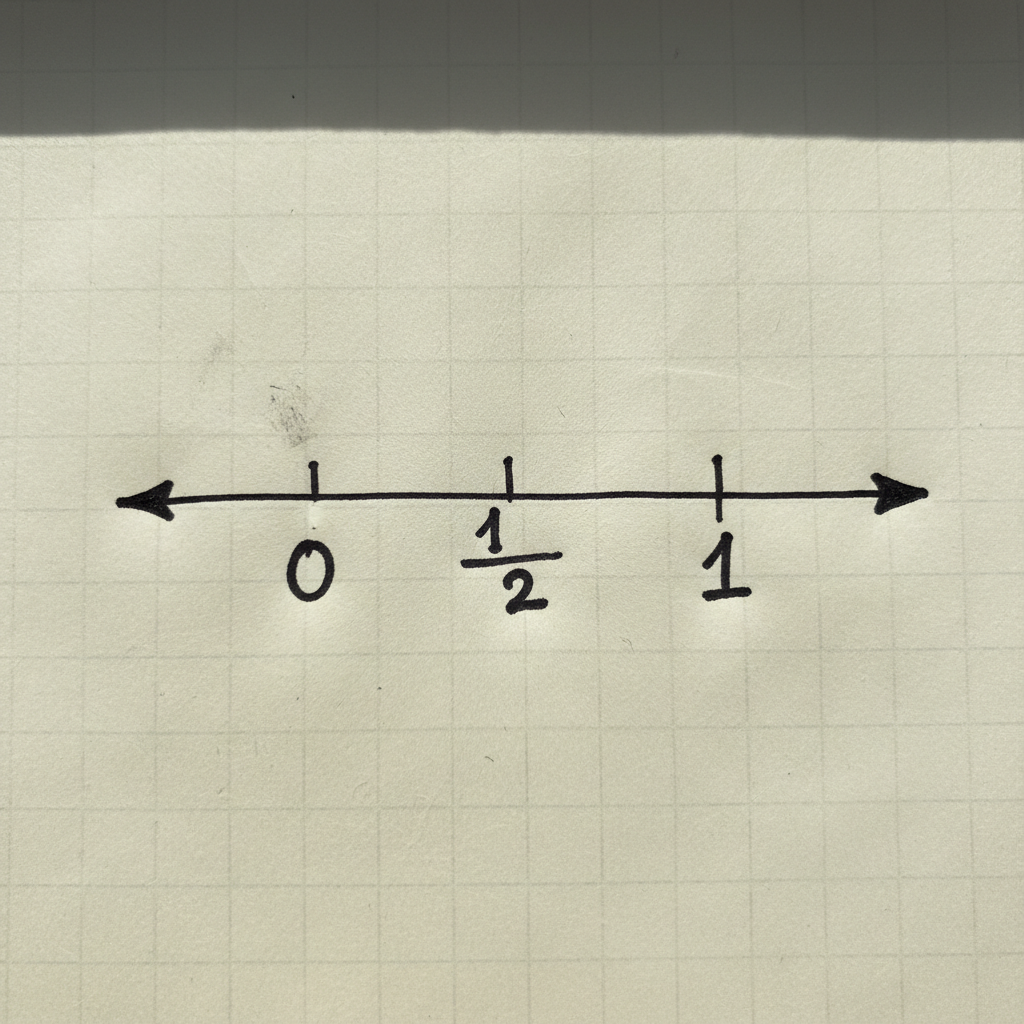
Example: Showing
Let's look at the fraction
- Draw a number line and mark 0 and 1.
- Divide the space between 0 and 1 into 4 equal parts. You'll need to make 3 marks.
- The first mark is
- The second mark is
- The third mark is
Think of it like cutting a cake into 4 equal slices.
Notice that
Fractions Greater Than 1
What about fractions like
Let's show
- Draw a number line and mark whole numbers 0, 1, and 2.
- Focus on the space between 0 and 1. Divide it into 4 equal parts because the denominator is 4. Mark
- Now, move to the space between 1 and 2. Divide this space into another 4 equal parts.
- The first mark after 1 will be
So,
Key Ideas to Remember
- The denominator tells you how many equal parts the space between two whole numbers is divided into.
- The numerator tells you how many of those parts you are counting, starting from 0.
- Fractions with a numerator smaller than the denominator are between 0 and 1.
- Fractions with a numerator larger than the denominator are greater than 1.
Fractions on the number line help us see how numbers are ordered and how different fractions relate to each other. Keep practicing, and you'll become a fraction number line expert in no time!
Keep learning, free
Create a free Syllabax account to unlock practice questions and games for this topic.
Visual Learning Enhanced! 🚀
To help you master this topic, we use Advanced Syllabax AI to generate detailed diagrams and visual models.
Note on Visuals: The AI sometimes makes spelling errors in image labels. Please refer to the lesson text for the correct terminology.