Computational Thinking Skills
Watch this topic in 60 seconds
Free preview · Lesson 1
Understanding Computational Thinking Skills
Unlocking Your Superpower: Computational Thinking for 7th Graders!
Hey 7th Graders! Ever wonder how people solve really big, tricky problems? Or how your favorite video game was designed? It all comes down to something called Computational Thinking (CT)! Don't let the word 'computational' scare you – it doesn't mean you need to be a computer scientist. It's actually a superpower for your brain, a way of thinking that helps you break down problems, find patterns, and create solutions, whether you're building a robot or just planning your day.
Think of Computational Thinking as a set of tools in your mental toolbox. Just like a chef uses different knives, pans, and ingredients to create a delicious meal, you'll use these CT tools to tackle any challenge. It’s about learning to think like a computer scientist, not just using computers!
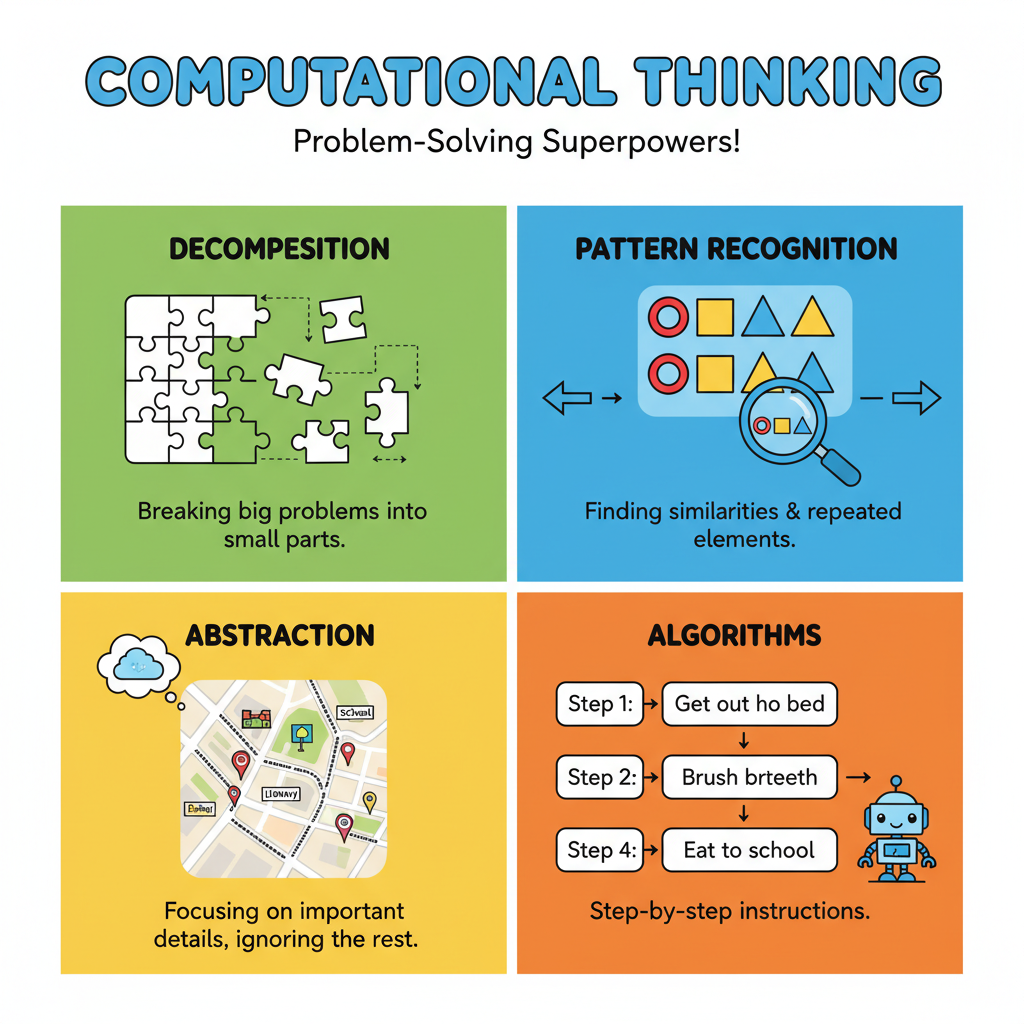 ⚠️ This picture may have spelling mistakes. Trust the words in the lesson.
The Four Pillars of Computational Thinking
Computational Thinking is built on four main ideas. Let's explore each one with simple terms and lots of examples!
1. Decomposition: Breaking It Down
Imagine you have a giant, delicious pizza in front of you. Would you try to eat it all in one bite? Probably not! You'd cut it into smaller, manageable slices. That's exactly what Decomposition is all about!
Definition: Decomposition is the skill of breaking down a large, complex problem or system into smaller, more manageable parts. Each smaller part is easier to understand and solve on its own.
Analogy: Building a LEGO Castle
If you get a huge box of LEGOs to build a magnificent castle, you don't just dump them out and try to build the whole thing at once. You look at the instructions (or design in your head) and build it piece by piece: first the foundation, then the walls, then the towers, and finally the roof. Each part is a smaller problem to solve.
Example: Planning a School Project
Let's say you have a big history project due. Instead of just thinking, "Oh no, a giant project!" you can decompose it:
- Research the topic.
- Outline your presentation.
- Gather images/videos.
- Write the script.
- Create the slides/poster.
- Practice your presentation.
2. Pattern Recognition: Finding Similarities
Have you ever played a game where you had to find matching pairs? Or noticed that certain things always happen after other things? That's your brain doing Pattern Recognition!
Definition: Pattern Recognition is the skill of observing trends, similarities, or recurring characteristics within problems, data, or systems. Once you find a pattern, you can often predict what might happen next or how to solve a similar problem more easily.
Analogy: Finding Matching Socks
After laundry day, you have a huge pile of socks. To put them away, you don't just grab two random socks; you look for patterns – color, length, design – to find their matching partners. You're recognizing the pattern of 'this sock goes with that sock'.
Example: Learning a New Language
When you learn a new language, you might notice patterns in how verbs change based on who is speaking, or how questions are formed. Once you recognize these grammatical patterns, it becomes much easier to form new sentences, even ones you've never heard before!
Another example: In math, if you know the pattern for multiplying by 10 (just add a zero!), you don't have to re-learn it for every single number.
3. Abstraction: Focusing on What Matters
Imagine you're giving directions to a friend. Do you tell them about every single crack in the sidewalk, every blade of grass, or every car parked on the street? No! You tell them the important stuff: turn left at the big oak tree, go straight past the school. That's Abstraction.
Definition: Abstraction is the skill of focusing on the essential information and details of a problem, while ignoring or hiding the unnecessary or less important details. It helps you simplify complex ideas.
Analogy: Using a Remote Control
When you use a TV remote, you just press a button like "Channel Up" or "Volume Down." You don't need to know how the electricity flows inside the remote, or how the TV decodes the signal. All those complex inner workings are abstracted away; you only need to interact with the simple buttons that matter for watching TV.
Example: Creating a Map
A map of your town doesn't show every single house, tree, or person. It shows main roads, important landmarks, and key features. It abstracts away all the small, irrelevant details to give you a clear, usable guide. If it showed everything, it would be too cluttered to be useful!
4. Algorithms: Step-by-Step Instructions
Have you ever followed a recipe to bake cookies? Or instructions to build a piece of furniture? You were following an Algorithm!
Definition: An Algorithm is a detailed, step-by-step set of instructions or rules designed to solve a specific problem or complete a particular task. It's like a recipe for a computer (or your brain) to follow.
Analogy: A Recipe for Baking a Cake
A cake recipe is a perfect algorithm. It tells you exactly what ingredients to use, in what amounts, and in what order to mix and bake them. If you follow the steps correctly, you get a delicious cake! If you skip a step or do them out of order, you might end up with a mess.
Example: Brushing Your Teeth
Think about how you brush your teeth every morning. You probably follow an unspoken algorithm:
- Pick up toothbrush.
- Apply toothpaste.
- Wet brush (optional).
- Brush all surfaces of teeth (front, back, chewing).
- Rinse mouth.
- Clean toothbrush.
- Put toothbrush away.
This is a clear, repeatable set of steps to achieve the goal of clean teeth!
How Do These Skills Work Together?
These four skills aren't used in isolation; they often work hand-in-hand! When faced with a big problem, you might:
- Decompose it into smaller parts.
- Look for Patterns within those parts or in similar problems you've solved before.
- Use Abstraction to focus only on the important information for each part.
- Create an Algorithm (a step-by-step plan) to solve each smaller part, and then combine those solutions to solve the whole big problem!
Why is Computational Thinking Your Superpower?
Computational Thinking isn't just for people who want to code. It's a valuable skill for everyone! It helps you:
- Solve problems more efficiently in school and life.
- Understand complex situations better.
- Be more creative and innovative.
- Prepare for future careers in any field, from science and engineering to art and business.
So, start practicing these skills every day! Whether you're organizing your locker, figuring out a strategy in a game, or planning a birthday party, you're using your computational thinking superpower!
Keep learning, free
Create a free Syllabax account to unlock practice questions and games for this topic.
Visual Learning Enhanced! 🚀
To help you master this topic, we use Advanced Syllabax AI to generate detailed diagrams and visual models.
Note on Visuals: The AI sometimes makes spelling errors in image labels. Please refer to the lesson text for the correct terminology.