Problem Solving with Logic
Watch this topic in 60 seconds
Free preview · Lesson 1
Understanding Problem Solving with Logic
Welcome to the World of Logic! Solving Problems Like a Super Sleuth!
Hello, young problem solvers! Have you ever wondered how detectives solve mysteries? Or how your parents figure out where you left your favorite toy? They use something very special called logic! Logic is like a superpower for your brain that helps you think clearly and solve problems. It’s all about using clues and smart thinking to figure things out.
Imagine your brain is a brilliant detective. When there's a problem, your brain detective doesn't guess. Instead, it looks for clues, thinks about what makes sense, and slowly puts the pieces together until the mystery is solved!
What is Logic? (Your Brain's Detective Kit!)
At its heart, logic is a way of thinking about things to make good decisions and find answers. It's not magic; it's just careful thinking! Here are some important tools in your brain's detective kit:
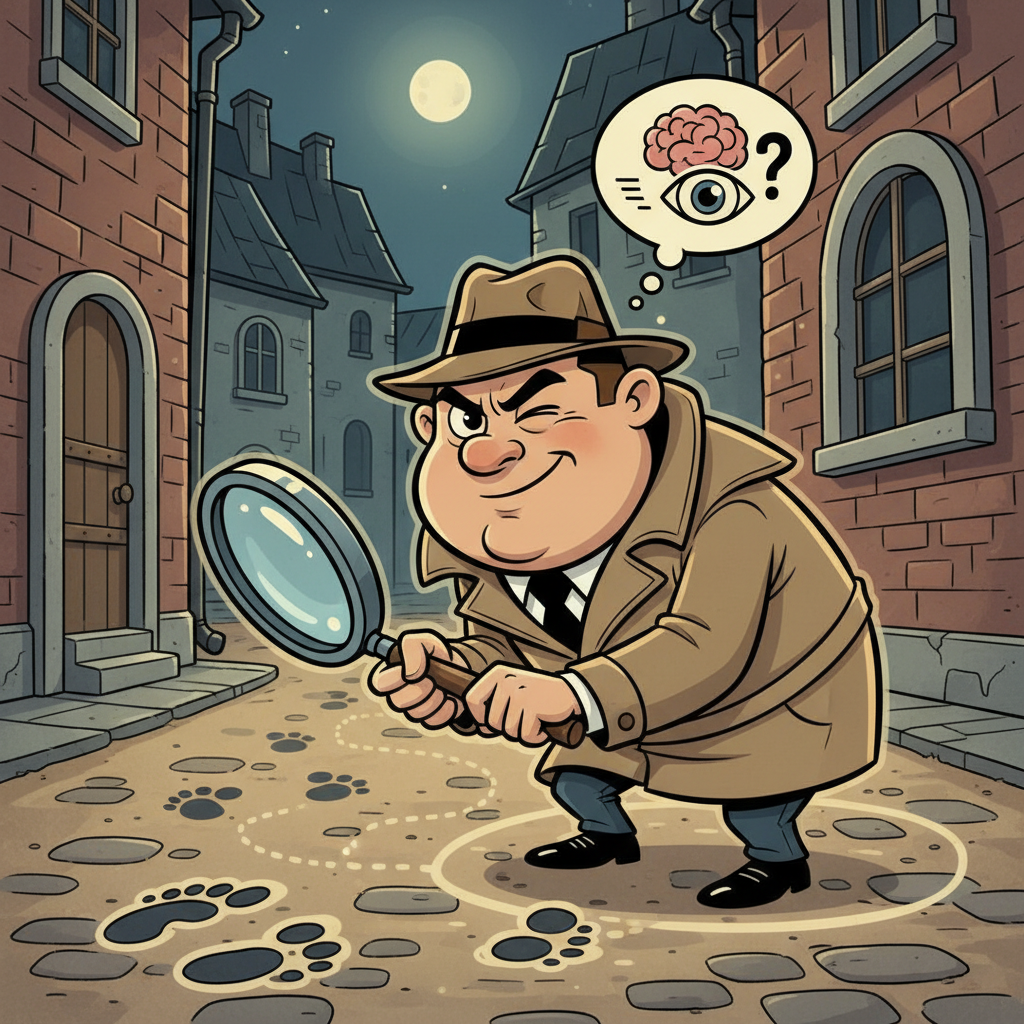
1. Observation: Looking Closely (Spotting the Clues!)
The very first step to solving any problem using logic is to observe. This means looking and listening very, very carefully to everything around you. Just like a detective searches for fingerprints or footprints, you need to notice all the details.
Analogy: Think about when you're looking for a missing sock. You don't just glance quickly. You look under the bed, inside the toy bin, and maybe even behind the door. You observe the different places it could be. If you see a tiny bit of red fabric sticking out from under your pillow, that's a clue you observed!
When you observe, you're gathering information. The more information you gather, the better your chances of solving the puzzle.
 ⚠️ This picture may have spelling mistakes. Trust the words in the lesson.
2. Patterns: What Repeats? What's Next? (Following the Trail!)
Once you've observed, you often start to notice patterns. A pattern is something that repeats itself or follows a certain order. Finding patterns is a super important logical skill because patterns help us predict what might happen next or what's missing.
Analogy: Imagine you see a line of toys: red car, blue car, red car, blue car... What do you think comes next? A red car, of course! You used the pattern to figure it out. Or maybe you're building with LEGOs and notice you've used a big block, then a small block, then a big block. The pattern tells you to use a small block next.
Patterns can be in colors, shapes, numbers, or even how things happen over time. Spotting these trails helps your brain detective move forward.
3. Cause and Effect: If This, Then That! (What Makes Things Happen?)
Cause and effect is all about understanding why things happen. A 'cause' is what makes something happen, and an 'effect' is what happens because of the cause.
Analogy: If you forget to water your plant (cause), it might start to wilt and turn brown (effect). Or, if you push a light switch (cause), the light turns on (effect). Your brain detective constantly thinks: "What caused this to happen?" or "If I do this, what will happen?"
Understanding cause and effect helps you predict outcomes and makes sense of situations. It's like knowing that if you mix blue and yellow paint, you'll get green.
4. Elimination: Getting Rid of What Doesn't Fit (Narrowing Down the Suspects!)
Sometimes, the easiest way to find the right answer is to get rid of all the wrong answers! This is called elimination. When you eliminate possibilities, you're saying, "Nope, that can't be it!"
Analogy: Let's say you're trying to figure out which friend took the last cookie. You know Sarah doesn't like chocolate chip cookies, and this was a chocolate chip cookie. So, you can eliminate Sarah! You've narrowed down your suspects. Or, if you're looking for your blue crayon and you see red, green, and yellow crayons, you know those aren't it, so you eliminate them from your search.
Elimination helps you focus on the few ideas that actually make sense, making the problem much simpler.
5. Sequencing: Putting Things in Order (Step-by-Step Thinking!)
Many problems require you to think about things in a specific order, or sequence. This means understanding which step comes first, which comes second, and so on.
Analogy: When you brush your teeth, you don't put the toothbrush in your mouth first, then get it wet, then put toothpaste on. There's a sequence: get brush, wet brush, put toothpaste, brush teeth, rinse! Or when you tie your shoes, there's a right way to do it, step-by-step.
Following a sequence or putting events in the right order is crucial for many logical puzzles and daily tasks.
How to Use Your Logic Superpower: A Step-by-Step Guide!
Now that you know the tools, let's put them all together! Here's how your brain detective solves problems:
-
Understand the Problem: First, listen or read carefully. What exactly is the problem? What are you trying to figure out? If you don't understand the problem, it's hard to solve it!
Example: Your teacher says, "Find the missing number in this pattern: 2, 4, __, 8, 10."
-
Gather Information (Observe!): Look for all the clues. What do you already know? What details are important?
Example: You see the numbers are 2, 4, 8, 10. The numbers are getting bigger.
-
Look for Patterns and Connections: Do you see anything repeating? Is there a special order? How do the clues relate to each other?
Example: From 2 to 4 is adding 2. From 8 to 10 is adding 2. It looks like the pattern is 'add 2' each time!
-
Think About Cause and Effect (What Makes Sense?): If this is true, what else must be true? If this happened, why did it happen?
Example: If the pattern is 'add 2', then to get the missing number, I need to add 2 to the number before it.
-
Eliminate Wrong Ideas: If an idea doesn't fit with your clues or patterns, cross it off your list! It can't be the answer.
Example: If you thought the number was 5, you'd check: 4 + 2 is not 5. So, 5 is wrong. Eliminate it!
-
Form a Solution and Test It: Once you think you have the answer, try it out! Does it work with all the clues? Does it make sense?
Example: If the pattern is 'add 2', then after 4 comes 4 + 2 = 6. Let's test it: 2, 4, 6, 8, 10. Yes! It works perfectly!
Practice Makes Perfect!
Just like practicing soccer or learning a new song, practicing logic makes your brain detective stronger and faster! The more you think logically, the easier it becomes to solve all sorts of problems – from finding your lost pencil to figuring out a tricky math puzzle. So, keep observing, keep looking for patterns, and keep thinking logically!
You have an amazing brain, and logic helps you use it in the smartest way possible. Keep training your inner detective!
Keep learning, free
Create a free Syllabax account to unlock practice questions and games for this topic.
Visual Learning Enhanced! 🚀
To help you master this topic, we use Advanced Syllabax AI to generate detailed diagrams and visual models.
Note on Visuals: The AI sometimes makes spelling errors in image labels. Please refer to the lesson text for the correct terminology.