Conduction, convection, radiation[PHYSICS]
Watch this topic in 60 seconds
Free preview · Lesson 1
Understanding Conduction, convection, radiation[PHYSICS]
Understanding Heat Transfer: Conduction, Convection, and Radiation
Welcome to our exciting journey into the world of heat! Have you ever wondered why a metal spoon left in a hot cup of soup gets warm all the way to the handle? Or how a campfire keeps you toasty even from a distance? Or how a hot air balloon stays afloat?
These everyday experiences are all thanks to the ways heat moves, or transfers, from one place to another. In physics, we call these three main methods of heat transfer: conduction, convection, and radiation. Let's explore each one in simple terms, using lots of analogies to make them easy to understand!
What is Heat Transfer?
Before we dive into the three types, it's important to know what heat is. Heat is a form of energy that makes things warm. When something is hot, its tiny particles (like atoms and molecules) are moving very fast. When something is cold, its particles are moving slower. Heat naturally moves from hotter things to colder things, just like water flows downhill.
Think of it like this: Imagine a crowded room where everyone is energetic and bumping into each other. That's like a hot object. Now imagine a quiet library where people are moving slowly. That's like a cold object. The energy (people moving) tends to spread out from the crowded, energetic room into the quiet, slow-moving library.
1. Conduction: The 'Touchy-Feely' Way Heat Moves
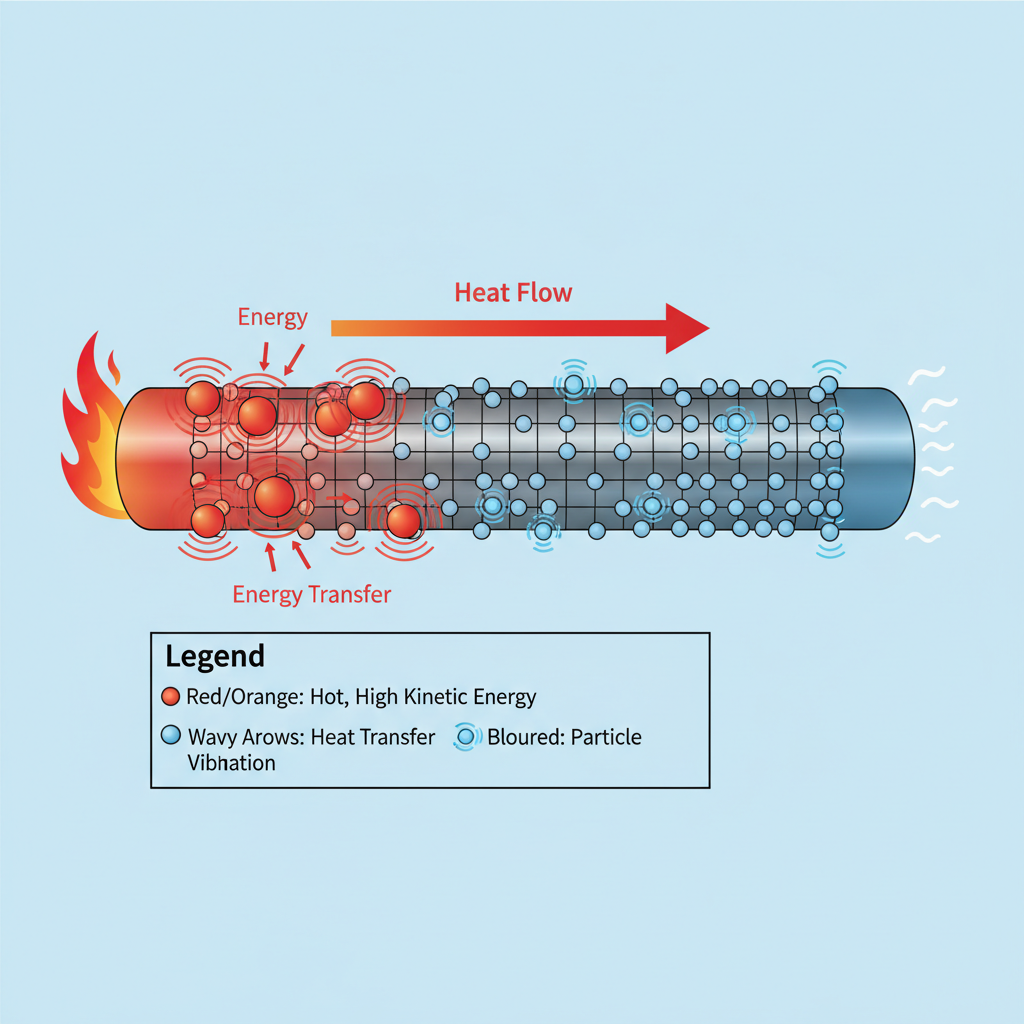
Conduction is how heat travels through a material when objects are touching each other. It happens when the faster-moving particles in a hotter object bump into the slower-moving particles in a colder object, passing their energy along.
How it Works (The Particle Party Analogy)
Imagine a line of people holding hands. The person at one end starts wiggling their fingers really fast (this represents the heat energy). As they wiggle, they bump into the person next to them, making that person wiggle a bit faster. This bumping and wiggling continues down the line, with each person passing the energy to the next, until everyone is wiggling faster than they were before. No one actually 'travelled' down the line, but the 'wiggle energy' did!
In solids, especially metals, the particles are packed very closely together. This makes it easy for them to bump into each other and transfer heat efficiently. That's why a metal spoon in hot soup gets hot.
Conductors and Insulators
Some materials are really good at conducting heat, while others are not.
- Conductors: These materials let heat pass through them easily. Metals like copper, iron, and aluminum are excellent conductors. This is why pots and pans are often made of metal – they quickly transfer heat from the stove to your food.
- Insulators: These materials resist the flow of heat. They don't let heat pass through easily. Examples include wood, plastic, rubber, and air. This is why pot handles are often made of plastic or wood – to prevent you from burning your hand! Think of a wool blanket; it traps air and doesn't let your body heat escape easily, keeping you warm.
Everyday Examples of Conduction:
- Touching a hot stove: Ouch! Heat conducts from the stove to your hand.
- An ice cube melting in your hand: Heat conducts from your warmer hand to the colder ice cube, making it melt.
- Walking barefoot on hot sand: The heat from the sand conducts to your feet.
 ⚠️ This picture may have spelling mistakes. Trust the words in the lesson.
2. Convection: The 'Moving Fluid' Way Heat Moves
Convection is how heat travels through liquids and gases (which we call fluids). It happens when the heated fluid itself moves, carrying the heat with it. Conduction requires direct contact, but convection involves the bulk movement of the medium.
How it Works (The "Boiling Water" Dance Analogy)
Imagine a pot of water being heated from the bottom. The water at the very bottom touches the hot pot and gets warm. When water gets warm, it becomes less dense (lighter) and starts to rise. As the warm water rises, the cooler, denser water from the top sinks down to take its place. This sinking cooler water then gets heated, rises, and the cycle continues. This creates a continuous 'dance' or circulation of water, moving heat throughout the pot.
This circular movement of the fluid is called a convection current.
Convection in Gases
Convection happens in gases just like in liquids. Think about the air in a room. A heater warms the air near it. This warm air rises, and cooler air sinks to be heated. This circulation helps to warm up the whole room.
Everyday Examples of Convection:
- Boiling water: As we described, the water circulates, distributing heat.
- Hot air balloons: The air inside the balloon is heated, making it less dense than the surrounding air. This causes the balloon to rise.
- Wind: Uneven heating of the Earth's surface causes air to heat up, rise, and move, creating wind. Land heats up faster than water during the day, causing cooler air from the sea to move inland (sea breeze).
- Ovens: Many ovens use convection fans to circulate hot air, cooking food more evenly.
3. Radiation: The 'Invisible Wave' Way Heat Moves
Radiation is the transfer of heat through electromagnetic waves, like light. Unlike conduction and convection, radiation doesn't need any material (like solids, liquids, or gases) to travel through. It can even travel through empty space!
How it Works (The "Sunbeam" Analogy)
Think about the Sun. The Sun is incredibly far away, and there's a vast vacuum of space between us and it. Yet, we feel its warmth on Earth. How? Through radiation! The Sun emits invisible infrared waves (a type of electromagnetic wave) that travel across space and warm up anything they hit, like our skin or the ground.
All objects that have a temperature above absolute zero emit thermal radiation. Hotter objects emit more radiation. When this radiation hits another object, it can be absorbed, reflected, or transmitted.
Absorption and Emission
- Dark, dull surfaces are good at absorbing and emitting radiation. Think of wearing a black t-shirt on a sunny day – it gets much hotter than a white one because it absorbs more sunlight (radiant energy).
- Light, shiny surfaces are good at reflecting radiation and poor at absorbing or emitting it. This is why astronauts wear shiny suits – to reflect the Sun's radiation.
Everyday Examples of Radiation:
- The Sun warming the Earth: The most significant example!
- Feeling the heat from a campfire: Even if you're not directly in the smoke or touching anything hot, you feel the warmth.
- Toaster ovens: The glowing red coils emit infrared radiation, which cooks your food.
- A warm sidewalk on a sunny day: The sidewalk absorbs sunlight (radiation) and gets hot, then it might conduct heat to your feet, but the initial heating was from radiation.
Putting It All Together: A Quick Review
Let's imagine making toast!
- The toaster element gets hot through electrical resistance (not one of our three main types, but the source of heat).
- The glowing red coils radiate heat onto the bread. (Radiation)
- The bread absorbs the radiant energy and heats up.
- The air inside the toaster gets hot and circulates, carrying heat to the bread. (Convection)
- The toaster slot itself might get warm, and if you touched it, heat would conduct to your finger. (Conduction)
Understanding conduction, convection, and radiation helps us explain so many things around us, from why we wear layers in winter to how weather patterns form!
Keep learning, free
Create a free Syllabax account to unlock practice questions and games for this topic.
Visual Learning Enhanced! 🚀
To help you master this topic, we use Advanced Syllabax AI to generate detailed diagrams and visual models.
Note on Visuals: The AI sometimes makes spelling errors in image labels. Please refer to the lesson text for the correct terminology.