Thomson, Rutherford, Bohr models[CHEMISTRY]
Watch this topic in 60 seconds
Free preview · Lesson 1
Understanding Thomson, Rutherford, Bohr models[CHEMISTRY]
Understanding Atomic Models: Thomson, Rutherford, and Bohr
Have you ever wondered what tiny, invisible particles make up everything around us? We're talking about atoms! For centuries, scientists have tried to understand what an atom looks like and how it works. Since we can't see them with our eyes, or even with most microscopes, scientists have used clever experiments to develop different 'models' of the atom, much like how an architect might draw blueprints for a building they haven't built yet. These models help us visualize and understand something incredibly complex.
Let's take a journey through three important models that helped shape our understanding of the atom: the Thomson Model, the Rutherford Model, and the Bohr Model.
1. The Plum Pudding Model: J.J. Thomson (Late 1800s)
Imagine you're baking a delicious dessert. J.J. Thomson, a British physicist, was working in the late 1800s when he made a groundbreaking discovery: the electron! He found that atoms weren't just solid, indivisible balls as previously thought (Dalton's model), but contained even tinier, negatively charged particles. These particles were called electrons.
What did Thomson's model propose?
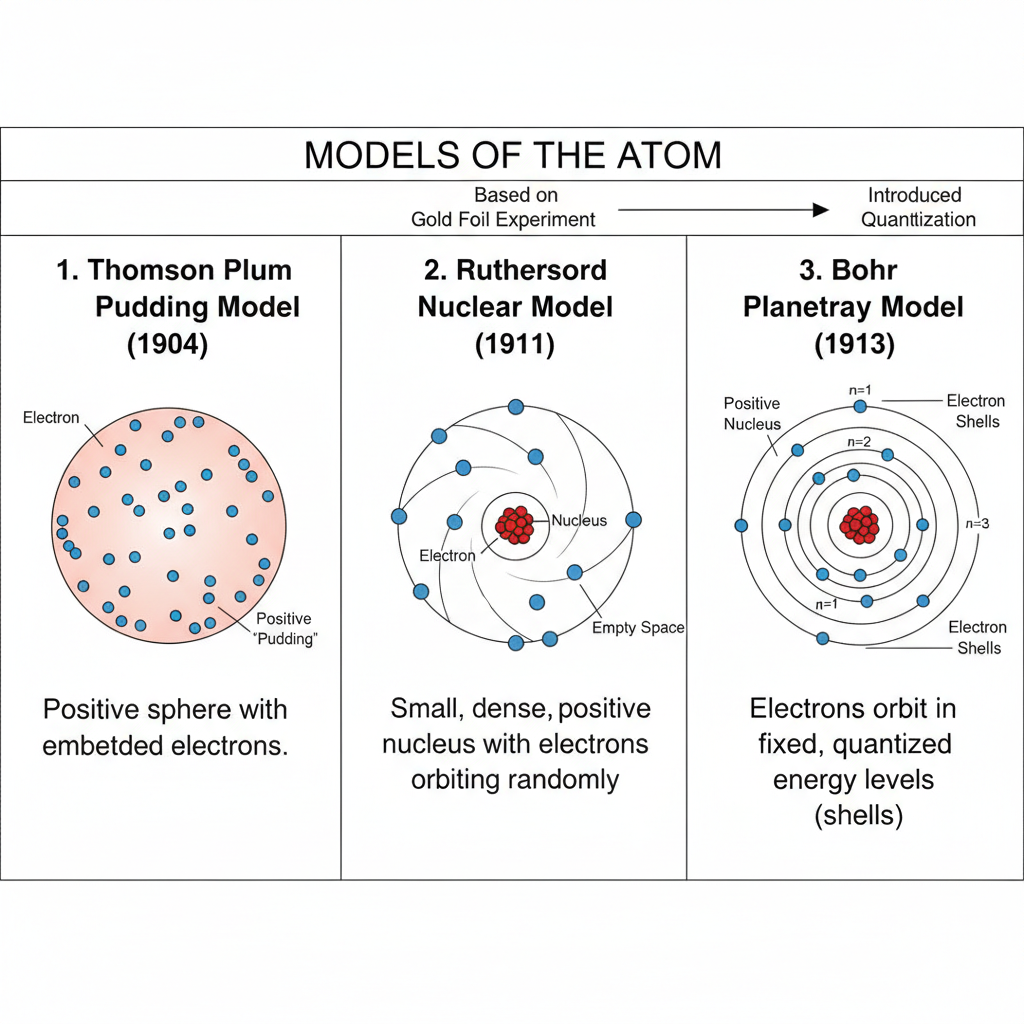
- Thomson proposed that an atom was a sphere of uniformly distributed positive charge. Think of it like a big, squishy blob of positive jelly.
- Embedded within this positive sphere were tiny, negatively charged electrons, like raisins or plums in a pudding. Or, if you prefer, chocolate chips in a cookie, or blueberries in a muffin!
- The total negative charge of the electrons was equal to the total positive charge of the sphere, making the atom electrically neutral overall.
Analogy: The Chocolate Chip Cookie
Picture a chocolate chip cookie. The dough represents the uniformly spread positive charge, and the chocolate chips are the negatively charged electrons scattered throughout. It was a simple, elegant idea for its time, and it was revolutionary because it was the first model to include subatomic particles (electrons).
Why it was important:
Thomson's model was the first to recognize that atoms are made of smaller parts and introduced the concept of electrons. However, it didn't last long, as new experiments soon revealed its flaws.
2. The Nuclear Model: Ernest Rutherford (Early 1900s)
Fast forward a few years. One of Thomson's former students, Ernest Rutherford, and his team conducted a famous experiment that completely changed how we thought about the atom. This experiment is known as the Gold Foil Experiment (or Geiger-Marsden experiment).
The Gold Foil Experiment: A Scientific Mystery Story
Rutherford's team fired tiny, positively charged particles called alpha particles at a very thin sheet of gold foil. Based on Thomson's plum pudding model, they expected the alpha particles to pass straight through the gold foil with perhaps only a slight deflection, like a bullet going through tissue paper. Why? Because in the plum pudding model, the positive charge was thought to be spread out and not very dense.
But the results were shocking!
- Most alpha particles passed straight through the gold foil, as if nothing was there.
- Some alpha particles were deflected at very large angles.
- A very small number of alpha particles actually bounced straight back!
Rutherford famously compared this to firing a 15-inch shell at a piece of tissue paper and having it bounce back at you. It was completely unexpected!
What did Rutherford's model propose?
To explain these unexpected results, Rutherford proposed a new model:
- He concluded that most of the atom is empty space. This explains why most alpha particles went straight through.
- At the center of the atom, there must be a tiny, dense, positively charged region he called the nucleus. This nucleus contains almost all of the atom's mass. This dense positive charge repelled the few alpha particles that hit it head-on, causing them to bounce back.
- The negatively charged electrons orbit this nucleus in a vast, empty space, much like planets orbiting the sun.
Analogy: A Football Stadium with a Marble
Imagine a massive football stadium. In the very center of the field, there's a tiny marble. The marble represents the nucleus, and the entire rest of the stadium (mostly empty space) is where the electrons are orbiting. This gives you an idea of how incredibly small and dense the nucleus is compared to the overall size of the atom.
Here's a visual comparison of how these models progressed:
 ⚠️ This picture may have spelling mistakes. Trust the words in the lesson.
Why it was important:
Rutherford's nuclear model was a huge step forward. It correctly identified the nucleus as the atom's core and showed that atoms are mostly empty space. However, it had a problem: according to classical physics, orbiting electrons should continuously lose energy and spiral into the nucleus, causing the atom to collapse. Clearly, atoms don't collapse!
3. The Planetary Model (or Bohr Model): Niels Bohr (Early 1910s)
Niels Bohr, a Danish physicist, was a student of Rutherford. He took Rutherford's nuclear model and added a crucial idea from quantum theory to solve the problem of why electrons don't crash into the nucleus.
What did Bohr's model propose?
Bohr's model kept Rutherford's idea of a central nucleus and orbiting electrons, but he added some very specific rules:
- Fixed Energy Levels (Orbits/Shells): Electrons can only orbit the nucleus in specific, well-defined paths or energy levels (like concentric circles around the nucleus). He called these 'stationary states' or 'shells'.
- No Energy Loss in Orbits: As long as an electron stays in one of these fixed orbits, it does not gain or lose energy. This solved Rutherford's stability problem.
- Energy Jumps: Electrons can move from one energy level to another, but only by absorbing or emitting a specific amount of energy (a 'quantum' of energy). Think of it like taking a step up or down a ladder – you can't hover between rungs.
- If an electron absorbs energy (e.g., from heat or light), it can jump to a higher energy level (an 'excited state').
- When an electron falls back to a lower energy level, it emits energy in the form of light. The color of the light depends on the energy difference between the levels.
Analogy: A Ladder of Energy
Imagine a ladder. Each rung represents a specific energy level that an electron can occupy. An electron can only be on a rung; it cannot float in between rungs. To move up a rung, it needs a specific amount of energy to climb. To move down a rung, it releases a specific amount of energy. This is why atoms produce distinct colors of light when heated – electrons are jumping down rungs and releasing light of specific energies!
Why it was important:
Bohr's model successfully explained why atoms are stable and why they emit and absorb light in specific patterns (atomic spectra), especially for simpler atoms like hydrogen. It introduced the groundbreaking idea of quantized energy levels.
Limitations:
While a huge advancement, Bohr's model still had limitations. It couldn't fully explain the spectra of more complex atoms (those with more than one electron) or why some spectral lines split into multiple lines when observed with higher precision. This led to even more sophisticated quantum mechanical models later on.
The Evolution of Understanding
These three models – Thomson's plum pudding, Rutherford's nuclear, and Bohr's planetary – represent crucial steps in our scientific understanding of the atom. Each new model wasn't a complete rejection of the previous one, but rather an enhancement and refinement, built upon new experimental evidence and scientific insights. They show us how science progresses: through observation, experimentation, questioning, and continuous refinement of our ideas about the natural world.
Keep learning, free
Create a free Syllabax account to unlock practice questions and games for this topic.
Visual Learning Enhanced! 🚀
To help you master this topic, we use Advanced Syllabax AI to generate detailed diagrams and visual models.
Note on Visuals: The AI sometimes makes spelling errors in image labels. Please refer to the lesson text for the correct terminology.